WeSemiBay showcases another form of strength connecting the world: Global Times editorial
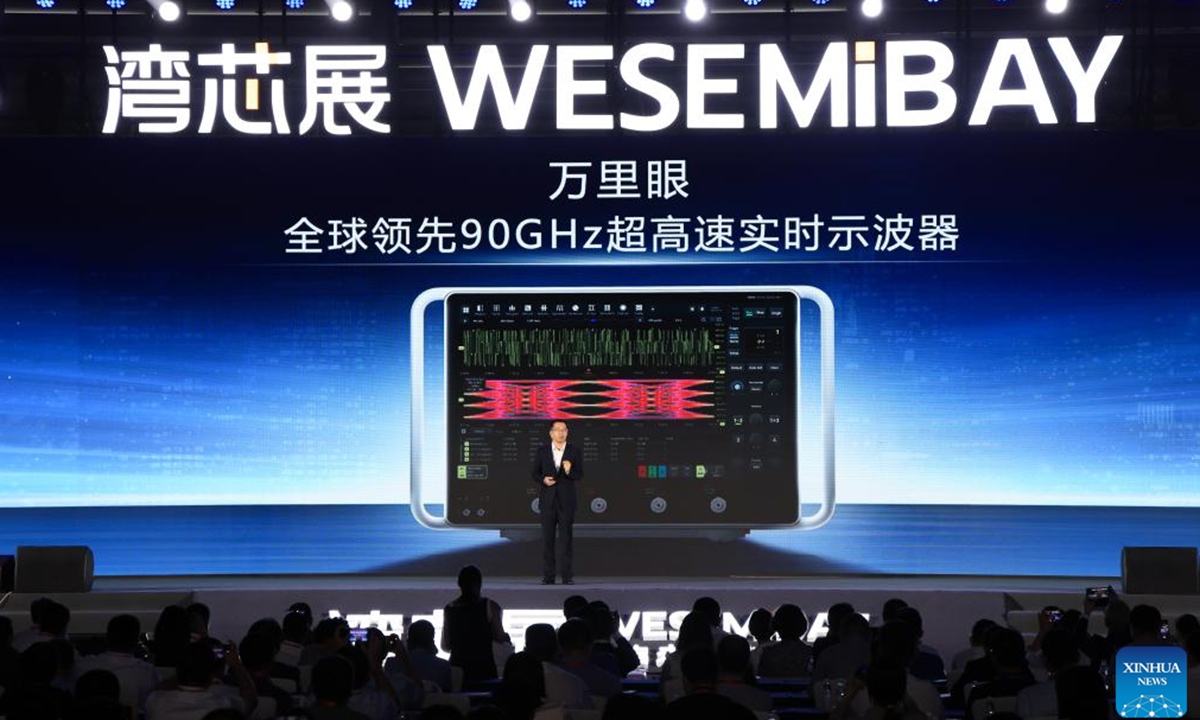
Liu Sang, CEO of Shenzhen Longsight Technologies Co., Ltd, introduces the 90GHz ultra-high-speed real-time oscilloscope in Shenzhen, south China's Guangdong Province, Oct. 15, 2025. China's homegrown 90GHz ultra-high-speed real-time oscilloscope was officially unveiled on Wednesday, marking a milestone in the global electronic communications sector. Photo: Xinhua
The three-day 2025 WeSemiBay Semiconductor Ecosystem Expo (WeSemiBay) concluded successfully on October 17. More than 600 companies showcased their innovations, with several landmark technological breakthroughs creating a stir across the tech community and public discourse. Among the highlights, Longsight Technologies Co., Ltd, a subsidiary of Shenzhen Xinkailai Technology Co. Ltd., unveiled a 90 GHz ultra-high-speed real-time oscilloscope that ranks among the world's best in bandwidth, sampling rate, and memory depth. Meanwhile, Shenzhen Qiyunfang Technology Co., Ltd. launched two domestically developed EDA software products for electronic engineering, whose performance benchmarks match leading international standards. These achievements are widely seen as evidence of China's leap forward in key segments of the semiconductor industry and a symbol of the country's systemic progress in high-end technological development.
This year's WeSemiBay not only showcased a wide range of new technologies and equipment, but also demonstrated that China has built a relatively complete semiconductor industry chain. From design software, chip design and manufacturing, and packaging and testing to semiconductor equipment, testing instruments, components, and materials, a comprehensive semiconductor production and manufacturing system is taking shape. This means that China is not only capable of producing chips with mature process nodes, but also chips with advanced nodes - and is rapidly developing the production and testing capabilities needed to compete at the world's most cutting-edge levels.
Behind this progress lies not only China's ultra-large domestic market and complete industrial system, but also continuous R&D investment and the ongoing optimization of industrial organization, moreover, along with the critical support provided by the Guangdong-Hong Kong-Macao Greater Bay Area (GBA) under major national regional strategies. In addition, the development advantages accumulated through self-reliance and a long-term approach have also played a key role.
Semiconductors and integrated circuits are capital-intensive industries with long investment cycles, requiring sustained commitment over time to provide the space for industrial growth. It is precisely by adhering to technological self-reliance with a long-term perspective that China's semiconductor industry has been able to continuously advance in scale, structure, and ecosystem resilience, even under pressure.
China's semiconductor industry has long been portrayed as "filling gaps" or a "follower," with some even misinterpreting it as "reinventing the wheel." The reality showcased at WeSemiBay is quite the opposite - it represents an open and collaborative Chinese approach. The innovation ecosystem exemplified by the GBA is becoming a model of institutionalized openness: research institutes, industrial clusters, capital markets, and international companies form a symbiotic network, where policy support and market mechanisms operate in harmony.
This system-building effort is not about self-isolation, but rather centers on openness and innovation, guided by the principles of co-creation and shared success. China's pursuit of technological self-reliance is not about drawing boundaries, but about maintaining development autonomy and the initiative for cooperation in an increasingly complex international system, making innovation a stable global language.
Despite ongoing geopolitical undercurrents, many companies from the US, Japan, Germany, and other countries still chose to participate in the exhibition, joining Chinese enterprises to showcase equipment and materials, explore project partnerships, and discuss technological applications. This scene itself illustrates: technological competition may exist, but technological isolation is destined to fail. China has not closed its doors; instead, it is driving the global semiconductor industry toward greater diversity and balance through broader openness and pragmatic engagement. For many developing countries, this kind of "participatory globalization" represents a true opportunity. In this sense, the WeSemiBay belongs not only to China but also to the Global South countries that aspire to take part in shaping the technological future. The significance of the Expo extends beyond semiconductors. It marks a transformation in China's role within the global science and technology system: from a passive follower to a co-builder of rules, from isolated breakthroughs to ecosystem development. The maturity of China's full-stack semiconductor technology has helped stabilize and reinforce the global supply chain, which has been affected by geopolitical disruptions.
At a deeper level, it also reveals a distinct Chinese logic: genuine technological security comes from the strength of independent innovation, while a genuine technological future arises from the spirit of cooperation and mutual benefit. The WeSemiBay vividly embodies this philosophy, demonstrating through tangible results that China not only has the capability to achieve breakthroughs in high technology, but also the willingness to share development opportunities with the world.
The future of technology depends on who can offer more inclusive solutions. The WeSemiBay sends a clear message: the value of technology lies not in building walls, but in building bridges. The technological landscape of the future will belong to those nations that can innovate and have the courage to collaborate. A China that is self-reliant, open, and willing to share is proving through concrete actions that technological self-reliance is not isolation, but another form of strength connecting the world.
RELATED ARTICLES