Chinese researchers use FAST to capture millisecond-scale radio bursts from starspot regions

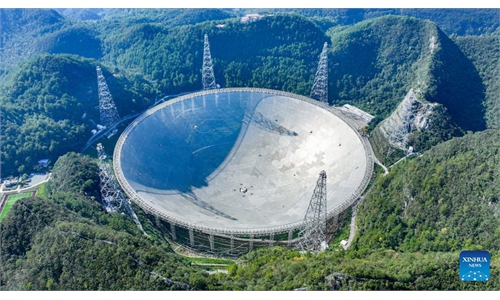
Diagrammatic drawing of ultrafast drifting radio bursts from M dwarf AD Leo received by FAST. Inset: The dynamic spectrum of the ultrafast drifting radio bursts. Photos: Courtesy of the research team led by Tian Hui
A Chinese research team using the Five-hundred-meter Aperture Spherical Radio Telescope (FAST), dubbed the "China Sky Eye," has for the first time unambiguously detected millisecond-scale radio bursts from starspot regions. This creates a new way to directly probe small-scale stellar magnetic fields and shed light on the origins of stellar magnetic activity, according to the research team on Sunday.
The research team, led by Professor Tian Hui from the School of Earth and Space Sciences, Peking University recently published its findings in Science Advances.
This study has filled a long-standing gap in the understanding of small-scale magnetic fields on stars beyond the solar system and provides new insights into the mechanisms behind their coronal eruptions and space weather activity, the team said.
In recent years, FAST has achieved major progress across many areas of astronomy, but few studies have focused on magnetic activity of individual cool stars. "Over the past few years, we have been working to open up this new research direction, aiming to leverage FAST's high spectral/time resolution and its excellent sensitivity to study cool stars," Tian, the head of the research team, told the Global Times on Sunday.
The success of this study relies on FAST's exceptional sensitivity and its ultra-high time and frequency resolution. Earlier stellar radio observations had time resolutions on the order of hours or minutes, whereas FAST has pushed the observational time resolution down to the sub-millisecond level, making it possible to capture subtle, rapid variations in stellar radio emission. At present there are virtually no other instruments in the world that can match this capability, the first author of the paper Zhang Jiale told the Global Times.
Sunspots are localized regions of intense magnetism on the solar surface. Eruptions in these areas can disrupt the near-Earth space environment and affect the normal operation of satellites and systems of communications, navigation and power. Other stars also have similar spot structures, and magnetic activity on some active red dwarf stars can be even more frequent and violent, said Zhang.
The team is also using FAST to study young solar-type stars, brown dwarfs, and magnetic interactions between stars and their planets, Tian said.
RELATED ARTICLES