ARTS / CULTURE & LEISURE
Public art should value social needs over self-expression
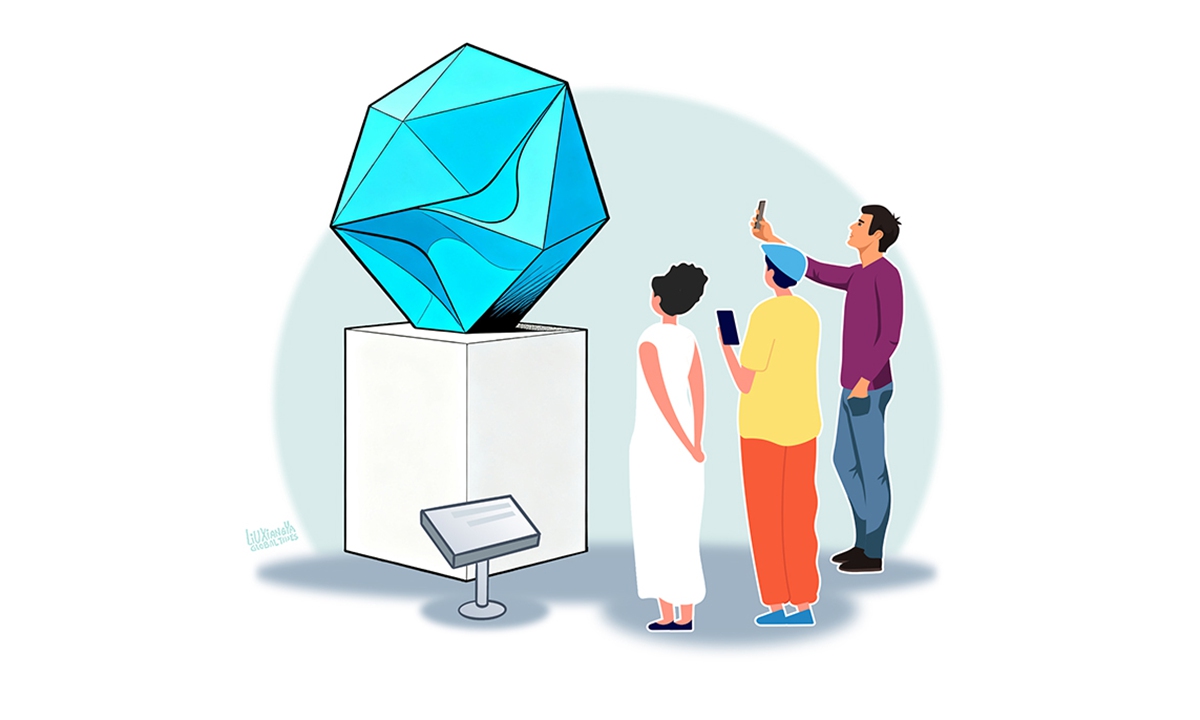
Illustration: Liu Xiangya/GT
Rather than being scenes from thriller films, a "human-faced centipede" and a "three-faced girl" are actual public sculptures that have recently sparked wide criticism among Chinese netizens. Located on a plot of wasteland in Lijiang, Yunnan Province, these sculptures brim with artist Qiao Xiaodao's personal aesthetics, but their appearance has been described by some viewers as "kinky" and "disturbing."Is the artist's taste too cutting-edge, or is the public's ability to appreciate art too limited? What these sculptures have sparked is no longer just a debate on the works themselves, but also a discussion on the very value of "art" created for the public - that is, public art.
All of Qiao's sculptures form an art park called "The Land of Wilderness." While the artist describes it as a fairy-tale kingdom built for his daughter, the park in fact is a ticketed attraction open to everyone. In other words, it is a public cultural space intended for general visitors, not just Qiao's family or fans.
Clarifying the public nature of "The Land of Wilderness" is important, since it directly shapes the artist's stance when working within it. Unlike the art of studios or institutions, public art is a different creative domain that values ordinary people's perception.
That's to say, if Qiao's "human-faced centipede" sculpture are displayed in his studio or a gallery, where viewers are predisposed to knowing his artistic style, then it would be much less controversial and more acceptable. If an artist intends to bring his work into a communal space, he then needs to ensure that these works bear not only his personal sentiments, but also resonates with, or at least thoughtfully considers, the public's feelings.
In short, successful public art often strikes a balance between social feelings and the creator's personal expression.
Sculptures, installations, artistic murals... many public art installations are immovable, but they are actually rooted in a dynamic: a creator brings his or her piece to interact with a project site's cultural spirit, the indigenous environment, the community life and visitors.
Regrettably, it is not just the "human-faced centipede" display, many other public art pieces also seem to fall short of this interactive goal.
Not long ago, an art piece appeared at a children's park in Kunshan, Jiangsu Province. The sculpture, which attempted to depict the historical tale of "Sima Guang smashing the vat," featured a figure that resembled a monkey but not quite. Its grotesque style ended up sparking controversy over whether it was suitable for children.
An even more telling example comes from Lushan county, Henan Province. A "Cowherd and Weaver Girl" installation was originally built to serve as a local cultural landmark. The piece went viral due to its jarring aesthetics, but controversy around it deepened when people discovered it was built for a stunning price tag of more than 7 million yuan ($982,000).
The Henan case reveals that poorly-conceived public art serves as a bad catalyst for more than just aesthetic judgment; it can become a source of negative public opinions and sow seeds for a broader crisis of public distrust.
So far, the construction issues behind the "Cowherd and Weaver Girl" piece have been investigated. Meanwhile, the art park featuring Qiao's sculptures and installations has issued a public apology and removed the controversial works. While these actions were timely, they are ultimately remedial measures taken after the fact. Although they have quelled the immediate public outcry, they offer no guarantee that other controversial public artworks will not be created in the future.
Hence, be it a public area with art or an artist who creates for the public, it is essential to contemplate a chain of questions such as what kinds of artworks should be commissioned as public displays? And also, how to create an artwork by drawing upon related cultural and natural character should be considered.
To answer the first question, prior to the creation of a piece, a project review committee must be formed. It must be made up of not just artists, but also experts in architecture and planning, cultural scholars, community residents, and even social psychologists.
Concurrently, public consultation via surveys is essential before an artwork enters a public space. These evaluative activities should align with guidelines from local authorities, including planning and park departments, to build a clear public art approval framework.
For artists, the focus must shift to understanding their work's social role and its public impact. The creative process must begin by unearthing local cultural and natural symbols. Nearby the wasteland where "The Land of Wilderness" is situated is the Yulong Snow Mountain. The local area is also rich with diverse ethnic culture such as that of the Naxi people.
Imagine, if interactive installations depicting traditional stories of local ethnic minorities were placed within the park, it would enhance the site's cultural specificity. Also, choosing reflective materials like stainless steel to construct installations that mirror the sky and snowy scenery would not only integrate viewers into the environment, but also make the land of "wilderness" a new and fun photo-worthy spot.
The pinnacle of successful public art is achieved when people see it as inherently belonging to a place. The artist's role, therefore, is not to decorate or talk about him or herself, but to use their unique vision to reveal a space's hidden memories and stories.
The author is a reporter with the Global Times. life@globaltimes.com.cn
RELATED ARTICLES