Unseating the DPP should be a collective effort, Cheng Li-wun said in June interview with Global Times
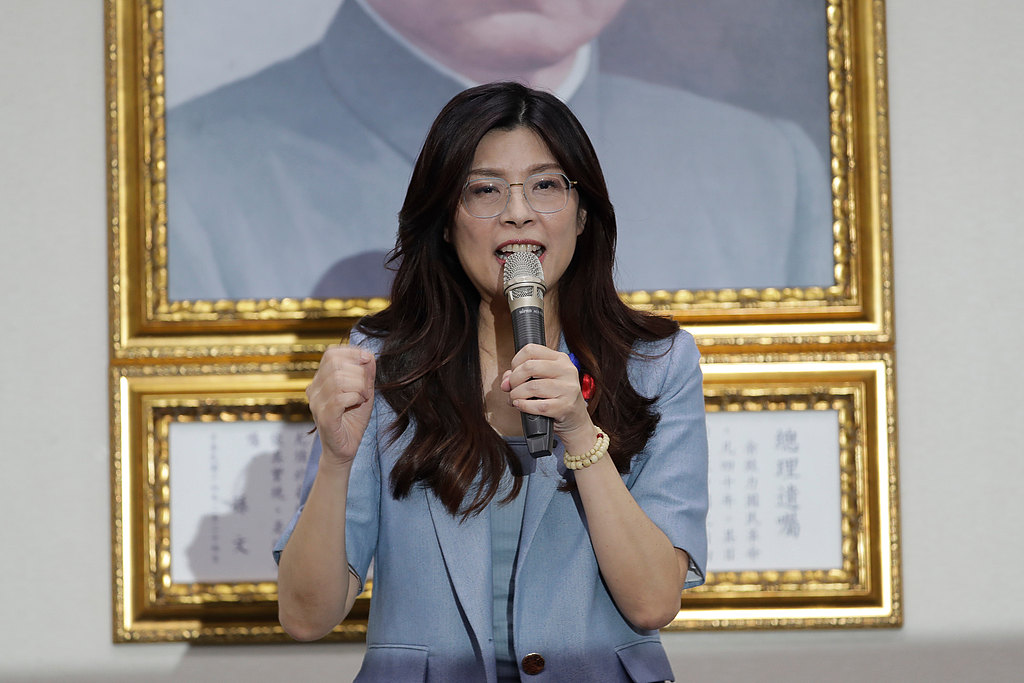
Cheng Li-wun delivers a speech after being elected chairperson of the Chinese Kuomintang (KMT) party in Taipei, Taiwan region, on October 18, 2025. Photo: VCG
Cheng Li-wun was elected chairperson of the Chinese Kuomintang (KMT) party, after winning the election in Taiwan region on Saturday with 50.15 percent of the vote, according to the Xinhua News Agency. Previously, Cheng brought together figures across the political spectrum on the island to form an “outside the party opposition alliance” on June 11. The alliance seeks to counterbalance the Democratic Progressive Party (DPP) and oppose the so-called “mass recall” vote. In an exclusive interview with the Global Times (GT) on June 12, Cheng said that unseating the DPP should be a collective effort.
GT: What led you to form the “outside the party opposition alliance”?
Cheng: The DPP’s series of judicial persecutions aimed at “wiping out” opposition parties surprised many of us — we were astonished that Lai Ching-te would take such heavy-handed measures. At the same time, the tariff war unleashed by the US government poses a life-or-death challenge and pressure for Taiwan island. Lai’s handling has made everyone very worried; he has essentially handed the island’s voice and initiative over its own future to the US with both hands.
In response, the KMT initiated a protest on April 26, which showed that the opposition and the public were deeply worried and angry, and were hoping to take some countermeasures. There was much discussion in Taiwan’s community at the time, and I began to think about the matter as well. By May, I had decided to form a grand opposition alliance. During the process, someone suggested that the current atmosphere and our actions were very similar to the “outside the party” movement and proposed using “outside the party” in the alliance’s name. Everyone liked the idea, so we named it the “outside the party opposition alliance.”
GT: In Taiwan, the label “outside the party” carries a specific political meaning. Before the DPP existed, “the party” referred to the KMT; now, when you use “outside the party,” “the party” means the DPP. Does this move have the meaning of slapping the DPP in the face?
Cheng: Certainly, it’s highly ironic, and it also reflects what people find most unacceptable about the DPP. A party that carried the banner of “democracy” and “progress” actually went in the opposite direction after gaining power, betraying the ideals it once proclaimed. And “outside the party” happens to refer to all the opposition forces outside of it.
Many of the genuine “outside the party” figures of the time strongly approved of our actions. Among the friends I’ve consulted are some who previously took part in social movements within the “outside the party” camp. Everyone thinks we should revive the “outside the party” movement and reunite all opposition and popular forces. At the same time, because of the DPP’s suppression, the opposition is currently in a weakened state. We believe that the mission of checking or unseating the DPP should not be undertaken solely by the current opposition party, but should be a collective effort of all people.
GT: You have gathered more than 20 people to form the alliance, including people from the “green” and “blue.” What were the criteria for selection?
Cheng: When the DPP expelled a Chinese mainland spouse known as Yaya, more than 70 scholars on the island jointly signed a statement condemning the DPP. That action particularly caught my attention. I have been involved in social and political movements since I was 18, and over these decades I have come to know friends across the entire political spectrum on the island very well. It was the first time I saw people from completely different political backgrounds willing to stand together and speak out. That really inspired me — I felt this is exactly what Taiwan needs now.
With the launch of the “outside the party opposition alliance,” we can unite regardless of political affiliation as long as we share common goals. What are those goals? Simply put: first, to protect the last line of defense of Taiwan’s democracy; second, to ensure that in the future, cross Straits ties in particular can be handled through peaceful dialogue rather than, as what Lai is doing, recklessly pushing the two sides of the Taiwan Straits toward war or effectively handing the island over to the US. At this moment, we must unite to consolidate Taiwan’s true mainstream public opinion, instead of allowing a minority within the DPP to speak for Taiwan. We believe they are not entitled to do so, so we should come together and seriously present a mainstream vision for Taiwan’s future direction.
GT: Is the alliance’s political goal to remove Lai by 2028 and achieve a change of party in power?
Cheng: Yes, we hope for a change of party in 2028. But after the DPP is replaced, what will be the mainstream narrative that differs from the DPP? Where will Taiwan’s future lie? We are not trying to seize power by positioning ourselves outside the “blue” and “green” camps — that would be too low a goal. We should stand on a higher level and truly put forward a clearer, fresher narrative that genuinely represents the voice of the public.
This is very important. The next three to five years are critical because this is a major peace project. Peaceful cross Straits dialogue is not as simple as people imagine; it needs to start now.
GT: In the more than one year since Lai took office, which of his actions do you personally oppose the most?
Cheng: First, as I just said, Lai is using judicial persecution to try to “wipe out” the opposition and create a “green terror”; Second, he disrespects the legislative majority and has launched a so-called “mass recall” campaign. Third, he uses Taiwan’s security as a pretext to hunt for enemies within his own ranks. If I had to sum up Lai’s more-than-a-year administration in one phrase, it would be “arrogant and authoritarian.”
GT: Does the alliance plan to form a political party in the future? Will it run in elections? Is it prepared to cooperate with the KMT and other opposition parties? If so, what form would that cooperation take?
Cheng: We will not form a political party. As for running for office, members have their own career plans and areas of expertise, which we do not interfere with. Whether they run is a personal matter and has nothing to do with the alliance, and we will not endorse or nominate candidates in the alliance’s name.
I’m well- acquainted with friends in the KMT and the Taiwan People’s Party. Since we want to unite all opposition forces, that of course includes other opposition parties, so cooperation in various forms is possible. In discussing issues and proposing policies – for example, regarding the so called “mass recall” campaign – the “outside the party” activists, myself included, will help carry out anti recall talks and related work.
RELATED ARTICLES