25 provincial-level regions to issue maternity allowances directly to individuals from November 1
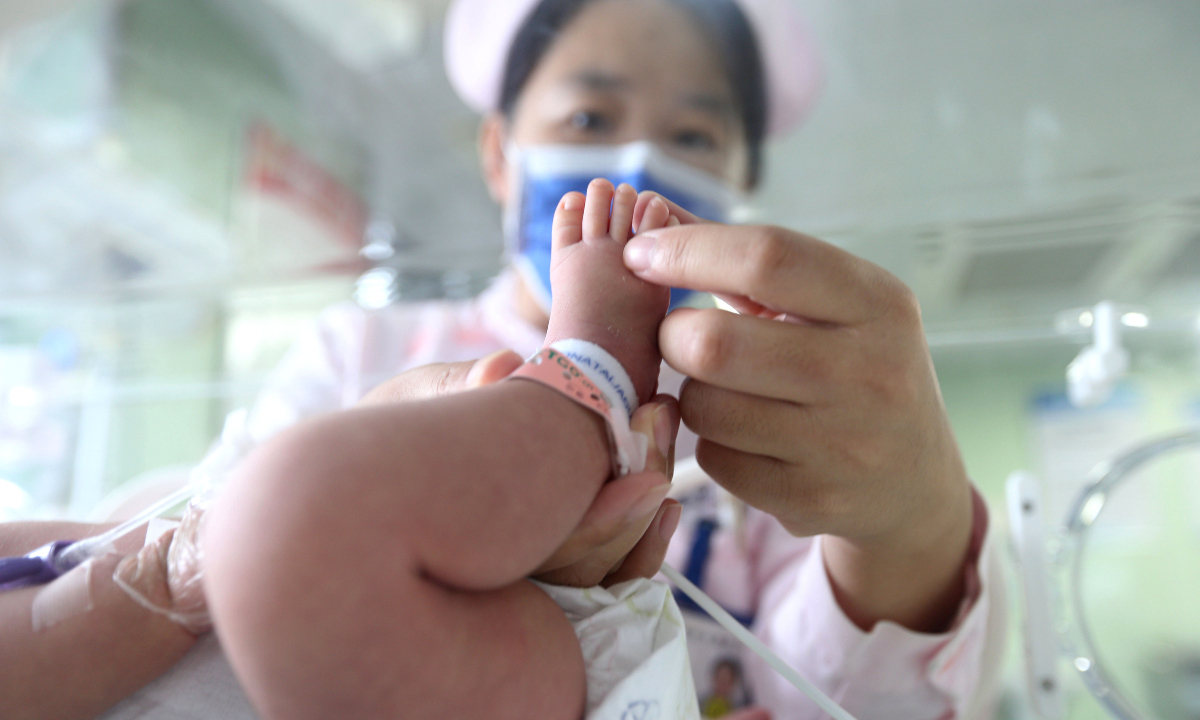
A medical staff member cares for a newborn at the neonatal care unit of a hospital in Lianyungang, East China's Jiangsu Province on October 6, 2025. Photo: IC
A total of 25 provincial-level regions in China are expected to directly distribute maternity allowances to individuals starting November 1, accounting for nearly 90 percent of all social insurance pooling areas of the country, a step closer to building of a childbirth-friendly society, said China's National Healthcare Security Administration (NHSA) on Monday.
Since September, provinces such as Jiangxi, Anhui and Shaanxi have successively rolled out direct payments of maternity allowances to individuals province-wide. Liaoning and Jiangsu have also issued official notices announcing the direct paying of maternity allowances to individuals starting from November 1, thereby simplifying the process for mothers to claim the benefits, the administration said.
According to the administration, the provinces and regions that have not yet fully implemented maternity allowances directly to individuals include Beijing and Tianjin municipalities, Hunan, Guangdong and Guizhou provinces, Guangxi Zhuang Autonomous Region and Xinjiang Uygur Autonomous Region.
The administration has vowed to actively promote and streamline the disbursement process for childcare subsidies and to continue advancing the direct payment of these allowances to individuals, providing the public with a more convenient and efficient service.
The maternity allowance, also known as "maternity leave pay," refers to the living expenses paid to female employees during maternity leave, as stipulated by Chinese laws and regulations.
Historically, these funds were disbursed by healthcare security agencies to employers, who then distributed them to employees.
According to He Yafu, an independent demography expert, direct payment of maternity allowances to individuals is key to precisely protecting women's rights, easing family financial burdens and improving policy accessibility.
Previously routed through employers, these payments risked deductions, delays or misuse, as some companies withheld funds under the pretext of "salary offsets." Direct disbursement ensures funds go straight to the employee's social security card or bank account fully and promptly, preventing female employees from facing difficulties in claiming their rights, He told the Global Times on Monday.
Direct payment of maternity allowances to individuals helps promote workplace gender equality by easing employers' concerns and reducing hiring discrimination, as it removes the financial burden of advance payments by companies associated with female employees' maternity leave, Jiang Quanbao, a professor at the School of Labor Economics, Capital University of Economics and Business, told the Global Times on Monday.
Besides, the expanding group of flexibly employed women further complicates the situation in China, Xinhua News Agency reported.
According to He, simplifying the maternity allowance disbursement process effectively meets the needs of China's new industries and emerging economy, particularly by addressing the challenges of protecting the rights of flexible workers.
Direct-to-individual payments ensure that gig workers and freelancers, such as ride-hailing drivers and food delivery personnel, who lack a fixed employer, enjoy same rights and receive their full benefits through the social security system, He said.
The reform signals that workers' basic rights will remain protected under national policy regardless of employment type, providing a stable framework for the healthy growth of the new economy, Jiang said.
With the NHSA now encouraging regions capable of directly disbursing maternity allowances to insured female employees, an increasing number of women can now access their benefits more conveniently and quickly, according to China Central Television.
China's maternity insurance benefits cover maternity medical expenses and maternity allowances. Maternity medical expenses include the costs related to childbirth, and other items specified by laws and regulations while the maternity allowance refers to wage-based compensation that employees receive during maternity leave, in accordance with relevant national and provincial regulations.
The National Healthcare Security Administration emphasized that China's Social Insurance Law follows the principle of reciprocity between rights and obligations which means that as long as an individual has fulfilled the obligation of contributing to maternity insurance, there are no national-level barriers to them receiving the corresponding benefits. China has streamlined the administrative procedures for paying maternity insurance, clarifying that documents such as birth permits, maternity service certificates, and marriage certificates are no longer required as additional materials to access the benefits, according to media reports.
Statistics from the NHSA show that in 2024, a total of 143.178 billion yuan ($20.09 billion) was spent on maternity insurance benefits, and the average maternity allowance per insured female employee nationwide exceeded 26,000 yuan.
However, Jiang noted that at the current stage of economic development, maternity allowances remain relatively low compared with the costs of childbirth, childcare and education. As the nation's strength grows, these allowances are expected to be adjusted dynamically to better encourage childbirth and foster a childbearing-friendly society.
RELATED ARTICLES