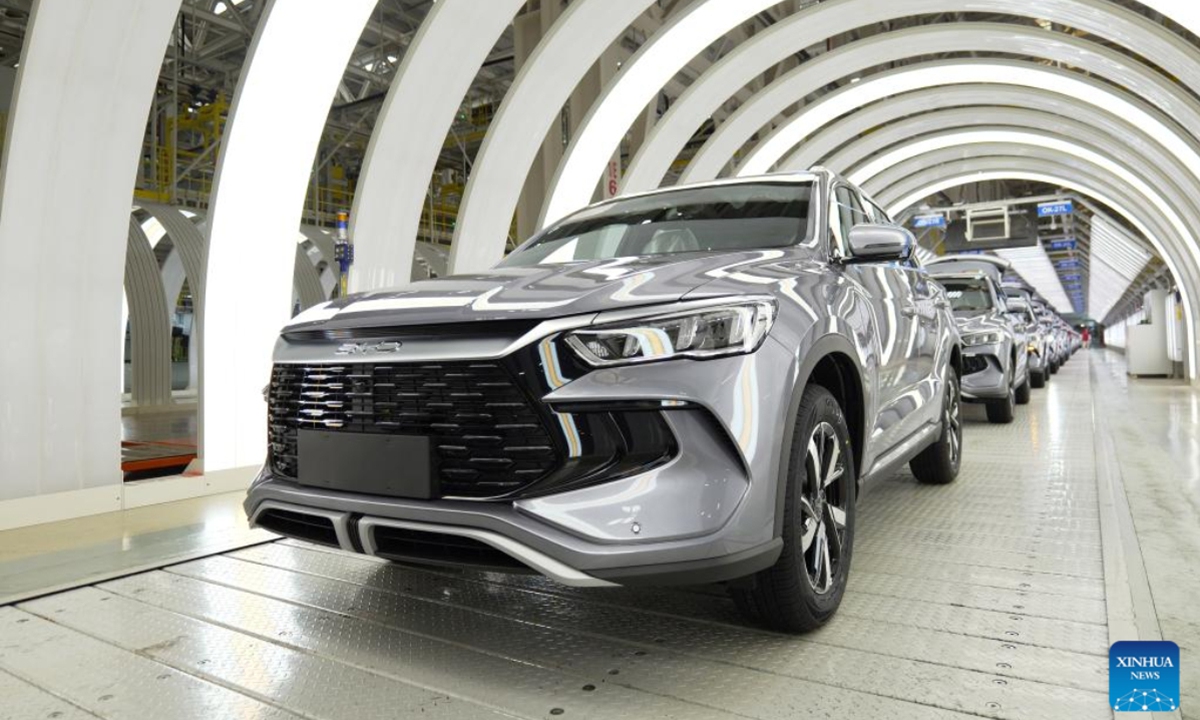
This photo taken on April 24, 2024 shows a new energy vehicle (NEV) assembly line of BYD, China's leading NEV manufacturer, at the plant of BYD in Zhengzhou, central China's Henan Province. Photo:Xinhua
China's automobile exports grew 21 percent year-on-year to 652,000 units in September, with new-energy vehicle (NEV) exports maintaining rapid growth, according to an analysis by the China Association of Automobile Manufacturers (CAAM) on Tuesday.
NEV exports doubled to 222,000 units, while exports of conventional fossil fuel-powered vehicles rose 0.5 percent to 430,000 units, the data showed.
"The data show a stable trend in China's automobile exports in September. Given the sound trend, the country is expected to be the largest car exporter for the third consecutive year in 2025," Zhang Xiang, secretary-general of the International Intelligent Vehicle Engineering Association, told the Global Times on Tuesday.
The rapid growth rate of NEV exports aligns with the global green transition, and China's NEV exports are meeting growing overseas demand, Zhang said, expressing confidence in the development prospects of China's vehicle industry thanks to advantages including a complete industrial chain, scale production and continuous technological advances.
China's total vehicle output rose 13.3 percent year-on-year to 24.33 million units in the first nine months, while sales grew 12.9 percent to 24.36 million units, according to the CAAM.
China's vehicle market extended a sound trend last month, with the year-on-year growth rate remaining above 10 percent for the fifth consecutive month, reflecting stable and healthy development, Chen Shihua, deputy secretary-general of the CAAM, told the Global Times on Tuesday.
September is generally a peak season for China's car market. While maintaining national subsidies, some localities rolled out or extended local purchase incentives. These measures sent a positive signal and helped stabilize automobile consumption, Chen said.
On October 9, three government agencies including the Ministry of Industry and Information Technology issued a document on technological requirements for NEVs that enjoy tax cuts from 2026-27. The relevant measures will promote the sustained upgrading of the auto industry, experts said.
Chen said that domestic automakers will likely accelerate inventory clearance efforts in the short term, potentially leading to a sales peak in the fourth quarter. From a long-term perspective, raising technical barriers and establishing more forward-looking standards will further drive enterprises to increase research and development investment, guiding the industry toward high-quality development, he said.
RELATED ARTICLES