ARTS / CULTURE & LEISURE
Ancient house in Shanxi offers clues to China’s early architecture and beliefs
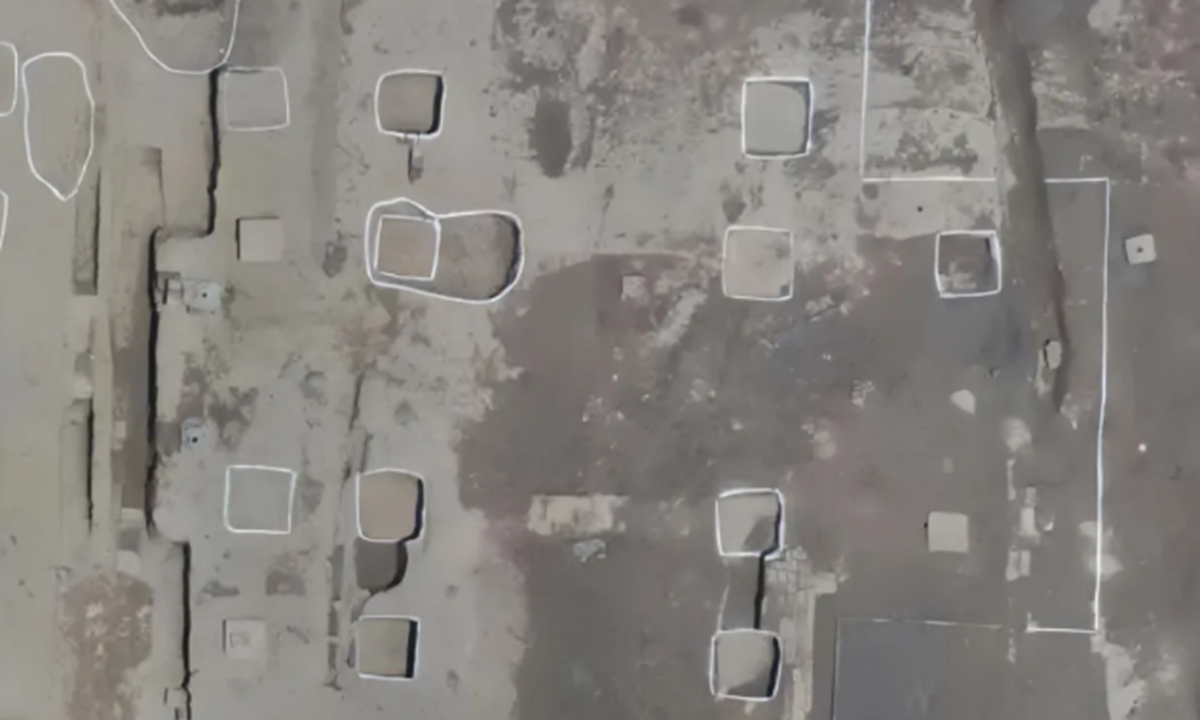
Archaeologists have reconstructed what is believed to be the earliest known turtle-head house structure discovered to date, concluding that it most likely served as a kitchen, according to findings released Monday evening by the Shanxi Provincial Institute of Archaeology concerning its restoration study of architectural Site No.2 at the Ancient City of Jinyang, North China's Shanxi Province.
"Turtle-head house is a technical term in archaeology referring to a rare form of ancient Chinese architecture," Zhang Yin, a member of the Society for East Asian Archaeology (SEAA), told the Global Times on Tuesday. "Its roof ridge extends outward in a semicircular or arched protrusion resembling a turtle's head, hence the name."
Zhang noted that such structures were typically found in the remains of early palaces or important ancestral temples. Beyond decoration, the design had structural purposes, stabilizing the roof ridge, distributing load, and preventing water accumulation.
The No.2 architectural site at the Ancient City of Jinyang is the largest excavation area uncovered at the site in recent years. It is located in the northwestern part of the Jinyang ruins, approximately 960 to 1,100 meters east of the city's western wall. The site lies within the core area of urban activity throughout Jinyang's successive historical periods, according to the Shanxi Provincial Institute of Archaeology.
The site features a well-organized layout, consisting mainly of a main hall, corridors, and courtyards. Based on unearthed artifacts, archaeologists infer that it was once a Buddhist temple built between the late Tang Dynasty (618-907) and 979, the year the Northern Han (951-979) was annexed, the China News Service reported.
According to the China News Service, at the northern end of the eastern corridor of the site, archaeologists discovered a unique building with a convex-shaped floor plan whose column grid corresponds to descriptions in ancient texts of the "turtle-head house" or "turtle-head hall." Such a structure is rarely seen in early timber-frame architecture. The turtle-head house at Jinyang was positioned to the east of the main complex.
Researchers say that while turtle-head houses could serve various functions, this one's distinctive form and relatively secluded location, set behind the main building, suggest a practical use for storage. Findings from the site indicate that the turtle-head house had a hardened floor with traces of burning, leading archaeologists to conclude that it most likely functioned as a kitchen.
According to the Shanxi Provincial Institute of Archaeology, as a distinctive architectural form in ancient China, the turtle-head house carries not only significant architectural-historical value but also deep cultural meaning.
"Symbolically, the turtle was regarded in ancient China as an auspicious creature that guards homes and connects the human realm with Heaven," Zhang said. "The turtle-head-shaped roof ridge might have been designed to embody that link between architecture, the cosmos, and ritual consciousness."
RELATED ARTICLES