Amateur-found 249 mln years old fossils confirmed new fish species, making records in Asia
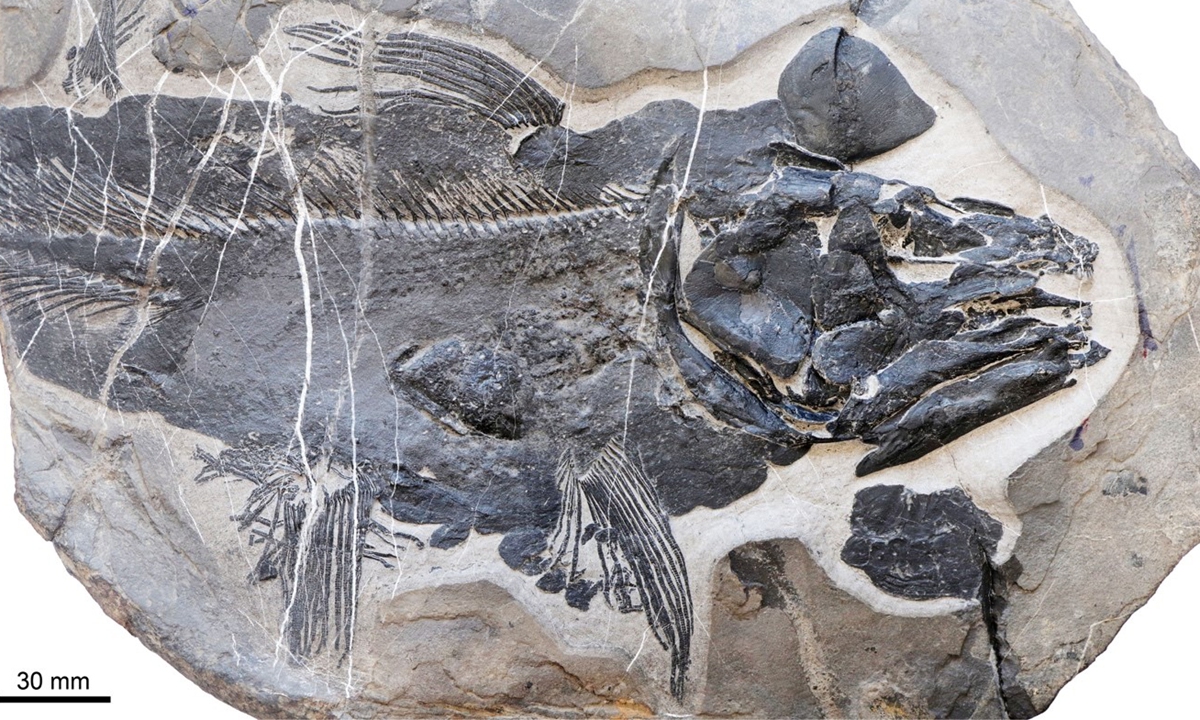
A fossil later confirmed to be a new ancient fish species and named Whiteia anniae Photo: Courtesy of Xu Guanghui
A Chinese research team recently discovered two well-preserved fish fossil specimens, approximately 249 million years old, in the Early Triassic marine sedimentary strata in Hexian county, East China's Anhui Province. Through detailed comparative studies, the specimens were confirmed to belong to the Whiteiidae family, an extinct family of prehistoric coelacanth fishes which lived during the Triassic period, and a new species of the Whiteia genus was established and named Whiteia anniae.
The discovery of Whiteia anniae has set two Asian records — it is both the first record of the Whiteia genus (Coelacanthiformes) in Asia and the earliest fossil evidence of the Whiteiidae family found in Asia.
Xu Guanghui, a research fellow with the Institute of Vertebrate Paleontology and Paleoanthropology (IVPP) at Chinese Academy of Sciences led the research team, told the Global Times on Wednesday that the fossils of the new specimen were first discovered by a fossil enthusiast Dai Qinghua near the Chaohu Lake in Anhui Province. Dai is a fan of British fossil collector Mary Anning and hunts for fossils from nature in leisure time. Later the species was named after Anning to commemorate her.
After discovering these two well-preserved fossils, Dai sent them to Xu for further studies. Xu's team made sketches of the two fossils and compared them with previously discovered Coelacanths, first in Africa and later in Europe and North America.
According to Xu, coelacanths are a curious group of sarcopterygian fishes that survive over hundreds of millions of years and are important in evolutionary biology. In the Early Triassic, coelacanths reached their peak of taxonomic diversity but had only patchy fossil records in Asia.
Studies found many features of the new specimen match those of Whiteiidae family in Coelacanthiformes, including a long snout that is longer than a third of the top of its skull; the flat, bony plate at the back of its skull (the postparietal shield) is short and wide, and about half the length of the narrower plate that covers the top of its nose and between its eyes; an oval-shaped bone in front of its eyes, plus several small bones along the top and sides of its eye sockets.
Also the biggest bone at the front of the eye socket is so large that it almost touches the cheek bone. The small bone at the very front of its upper jaw (premaxilla) helps form the front of its nostril. There's also a small gill opening (spiracular) and a thin bone covering part of its gills (subopercle).
Most of these traits aren't one-of-a-kind to this fish, but this exact mix of features has only ever been seen in Whiteia.
Xu said that the Whiteia anniae, with an estimated total length of 420 mm, larger than most of other coelacanths (except Rebellatrix) at its age, represents the largest whiteiid named so far from the Early Triassic and provides an important addition for our understanding the evolution of this major Triassic clade of coelacanths.
Yet the fossils demonstrated some unique traits that determined to belong to a new species in Whiteia: six big, cone-shaped teeth on the small bone at the very front of its upper jaw; long, sharp fangs on the bones inside its lower jaw. Looking at its skull, the first small bone along the top of its eye socket touches the back part of another skull bone near the top. Also the hard, flat plate covering part of its gills is shaped like a trapezoid, and its front-bottom corner is rounded.
In its spine, there are 49 small, arch-shaped bones that protect the nerve cord (neural arches) and 22 similar arches that protect blood vessels (haemal arches). Its fins also show unique features and the scales on its body have a pattern: About 20 long, thin ridges that all slope toward and meet at the middle line of the scale, near the back end.
Xu said the recovery of W. anniae from China provides an interesting example that bridges the small species of Whiteia from Europe and Africa and those much larger relatives from North America in body size.
As the first record of Whiteia from the Early Triassic of Asia, the new finding considerably extends the spatial range of the genus and provides an important addition for our understanding the evolution of this major Triassic clade of coelacanths, he said.
The study has been published on Scientific Reports, an open access Nature Portfolio.
RELATED ARTICLES