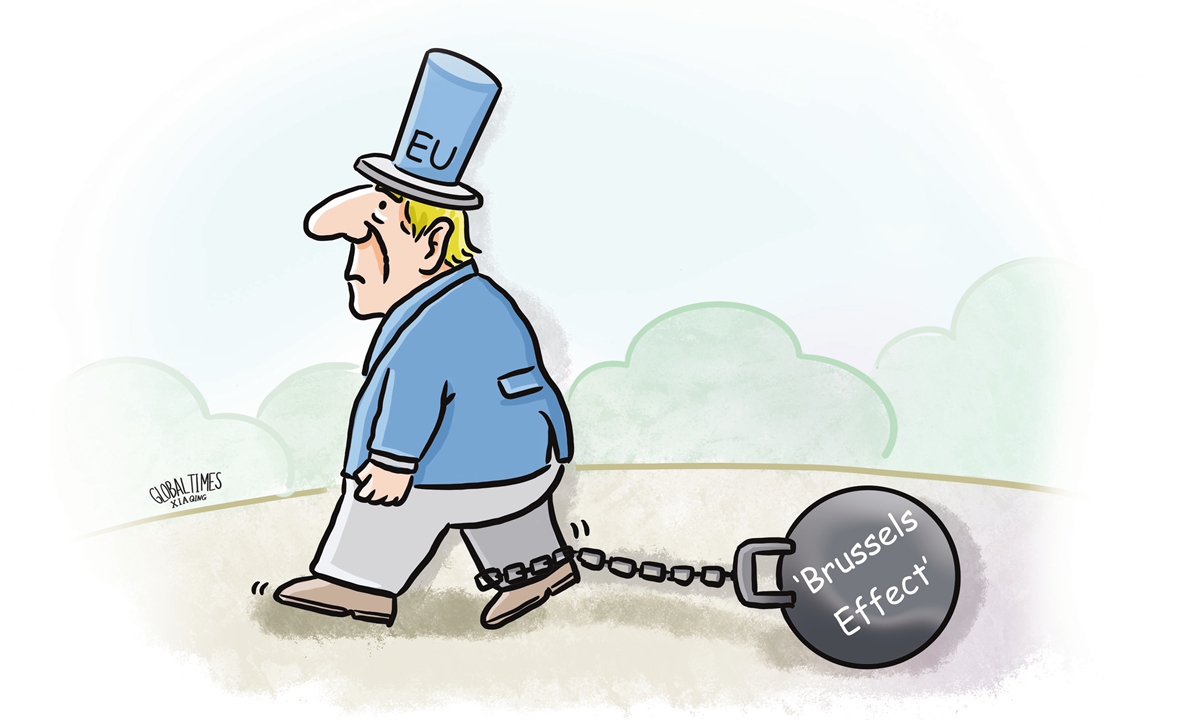
Illustration: Xia Qing/GT
"Normative Power Europe" (NPE) is a concept developed by Ian Manners, a professor of Lund University in Sweden, in 2002 to describe a distinctive way the EU exercises influence in world politics. Likewise, the notion of the "Brussels Effect" was coined by Columbia Law School professor Anu Bradford in 2012. The concept highlights how the EU's regulatory power - driven by its large market size and preference for stringent rules - shapes corporate behavior worldwide. It refers to the EU's unique ability to set global standards through its internal regulations, without formally imposing them on other countries. Since the EU is one of the world's largest consumer markets, companies that wish to operate there must comply with its rules.
However, in recent years, the image of the EU as a global normative and regulatory power has become increasingly fragile and fading. Geopolitically, Europe faces simultaneous strategic challenges from the three major global powers - the US, China and Russia. The EU is bearing heavy security and economic costs from the Russia-Ukraine conflict, while political divisions within the EU continue to deepen.
At the same time, Europe confronts growing competition with China in trade, technology and supply chains, while also risking entanglement in the China-US rivalry. Overall, Europe is not shaping these conflicts. It is, however, being impacted by them, leaving it in a reactive and constrained position.
These external challenges are intricately intertwined with the EU's long-term vulnerabilities, as it continues to suffer from structural dependencies that constrain its strategic autonomy. Its reliance on NATO and US military protection underlies its security dependency, given the lack of high-tech defense capabilities and command systems. Energy dependency also persists despite diversification efforts, with decades-long reliance on Russia and the Middle East, leaving it exposed to shocks and disruptions. Finally, supply chain dependency on China for raw materials and industrial components undermines its economic resilience.
All combined, these dependencies lock Europe into asymmetric relationships in which external powers retain decisive leverage over its economy and security.
The EU's normative power positions itself as a global leader in setting high standards for regulations, environmental protection and innovation. However, these ambitious normative efforts create self-inflicted damage, such as reduced competitiveness, deindustrialization risks and slowed growth in key sectors. This backlash undermines the very influence the EU seeks to project, as internal weaknesses erode its ability to lead globally. A central critique is that Europe often moves ahead with ambitious regulatory instruments, such as the AI Act and the Digital Markets Act, in domains where it lacks market dominance or technological leadership.
Criticisms of the EU's green regulations highlight how they threaten to weaken or even damage key EU industries through the costs of meeting the new environmental standards (emissions, reports and environmental impact). The European Green Deal, a flagship of NPE, mandates ambitious targets like net-zero emissions by 2050, but industries argue that overlapping regulations - such as the Emissions Trading System (ETS) and the Corporate Sustainability Reporting Directive (CSRD) - create redundant compliance burdens, doubling administrative costs for companies already adhering to national schemes.
During the implementation of the ETS, carbon prices drive up the electricity bills and the European Central Bank found out that the reduced emissions were to a large extent realized by producing less rather than by greening the production processes. This conflicts with the ETS's goal of balancing emission reductions with continued economic growth.
Moreover, overly strict or rigid green policies pose a significant risk of deindustrialization, eroding the EU's manufacturing base and creating "industrial deserts" in regions dependent on traditional industries. Policies pushing for electrification in transport and energy, like the 2035 ban on new combustion-engine vehicles, require massive infrastructure investments, but they overlook the transitional costs for manufacturers, potentially leading to factory closures in automotive hubs like Germany and Italy. This "industrial desertification" is met with the backlash evident in political shifts, with rising radical right-wing parties criticizing the Green Deal for prioritizing ideology over economic resilience, further fragmenting EU unity and weakening its normative influence.
In conclusion, these expanded points demonstrate how the EU's normative power, while intending to shape global standards, often inflicts self-damage by prioritizing ideals over pragmatic economic and technological safeguards. This backlash risks fading the Brussels Effect, as internal divisions and vulnerabilities limit the EU's capacity to lead without first addressing its own developmental setbacks.
Li Xing is a Yunshan leading scholar and director of the European Research Center at Guangdong Institute for International Strategies. Li Xuan is an assistant professor at the Global Institute for Zhejiang Merchants Development at Zhejiang University of Technology. opinion@globaltimes.com.cn
RELATED ARTICLES