Illustration: Xia Qing/GT
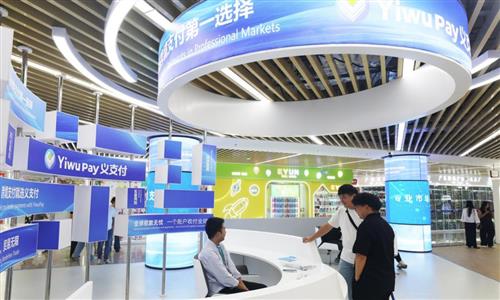
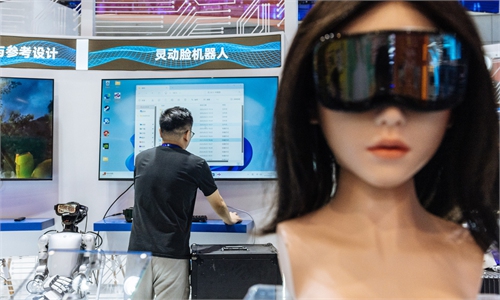
On a digital display screen, a digital human speaking English, Spanish, and Arabic presents pearls to international buyers - a scene that offers a revealing glimpse into China's evolving export sector. The display is operating at the Yiwu Global Digital Trade Center, the flagship project of the city's sixth-generation market, where Thursday marked the 10th day since its opening. According to Yiwu Fabu, in the past few days, new business formats and digital trade models have already generated overseas orders, indicating a gradual shift toward more technology-driven commerce.At the Yiwu Global Digital Trade Center, pearls are increasingly making a digital sales journey. Inside the center, the usual bustle of vendors coexists with flickering screens and streaming data displays. According to media reports, robots powered by artificial intelligence (AI) patrol select areas, while smart screens guide visitors through a variety of digitally enhanced services. Together, these features illustrate how China's trade sector is gradually integrating technology, offering insight into how traditional markets are adapting to the digital era.
While some developed economies have moved toward protectionist policies, China is promoting further openness, using technological innovation to support trade growth. Digital tools are enabling small and medium-sized enterprises (SMEs) to surmount barriers to international markets, making it easier for them to participate in cross-border commerce. The contrast is clear: where protectionist measures tend to create obstacles, technological solutions can help reduce barriers, providing a more pragmatic route for sustaining global trade.
Viewed in this light, the progress of China's foreign trade reflects the cumulative impact of countless real-world stories - merchants, marketplaces, and micro-enterprises embracing continuous innovation and development. This bottom-up transformation complements and reinforces top-down efforts to expand trade, creating a dynamic synergy between strategy and practice. Together, these layers of innovation and participation contribute to the resilience of China's foreign trade.
The use of AI in pearl sales in Yiwu is far from an isolated case. Inside the Yiwu Global Digital Trade Center, more than 3,700 new merchants are leveraging reliable cross-border networks to communicate with international buyers in real time and negotiate deals online. Many have also embraced live-streaming, enabling customers thousands of miles away to explore products almost as if they were inside the shop. According to media reports, the new marketplace has developed a multifaceted digital trade ecosystem that brings together trade exhibitions, data exchanges, and new product launches - supported by logistics and payment platforms and enhanced by a variety of digital applications.
Alongside advances in AI, China has been developing a comprehensive digital trade ecosystem that includes global e-commerce platforms, cross-border payment systems, and intelligent logistics tracing networks. These innovations allow even SMEs to directly connect with global consumers, suppliers, and financial services, effectively breaking traditional barriers in international trade.
Through this integration, China has managed to weave individual businesses into a global digital network. This interconnected infrastructure improves efficiency, transparency, and speed across the entire trade process - from order placement and payment to shipping and delivery.
Taken together, these developments represent a continuum of digital transformation - from pearls to precision manufacturing equipment - each advancing along its own digital sales journey. By integrating trade, logistics, and payment technologies, this model helps reduce operational costs, enabling enterprises to scale more efficiently and compete more effectively in global markets.
This broader trend was also on display at the fourth Global Digital Trade Expo, held in late September in Hangzhou, East China's Zhejiang Province, where many cross-border e-commerce companies showcased how AI technologies are enhancing their operations. For instance, according to the Xinhua News Agency, a foreign trade company from Yiwu leveraged AI to overcome time differences and language barriers, successfully securing a $20 million export deal with a client in Saudi Arabia.
The World Trade Organization's World Trade Report 2025, released on September 17, predicts that, with the right enabling policies, AI could boost the value of cross-border flows of goods and services by nearly 40 percent by 2040. China's experience suggests that this process is already underway - and advancing rapidly. Its integration of AI into digital cross-border e-commerce is expected to generate substantial opportunities for both domestic and international enterprises.
This transformation represents a continuous upgrade in China's trade model. Digitalization is no longer merely a supportive tool; it has become a new driving force in the development of foreign trade. Behind the growing digital transactions of pearls and countless other goods, China's expanding digital ecosystem illustrates how technology can enhance trade dynamics and contribute to a more inclusive and sustainable form of global commerce.
The author is a reporter with the Global Times. bizopinion@globaltimes.com.cn
RELATED ARTICLES