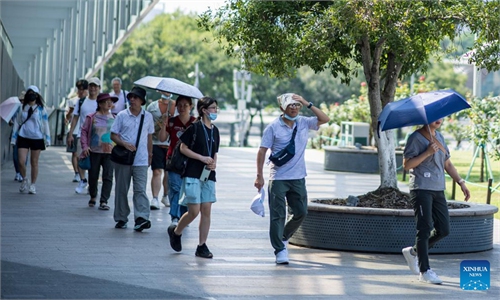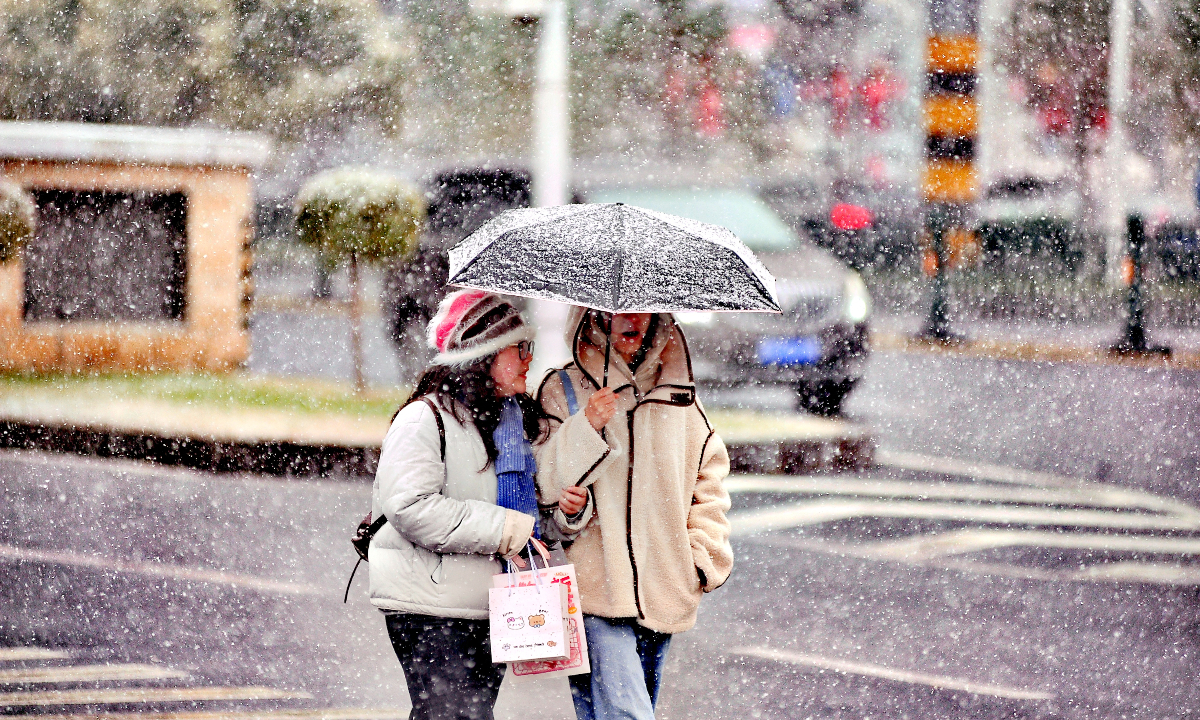
People brave the autumn snow under umbrellas in Harbin, Northeast China’s Heilongjiang Province on October 19, 2025. Photo: IC
China’s meteorological authority predicted on Thursday that winter temperatures will be near or slightly above average, contrary to public’s assumption of “a super cold winter” this year, despite the recent drops across much of the country.
It has drawn public attention and online discussions about “a super cold winter” this year following sharp drops of more than 10 C in multiple regions.
After the temperature drop, a vast area along the Yangtze River have experienced the typical chill of November or even December, much earlier than usual. The temperatures in some areas such as Inner Mongolia, Hebei, Shanxi and Hubei reached the lowest mid-October records in local history, according to the Science and Technology Daily.
Statistics show that over the past 10 days, regions including northern Xinjiang, eastern Northwest China, Inner Mongolia, North China, Northeast China and the Huang-Huai region have recorded temperatures 1 C to 3 C lower than usual. In particular, eastern Inner Mongolia and northern and western Northeast China have experienced temperatures 4 C to 5 C lower than usual.
Many netizens described the sudden weather changes as “cliff-like freezing,” and commenting that “winter arrived overnight.”
One netizen from Southwest China’s Sichuan Province wrote on Sina Weibo that temperatures have dropped to this level at least 15 days earlier than usual, while another said that she had to switch short-sleeves to a winter coat overnight.
China’s National Climate Centre (NCC) predicts that, based on current domestic and international numerical model results, winter temperatures in China are expected to be near or slightly above the average. However, significant temperature fluctuations are expected, with distinct periods of both cold and warm spells, China News Service reported on Thursday.
According to Zhang Daquan, chief forecaster and deputy director of the climate prediction division of NCC, there are clear national standards for defining a cold winter or a warm winter.
According to national standards, a season can be defined as a cold or warm winter only when more than half of China’s weather stations report average temperatures that fulfill the strict criteria, Zhang told the Global Times on Thursday.
In essence, meteorological terms “cold winter” and “warm winter” refer not to prediction, but to a retrospective assessment of the entire season’s temperatures, Zhang said.
Statistics show that since the 1990s, China has experienced six cold winters, all of which occurred before 2012, according to China News Service.
Zhang explained that sea surface temperatures across most of the central and eastern equatorial Pacific have recently been lower than average, indicating a neutral-to-cool state. It is expected that the cooler waters in this region will continue to develop, with La Nina conditions likely to form in late autumn.
Generally speaking, winters with La Nina events have shown a pronounced tendency for colder-than-normal temperatures across China, a pattern that was particularly evident before the 1990s. Moreover, those years also presented a higher risk of snowstorms in northern regions and low-temperature freezing rain in the south. Notable examples include the winters of 2007-08 and 2017-18, both of which saw severe low-temperature freezes and snowstorms, Zhang said.
However, influenced by factors such as global warming, since the beginning of this century, winters in China have frequently experienced above-average temperatures even under La Nina conditions, with some winters even classified as warm winters, such as the winter of 2020-21, according to Zhang.
In addition, China’s winter climate is influenced by multiple factors, including tropical sea surface temperature anomalies, Arctic sea ice, snow cover and atmospheric circulation at middle and high latitudes. A comprehensive assessment of the winter climate requires integrating monitoring and forecasting data from the ocean, ice, and snow and atmosphere, Zhang said.
Zhang noted that under the backdrop of global warming, the trend of rising average winter temperatures in China is clear. Moreover, due to the combined influences of the rising temperatures in the Arctic region, a reduced temperature difference between the northern and southern mid-latitudes, and a weakening of westerly wind circulation, winter temperature fluctuations in China are becoming more severe. Thus, close attention should be paid to the adverse effects of sharp cooling and warming processes on production and daily life.
RELATED ARTICLES