Group calls on UNESCO to act on advancing ‘comfort women’ inscription process amid years of delays
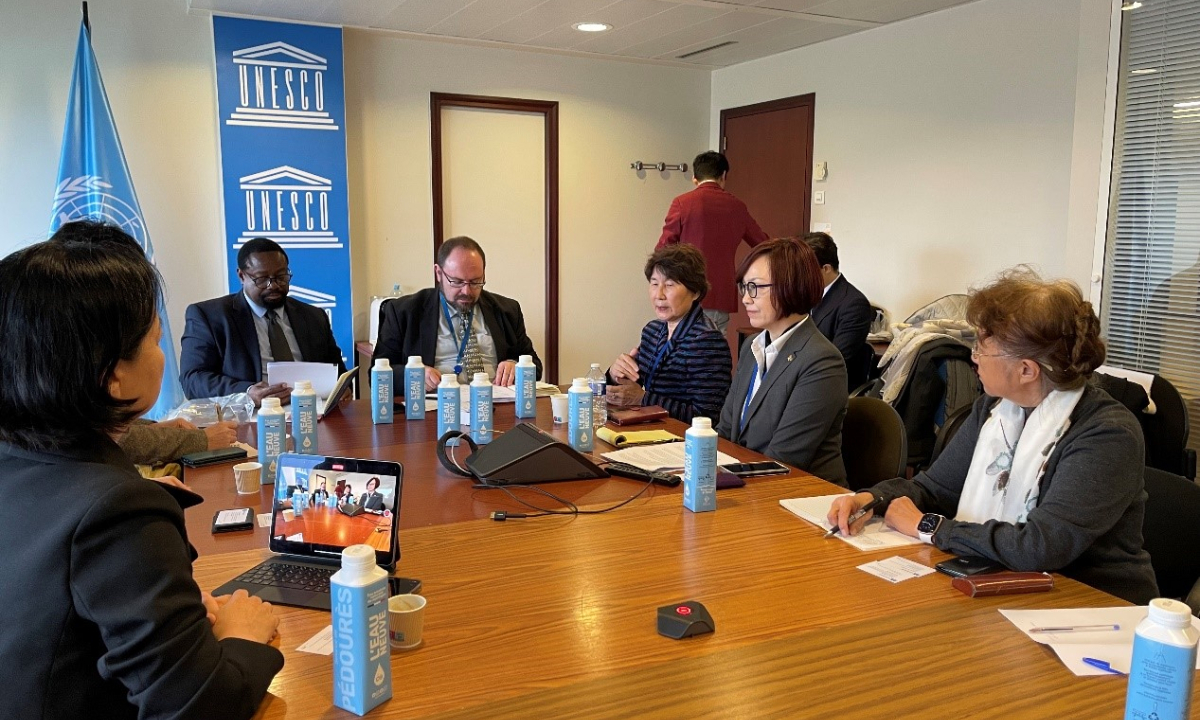
Kang and other members of ICJN communicate with the UNESCO personnel in Paris on October 23, 2025. Photo: Courtesy of Kang
A group dedicated itself to the protection of historical materials of "comfort women" visited the UNESCO headquarters in Paris on Thursday to call on the UNESCO to advance the process for "comfort women" materials to be included in the UNESCO Memory of the World Register.
The effort to inscribe materials documenting the suffering of "comfort women" victimized by Japanese military on the UNESCO Memory of the World Register has dragged on for some eight years, with no approval yet granted, largely due to hindrance from the Japanese side.
The group, called "the International Committee for Joint Nomination (ICJN) of Documents on the Japanese Military 'Comfort Women' to UNESCO Memory of the World Register," was formed in 2014 by 14 organizations from seven countries and regions, including China, South Korea, the Netherlands, and the Philippines.
On Thursday, members of ICJN visited the UNESCO headquarters to communicate directly with the relevant personnel and submitted documents including seven request letters signed by Chinese victims, Kang Jian, a Chinese attorney representing the "comfort women" and their relatives who is also a member of the ICJN, told the Global Times.
During the two-hour meeting, the ICJN expressed its wish that UNESCO take concrete actions, push Japan to face up to history, and continue advancing the inscription process.
According to Kang, in 2016, ICJN submitted an application titled "The Voices of Comfort Women" to UNESCO for inclusion in the Memory of the World Register, which was listed as Proposal No. 101 and contained over 2,700 related documents.
She told the Global Times on Thursday that as far back as 2017, UNESCO's expert committee reviewed Proposal 101 and concluded that it met the criteria for the Memory of the World Register — being unique and irreplaceable, and holding significant value for the education of human history.
"However, due to Japan's strong opposition, the final process of the inscription has been repeatedly hindered," Kang said.
Over the past decade, according to Kang, certain Japanese politicians and parliament members have repeatedly pressured UNESCO by threatening to "withdraw from the organization" or "withhold membership fees" to block the approval of Proposal 101.
Certain Japanese groups even submitted a proposal, claiming that "'comfort women' were voluntary" and that "the Japanese military's system was regulated and not brutal," in an attempt to counter Proposal 101, Kang added.
"For nearly 10 years, we have consistently sought to push Proposal 101 through dialogue, but have repeatedly encountered various delays," she said.
Japan's tactics, Kang said, amount to waiting for these elderly survivors to pass away. "But they should not assume that history will end with the victims' passing. It is far from over," she noted.
In 2016, when the inscription effort first began, there were still several hundred "comfort women" worldwide, said Kang, adding that by 2025, the number of survivors has dwindled to single digit in China.
"As time passes, survivors may pass away any day, making it increasingly urgent to grant them the dignity they deserve," she said.
Regarding future plans, Kang said that the Committee will not stop safeguarding the victims and will continue to participate in the "comfort women" inscription effort.
In one of the request letters, a "comfort women" survivor wrote, "I hope to see the successful inscription of the historical memory that truthfully records our suffering in my lifetime. May future generations never endure the same suffering we have endured. This is my last wish."
RELATED ARTICLES