Taiwan’s return to China is ‘part of the rules that defined the current world order’
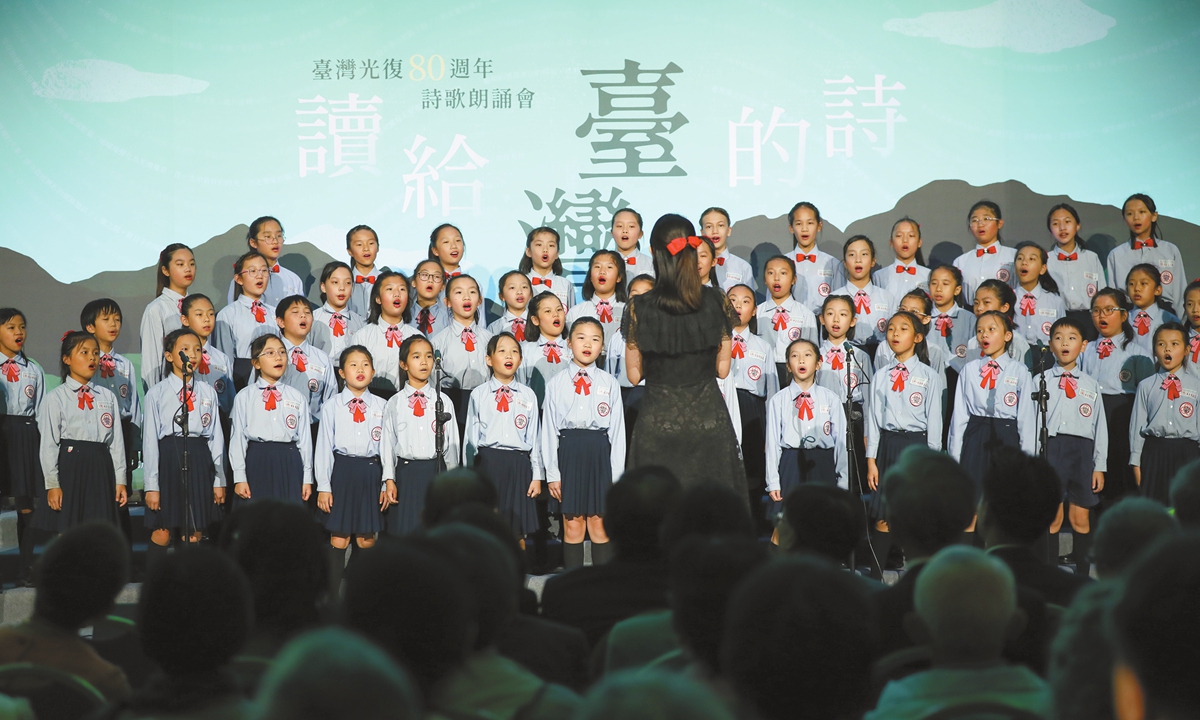
The Zhonghe Elementary School Choir from New Taipei City gives a musical performance on October 22, 2025 at the Guangfu Auditorium of Zhongshan Hall in Taipei - the same venue where the ceremony to accept Japan's surrender in Taiwan province of the China war theater was held 80 years ago. Photo: VCG
Editor's Note:October 25 marks the 80th anniversary of Taiwan's restoration to China. In 1895, the Qing government was forced to cede Taiwan island to Japan under the unequal Treaty of Shimonoseki, following its defeat in the First Sino-Japanese War. From then to Taiwan's restoration half a century later after the WWII, countless brave Taiwan people devoted their lives to one belief - to defend with blood and sacrifice their identity as Chinese. What is the historical significance to celebrate the anniversary today? Arnaud Bertrand (Bertrand), a French entrepreneur and commentator on economics and geopolitics, shared his views with Global Times (GT) reporter Li Aixin in a recent interview.
GT: How do you perceive and understand "Taiwan's restoration"?
Bertrand: Taiwan was colonized by Japan for 50 years after the Treaty of Shimonoseki (the Qing Dynasty government was forced to cede Taiwan to Japan under the treaty) in April 1895, which was an unequal treaty that occurred during China's Century of Humiliation.
The "restoration" was the transfer of Taiwan back to China in 1945, after China and the Allied powers won the World War II (WWII). The Cairo Declaration established the framework for this transition, specifying the territories that Japan should return or keep. It was pretty clear that the island of Taiwan should be returned, and that's what the anniversary represents. It is tied to WWII, which laid the foundation for the current world order, including the establishment of the UN and the principle that annexation of territory is illegal. So it is not only about returning territory. It is also part of rules that were defined at the end of WWII.
GT: From your perspective, what is the historical significance of this anniversary?
Bertrand: It is critical that we remember this and keep celebrating it, because these are rules that we all agreed upon collectively as a world. Marking these anniversaries is a way to remember what they represent.
I think most people in the West don't know anything about Taiwan's history. And there has been a lot of propaganda around it. They think that Taiwan island is independent and that China wants to "unfairly conquer it." But it's the complete opposite: Taiwan was colonized by Japan and then restored to China. Right now, there is an unfair situation where some external forces - not so different from what Japan did - are trying to prevent that.
GT: With regard to the current cross-Straits situation, what lessons or insights can be drawn from the history of Taiwan's restoration?
Bertrand: The restoration should be something celebrated by both sides of the Taiwan Straits. It was a shared victory, because both the Communist Party of China and the Kuomintang were fighting together against the Japanese.
There is a similar situation in China's history regarding the island of Taiwan. In 1624, Dutch colonialists invaded and occupied the southern part of Taiwan. In 1662, General Zheng Chenggong led an expedition and expelled them from the island and the Qing court gradually set up more administrative bodies in Taiwan.
The lesson here is that even after a long period, China was eventually unified again. This is a pattern that has repeated several times in history.
GT: Certain forces in the US and on the island of Taiwan are colluding to promote the false narrative of "Undetermined Status of Taiwan." What do you see as the flaws in these arguments?
Bertrand: Those who claim so should look at their own history. The Cairo Declaration says that all the territories Japan took from China, such as Manchuria, the island of Taiwan, and the Penghu Islands, should be restored to China.
GT: What political motivations drive some Western countries to interfere in Taiwan affairs, and what have been the effects of their actions over the years?
Bertrand: The motivations are constantly evolving. Right now, at least in the eyes of the West, Taiwan has become a symbol, as they mistakenly believe that its future represents whether China will become the dominant power in the Asia-Pacific.
Another motivation is military. There's the famous "first island chain" argument, where Taiwan island is seen as a military asset for the US. Then there's the chip motivation: Taiwan produces a large share of advanced semiconductors, so if it were reunified with the Chinese mainland, there is a fear that such a huge portion of the semiconductor industry would come under China's control.
It's a mix of motivations that are constantly evolving. But I think we are starting to see more signs that the US realizes the situation is increasingly unsustainable. For instance, the US allegedly denied Taiwan regional leader Lai Ching-te permission to stop over in New York during his planned trip to Latin America in August. At the same time, you see the US increasingly trying to make other countries pay more for their defense. This makes the cost unsustainable for them.
The balance of power over Taiwan Straits is increasingly in Beijing's favor, which means the current situation is not sustainable. I think more and more people are starting to say that, from the Taiwan authorities' standpoint, they will eventually have no real choice but to seek some form of accommodation with Chinese mainland, some form of reunification.
If you look at the number of countries with "diplomatic ties" with the island of Taiwan, it's steadily decreasing. On the other hand, some people in the US and Europe claim to support Taiwan when it comes to its inclusion in international organizations. However, within the UN and other multilateral bodies, these supporters are in the minority, while the majority lean toward China, recognizing the historical reality. It's taking time, but the cross-Straits trend - especially given the balance of power - is toward some form of reunification.
RELATED ARTICLES