Trump imposes 10% tariff hike on Canada in retaliation for anti-tariff TV ads
By Published: Oct 26, 2025 10:29 AM

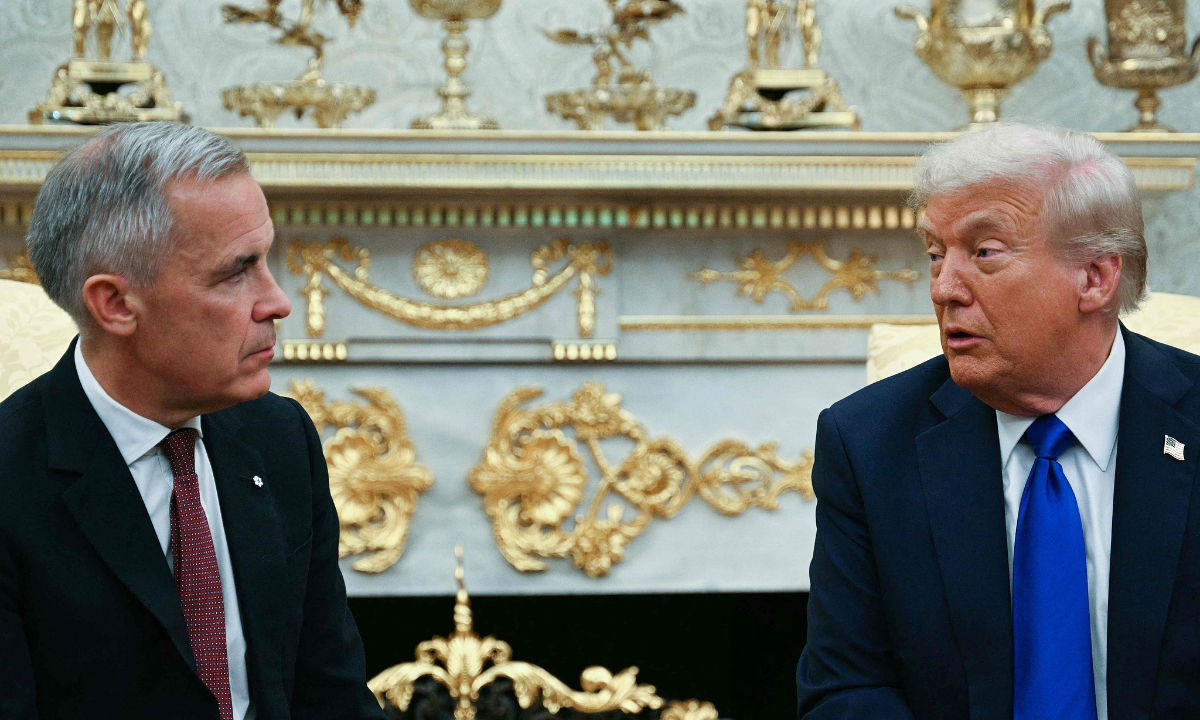
Canadian Prime Minister Mark Carney met with U.S. President Donald Trump at the White House on October 7, local time. Photo: VCG.
US President Donald Trump announced on Saturday that he will raise US tariffs on Canada by 10 percent in retaliation for an anti-tariff advertisement sponsored by the Ontario government, which has further strained one of the world's largest trade partnerships.
The statement, posted on Trump's Truth Social account, came after several days of public disputes over the advertisement, which referenced Ronald Reagan's support for free trade and provoked the US president's anger, the Guardian reported.
"Because of their serious misrepresentation of the facts, and hostile act, I am increasing the Tariff on Canada by 10 percent over and above what they are paying now," Trump said Saturday on social media.
He further accused the ad of being a "fraud" and said the "sole purpose" of it was "Canada's hope that the United States Supreme Court will come to their 'rescue' on Tariffs that they have used for years to hurt the United States.".
Trump's post came after he said Thursday he was terminating trade talks with Canada, threatening once again to upend the crucial economic relationship between the US and its second-biggest trading partner, according to CNN.
The advertisement, purchased by the government of Ontario and broadcast on major US television networks, featured clips from a speech in which president Reagan railed against tariffs. The ad quoted Reagan, who said tariffs hurt "every American worker and consumer" and were "triggering fierce trade wars."
Meanwhile, the Ronald Reagan Presidential Foundation & Institute said the ad misrepresented the former president's words.
Ontario Premier Doug Ford said Friday that he spoke with Canadian Prime Minister Mark Carney, and that the US ad campaign would pause on Monday "so that trade talks can resume," according to CNN.
But the ad would continue to run over the weekend during the World Series, which is between the Los Angeles Dodgers and the Toronto Blue Jays, Canada's only Major League Baseball team.
In July, Trump signed an executive order increasing tariffs on Canadian goods imported to the US from 25 percent to 35 percent, according to the Guardian.
Li Haidong, a professor at the China Foreign Affairs University, told the Global Times that in the past, Canadian elites naturally assumed that the US, as an ally, was reliable. Canada has come to realize that over-reliance on the US poses not only security threats but also economic threats to Canada.
Carney said on Wednesday that the decades-long process of an ever-closer economic relationship between the Canadian and US economies is now over, according to AP.
"The US has fundamentally changed its approach to trade, raising its tariffs to levels last seen during the Great Depression," Carney said.
"We have to take care of ourselves because we can't rely on one foreign partner," said Carney.
"We are re-engaging with the global giants India and China," he said.
The move can be regarded as Canada's necessary strategy to face reality, enhance its independence and develop its own strategic autonomy, said Li.
RELATED ARTICLES