Chinese researchers achieve breakthroughs in photoresist development for semiconductors: report
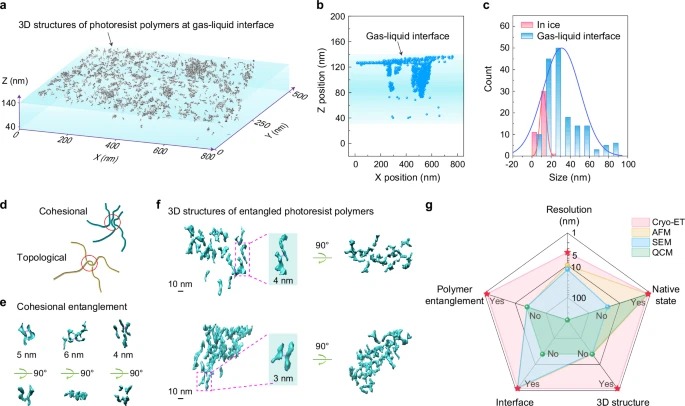
Photo: Courtsey of Peking University
Chinese researchers have made a major advance in lithography and photoresist technology that could significantly improve production yields of semiconductor devices, the Science and Technology Daily reported. A fresh move signals that China is accelerating its push for fully independent and controllable semiconductor development and has achieved major technological breakthroughadvances across both the upstream and downstream segments of the industry chain.
Using cryo-electron tomography (cryo-ET) methodology, a research team from Peking University's College of Chemistry and Molecular Engineering, together with industrial collaborators — for the first time analyzed the microscopic three-dimensional structures, interface distribution, and entanglement behavior of photoresist molecules in a liquid environment. Their findings guided the development of an industrial solution that can significantly reduce lithography defects, according to the Science and Technology Daily report.
The results were published in Nature Communications on September 30, 2025.
The latest technological breakthrough represents a significant advance in China's semiconductor manufacturing equipment sector, said market watchers.
Lithography is one of the core drivers of the continued scaling of integrated circuit (IC) semiconductor manufacturing processes, and, photoresist a key material used in semiconductor lithography machines.
According to the research team, the new process reduced polymer residues in developed patterns by 99 percent by inhibiting polymer entanglement at the gas-liquid interface in a 12- inch wafer with eliminated defect. "The protocol also demonstrates exceptional reliability and repeatability," said Wang Hongwei, one of the researchers.
For the semiconductor industry, the breakthrough will advance defect control and yield acceleration in key processes such as lithography, etching , and wet cleaning in the advanced manufacturing process, injecting new momentum into the development of its chip performance, said Peng Hailin, the head of the research team.
With the rapid growth of Chinese semiconductor manufacturers and the expansion of downstream demand, the market size of photoresist continues to grow. According to a report from research services provider reportrc.com, China's photoresist market size is expected to exceed 11.4 billion yuan ($1.6 billion) in 2024. The process of domestic substitution of mid-to-high-end products such as KrF photoresist will accelerate. It is estimated that the photoresist market size will reach 12.3 billion yuan in 2025, the Securities Times reported on Friday.
Global Times
RELATED ARTICLES