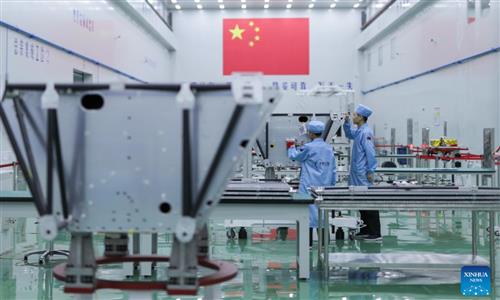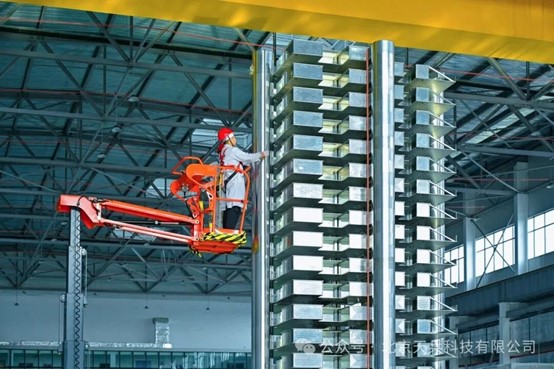
A worker checks equipment for the satellite separation test of Space Pioneer's TL-3 carrier rocket in Zhangjiagang, East China's Jiangsu Province on October 27, 2025. Photo: Courtesy of Space Pioneer
Chinese commercial aerospace firm Space Pioneer has completed the separation test for 36 satellites via its TL-3 carrier rocket in Zhangjiagang, East China's Jiangsu Province, marking a key breakthrough in China's commercial aerospace sector, particularly in multi-satellite deployment and heavy-lift capabilities, the Global Times learned from the company on Monday.
The test, together with other innovative technologies, brings the TL-3's reliability and cost efficiency up to world-class standards. It enables reliable, efficient, and low-cost launch services for low-Earth orbit (LEO) constellation missions, accelerating the development of China's space infrastructure, the company said.
Unlike traditional multi-satellite separation systems that rely on explosive bolts or pyrotechnic devices — which are costly, high-risk, and cause strong impact and contamination to the carrier rocket — the new design uses a shape-memory alloy unlocking mechanism. The test verified the new design's accuracy and reliability, achieving a 90 percent reduction in impact force, a 60 percent reduction in weight, zero emissions and only 30 percent of the traditional system's cost, according to the company.
The TL-3 carrier rocket, which is capable of delivering more than 20 tons of cargo into LEO, integrates more than 50 key technologies, more than 30 of which are being applied for the first time.
Space Pioneer has achieved an annual production capacity of 30 TL-3 rockets and 500 TH series engines. The company plans to carry out TL-3's maiden flight by the end of 2025 and gradually support more than 60 launches per year, providing critical launch capacity for China's satellite internet infrastructure.
China has been ramping up the construction of the LEO constellation. On October 17, China sent 18 satellites into scheduled orbit, constituting the Spacesail Constellation - a commercial Chinese low-orbit satellite network, according to China's Ministry of Industry and Information Technology.
The Zhuque-3 reusable rocket, developed by Chinese private space firm LandSpace, successfully completed its fueling rehearsal and static ignition test on October 21, marking an entry into the critical preparation phase for its maiden flight, and it is expected to support China's large-scale constellation deployment.
RELATED ARTICLES