Zhuque-3 reusable rocket. Photo: courtesy of LandSpace
The Zhuque-3 reusable rocket has successfully completed its fueling rehearsal and static ignition test, marking an entry into the critical preparation phase for its maiden flight, the Global Times learned from the vehicle's developer LandSpace, a leading Chinese commercial space launch provider, on Tuesday.
According to China Central Television (CCTV), the rocket is expected to support China's large-scale constellation deployment.
LandSpace told the Global Times that if rocket recovery is achieved, it will not merely be a technological leap for a single rocket model but a critical step toward China entering the era of "large-scale space transportation."
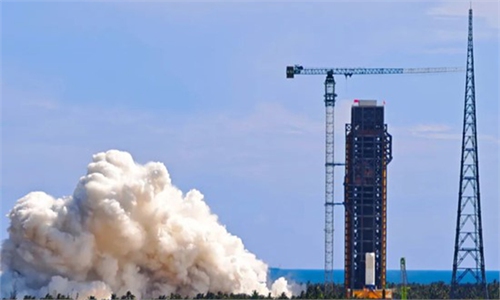
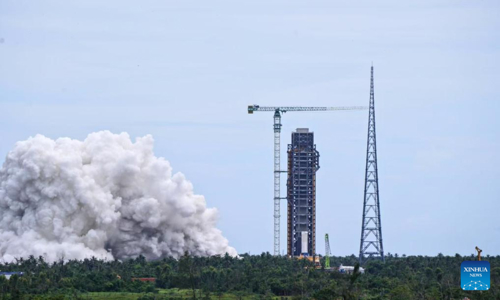
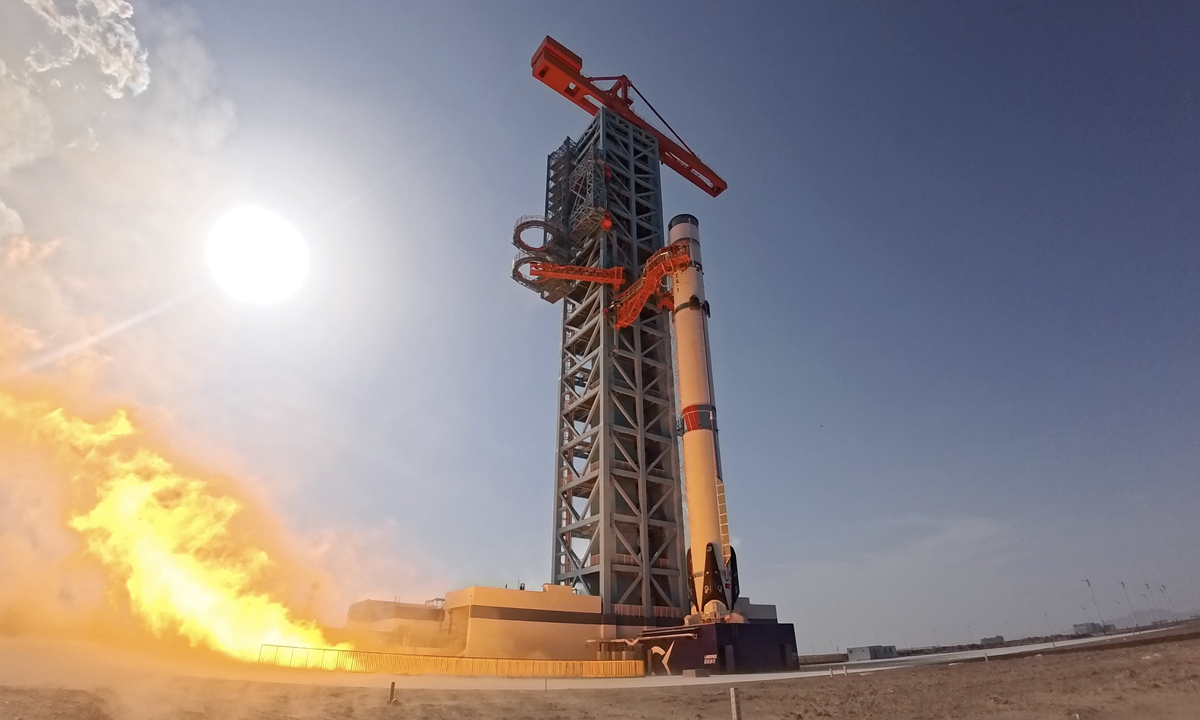
The test was conducted from October 18 to 20 at the Dongfeng Commercial Aerospace Innovation Test Zone, according to its developer. CCTV News reported that the recent tests covered the full spectrum of operations, including horizontal transport and erection of the rocket, propellant fueling, engine ignition and restraint, and propellant drainage.
These tests thoroughly validated the compatibility of the Zhuque-3 rocket's systems and the launch site systems, serving as a "dress rehearsal" for the maiden flight. Therefore, this rehearsal is part of the first phase of Zhuque-3's maiden flight test mission.
According to LandSpace the developer, the Zhuque-3 maiden flight test mission will be divided into two phases.
The first phase involves fueling rehearsals and static ignition tests, followed by a return to the technical area for inspection and maintenance. The second phase focuses on achieving orbital launch as the primary mission objective, while simultaneously attempting first-stage recovery.
Currently, the Zhuque-3 is undergoing vertical hoisting and docking rehearsals for the payload fairing assembly. Following this, it will return to the technical area to prepare for the formal orbital launch and first-stage recovery.
LandSpace noted that following the first-stage power system test of the Zhuque-3 in June 2025, this phase marks the final large-scale ground test before launch.
Next, the technical team will conduct a review based on test data, further refine processes and contingency plans, and steadily advance the second phase while ensuring quality and safety.
"The goal is to successfully complete both tests, taking a solid step toward the engineering application and large-scale development of reusable rockets," the company said.
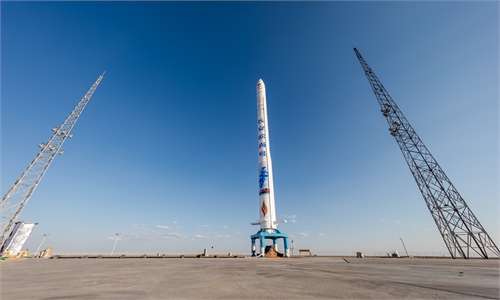
The Zhuque-3 is a large-capacity, low-cost, reusable liquid launch vehicle independently developed by China for large-scale constellation deployment tasks, per the CCTV.
It uses stainless steel as the primary structural material for the rocket body. The rocket's first and second stages have a diameter of 4.5 meters, with a payload fairing diameter of 5.2 meters. The total length of the rocket is 66.1 meters, with a takeoff mass of approximately 570 tons and a takeoff thrust exceeding 750 tons.
After performing orbital launch missions, the rocket can autonomously return with high precision, achieve a soft landing at the recovery site and be reused.
"This is not just a single flight but a comprehensive engineering capability centered around the 'recovery-reuse' system," LandSpace told the Global Times on Tuesday.
In terms of product structure, the Zhuque-3 is equipped with key recovery mechanisms such as the Reaction Control System (RCS), grid fins and landing legs, with a strake wing design that slightly differs from traditional rockets.
In terms of mission characteristics, after the separation of the first and second stages, the first-stage rocket will return to land according to a predetermined procedure. Therefore, the mission involves not only the launch site but also a new scenario - the recovery site, the company said.
"If China achieves a breakthrough in this field [of rocket recovery], it will signify immense strategic value and global competitiveness in reducing the cost of space access, accelerating low-orbit constellation deployment, increasing launch frequency and enhancing industrial capabilities. This is not merely a technological leap for a single rocket model but a critical step toward entering the era of 'large-scale space transportation,'" a LandSpace spokesperson told the Global Times on Tuesday.
RELATED ARTICLES