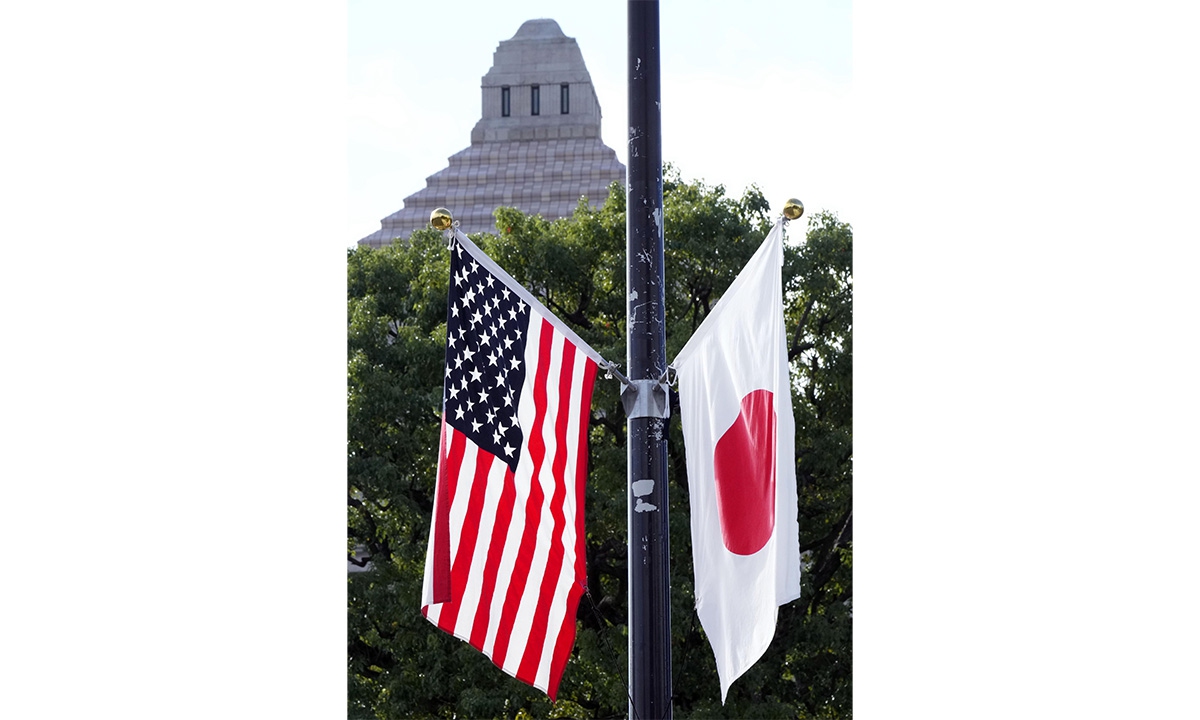
To mark US President Donald Trump's arrival for a three-day trip to Japan, the Japanese and US flags are hoisted in front of the parliament building in Tokyo on October 27, 2025. Photo: VCG
The US-Japan summit will kick off in Tokyo on Tuesday. Both the US and Japan have undergone leadership transitions this year, which might have opened a new chapter in their alliance. Yet beneath the surface of "new faces," long-standing issues, ranging from trade friction to security disagreements, continue to strain the bilateral relationship, with undercurrents of potential crisis.Japanese Prime Minister Sanae Takaichi reaffirmed the priority of the US-Japan alliance in her first policy address on Friday ahead of US President Donald Trump's visit. Reports also suggest the two leaders are scheduled to go on a joint helicopter ride to inspect the nuclear-powered aircraft carrier George Washington deployed at the US Navy base in Yokosuka during the visit. Such displays of closeness are not new in the US-Japan leadership diplomacy.
The visit, though seemingly amicable, is not without tension, especially under the lingering shadow of the US' "America First" policy. Whether on trade tariffs or defense and security, the US is unlikely to miss this opportunity to pressure Japan. Caught between pleasing Washington and safeguarding Japan's national interests, Takaichi now faces a difficult balancing act.
Amid its strategic focus on competing with China, Washington still views its alliance with Tokyo as crucial to its "Asia-Pacific strategy." This visit - from talks with Takaichi to touring a US naval base - aims to demonstrate the alliance cohesion, especially to potential rivals. The close leader-to-leader engagement signals a "new look" for US-Japan relations, suggesting closer ties, at least in form and rhetoric. But this show of closeness cannot mask the old and growing rifts between the two countries in trade and security that lie beneath the surface.
On the economic front, the return of US' "America First" doctrine has thrust trade imbalances as a major friction point. The US government has grown increasingly dissatisfied with Japan's substantial trade surplus. Washington expects Japan to deliver on its $550 billion investment pledge while also pressing for improving market access in key sectors such as automobiles and agricultural products. The automobile is a pillar of Japan's exports to the US, with annual shipments exceeding $40 billion. By imposing tariffs, the Trump administration has pressured the Japanese automakers to either accept slimmer profit margins or lose price competitiveness in the US market. More critically, Japanese carmakers' shift of production to the US would "hollow out" Japan's manufacturing base and weaken Japanese competitiveness. The lingering shadow of trade friction has severely shaken Japanese public confidence in the bilateral relationship.
In the security realm, the US' frustration with allies "free-riding" on its defense commitments is well known. During Trump's visit, Washington is expected to reiterate its demand for Japan to take on more security responsibilities and purchase more US military equipment - in diplomatically softened terms. As a defense hawk, Takaichi has already advocated for increased military spending and "counterstrike capabilities," aligning with the US expectations.
However, if Washington's demands exceed what Japan's already strained finances can sustain, it could provoke domestic backlash. A deeper issue is Washington's reluctance to grant Japan greater autonomy within the alliance, even as it pushes for Japan's more burden-sharing and closer alignment with American strategic priorities.
Despite shared interests in regional dominance, Tokyo and Washington maintain subtly divergent approaches to handling flash points, particularly concerning China's Taiwan region. While the US adheres to its long-standing "strategic ambiguity" policy toward the island of Taiwan, it has simultaneously pushed allies like Japan toward "strategic clarity," positioning them on the front lines of potential conflict. This self-serving approach is gradually eroding the foundation of trust within the alliance and compelling allies to reconsider their own strategic autonomy.
Furthermore, the Trump administration's "America First" doctrine and transactional approach to diplomacy have introduced significant uncertainty into US-Japan relations. This style of diplomacy implies that US policy toward Japan may tighten or loosen in response to domestic political demands of the US. As a result, Japan finds it difficult to formulate stable and long-term plans for the development of the alliance.
In summary, while the US-Japan summit may appear warm and the leaders' interactions close, Tokyo's underlying anxiety is palpable. The Takaichi administration will need greater strategic autonomy to navigate Washington's demands - demands that may ultimately test the loyalty and patience of one of America's closest allies.
The author is a distinguished research fellow at the Department for Asia-Pacific Studies of the China Institute of International Studies. opinion@globaltimes.com.cn
RELATED ARTICLES