Illustration: Tang Tengfei/GT
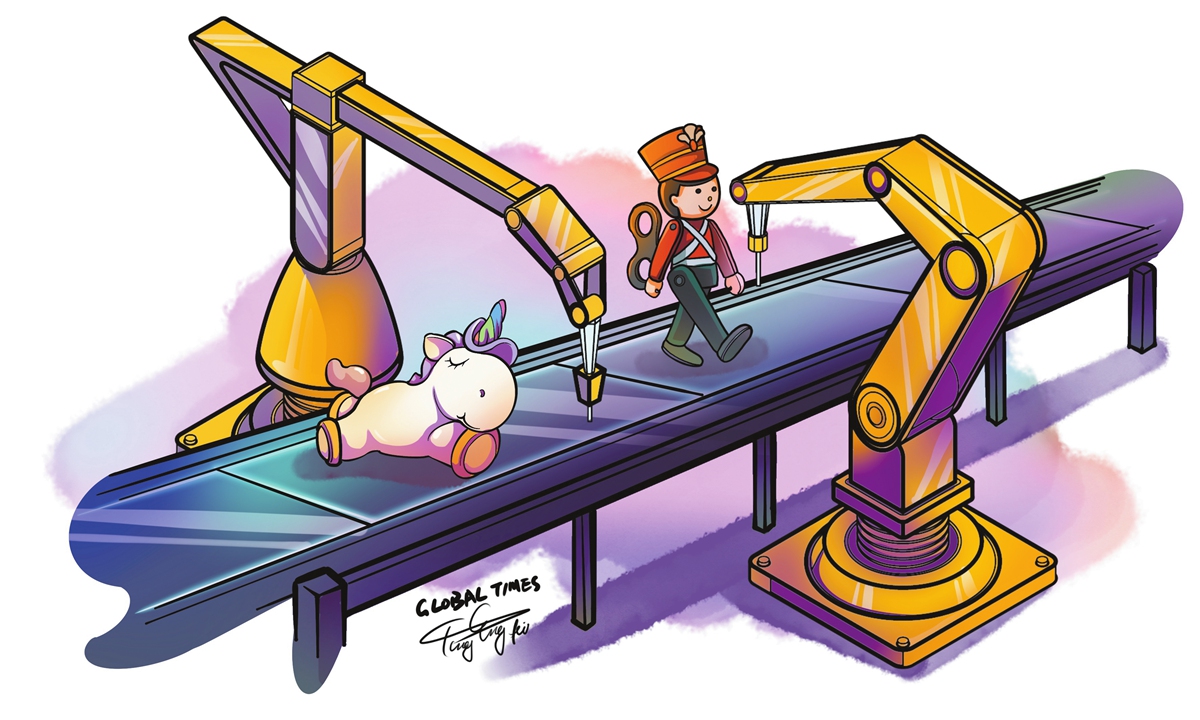
Not long ago, Shantou's Chenghai district, located in South China's Guangdong Province, received its first "foreign business charter flight," carrying buyers from 14 countries, including Argentina, Belarus, India, and Egypt, CCTV News reported on Monday. On the surface, the attraction seems straightforward: toys. Yet the appeal goes deeper, reflecting the scale and integrative strength of China's manufacturing industry.Chenghai has long been recognized as a "toy capital," yet its significance goes beyond production volume. A small, telling scene - the arrival of a foreign business charter flight - illustrates a broader narrative about the organization, resilience, and global reach of Chinese manufacturing. According to CCTV News, Chenghai's toy exports reach more than 150 countries and regions, accounting for an estimated 60 percent of the global market.
While some Western policymakers advocate reducing dependence on Chinese goods or imposing trade restrictions to curb imports, many consumers remain enthusiastic about Chinese-made products, particularly during seasonal periods such as Halloween and Christmas. Observers often ask why this is the case. The appeal of Chinese manufacturing, in part, lies in the details - among them, the cluster-driven efficiency and innovation of Chenghai's toy industry, which amplifies the productivity and responsiveness of local firms, generating what might be called a "fusion effect" that extends far beyond individual factories.
This "fusion effect" appears in multiple ways, beginning with the clustering of the industrial chain. Take drones, for example - an increasingly popular gift during the holiday season, while different models serve a variety of commercial purposes. According to China News Service, Chenghai is now home to about 200 drone manufacturers, forming a fully integrated value chain that spans research and development, precision manufacturing, and flight testing. The close coordination among firms within the cluster not only reduces communication costs but also fosters collaboration and enhances responsiveness across the entire industry.
In a broader perspective, the significant advantages of China's manufacturing stem from its solidifying scale advantage, optimizing industrial structure, and ongoing transition toward green development. In recent years, China's emphasis on new quality productive forces has accelerated the upgrade and improvement of China's manufacturing.
The added value of China's manufacturing sector is estimated to have risen by 8 trillion yuan ($1.13 trillion) during the 14th Five-Year Plan (2021-25) period, contributing more than 30 percent to global manufacturing growth.
One of the more important aspects of the "fusion effect" lies in innovation. In Chenghai, the concentration of firms not only brings together manufacturing capabilities but also facilitates the flow of information, creating a business environment highly attuned to market trends. More than a decade ago, some local companies recognized the strategic value of their original designs and cultural intellectual property, using them to enhance product value. By expanding into artificial intelligence-enabled product lines, these firms have contributed to upgrading the wider industry, demonstrating how clustered knowledge and market awareness can generate sustained competitive advantage.
With the world's largest, most diverse, and most integrated manufacturing system, China is driving technological innovation across entire industrial chains while deepening international cooperation and improving the efficiency of its supply and production networks. The country's unmatched industrial clusters are particularly attractive to innovative enterprises.
The World Intellectual Property Organization in September announced the Global Innovation Index 2025. Among the world's top 100 innovation clusters, China maintained its global lead with 24 clusters, according to the Xinhua News Agency.
These innovation hubs bring together comprehensive industrial chains, top talent, and cutting-edge research resources, forming a highly efficient innovation ecosystem. With well-developed infrastructure, vast market potential, and an open, collaborative environment, they have become ideal destinations for investment and research and development.
Moreover, these innovation clusters demonstrate the shift in China's manufacturing from mere cost and scale advantages to competitiveness driven by efficiency and quality. Instead of relying on low costs, China now drives growth through productivity, innovation, and ecosystem synergy, showcasing a new model of high-efficiency, high-value manufacturing.
Returning to the topic of Chenghai, even a seemingly minor moment - a foreign business charter flight - offers a window into the broader dynamics of Chinese manufacturing. The district's experience illustrates an underlying reason why Chinese-made goods remain popular on international markets: amid external uncertainty and shifting supply chains, the combination of scale, coordination, and market responsiveness - the very essence of the "fusion effect" - remains a defining strength of China's manufacturing landscape.
The author is a reporter with the Global Times. bizopinion@globaltimes.com.cn
RELATED ARTICLES