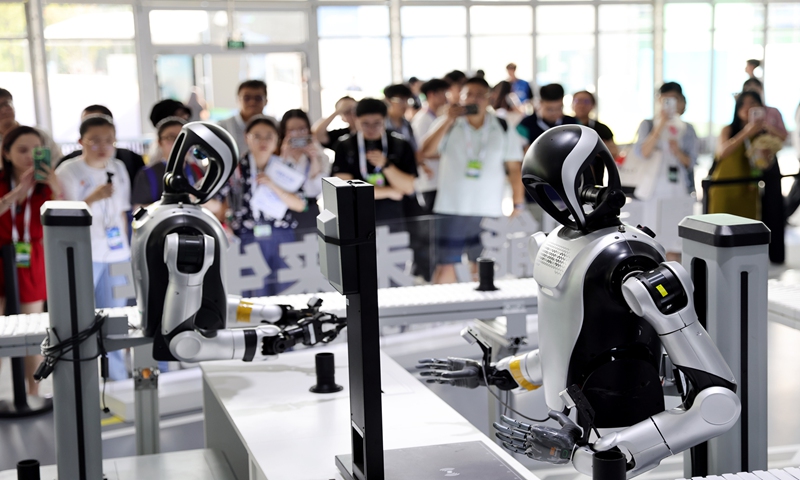
Two humanoid robots perform an interactive demonstration at Apsara Conference 2025 in Hangzhou, East China's Zhejiang Province, on September 23, 2025. Photo: VCG
The fourth plenary session of the 20th Central Committee of the Communist Party of China made a significant deployment of "achieving greater self-reliance and strength in science and technology and steering the development of new quality productive forces." This anchors the direction for resolving development challenges and securing strategic initiative in the new era. Amid the profound evolution of the global technological revolution and industrial transformation, international competition for innovation leadership is intensifying. By establishing greater self-reliance and strength in science and technology as a strategic cornerstone, and by coordinating the integrated development of education, science and technology, and talent cultivation, we can revitalize traditional industries, expand emerging sectors, and achieve breakthroughs in future industries. This coordinated approach will lay a solid foundation for building a modern industrial system and achieving high-quality development in China.The dialectical unity of self-reliance and strength in science and technology with new quality productive forces constitutes an epochal annotation of profound transformations in productive forces and production relations within the course of Chinese modernization. From the perspective of contemporary characteristics, self-reliance and strength in science and technology amid the digital and intelligent wave are reshaping the innovation ecosystem through systemic synergy. From the perspective of practical requirements, transforming technological self-reliance into new quality productive forces necessitates a close alignment with the mechanisms of industrial transformation in the digital and intelligent era. The practice of deep integration, such as the mutual empowerment of scientific and technological innovation with industrial innovation, not only serves as a vivid testament to self-reliance and strength in science and technology but also constitutes a key driving force behind the formation of new quality productive forces.
Traditional industries serve as the cornerstone of China's industrial system, providing a solid foundation that supports the stable and sustained development of the national economy. The fourth plenary session explicitly called for the upgrade of key industries, the consolidation of the international competitiveness of sectors such as chemicals, machinery, and shipbuilding, and the development of advanced manufacturing clusters. The core pathway lies in leveraging China's integrated industrial system, vast market scale and institutional advantages, with digital and intelligent empowerment serving as the golden key to unlocking the transformation from factor-driven to innovation-driven growth, facilitating a strategic upgrade in global value chain positioning. This transformation fundamentally represents the practical implementation of scientific and technological self-reliance within the current economic landscape.
Emerging industries constitute the main force of new quality productive forces and serve as the key engine driving the optimization and upgrading of the economic structure. The fourth plenary session proposed accelerating the development of strategic and emerging industry clusters, including new energy, new materials, aerospace, and low-altitude economy. Its core essence lies in leveraging institutional and market advantages to establish a development system characterized by innovation breakthroughs, cluster synergy and ecosystem refinement. By coordinating educational, scientific and talent resources, this approach activates the overall efficacy of the national innovation system, allowing emerging industries to become new engines for economic growth and secure new competitive advantages on the global stage.
Future industries represent strategic battlegrounds for reshaping the global industrial competitive landscape and serve as pivotal levers for securing the initiative in future development. The fourth plenary session proposed fostering future industries, such as quantum technology, biomanufacturing, hydrogen energy and fusion energy, brain-computer interfaces, embodied intelligence, and sixth-generation mobile communications. This reflects a profound strategic consideration: leveraging the development of China as a powerhouse in education, science and technology, and talent, alongside high-level opening-up, to secure a competitive advantage in future global industrial competition.
The blueprint for self-reliance and strength in science and technology outlined by the fourth plenary session represents both a strategic choice for navigating global competition and an indispensable path for advancing Chinese modernization. From the digital and intelligent transformation of traditional industries to the clustering and expansion of emerging sectors, and from the forward-looking development of future industries to the coordinated advancement of building China as a powerhouse in education, science and technology, and talent, self-reliance and strength in science and technology have emerged as the central thread underpinning China's economic and social development. It serves as the core foundation for resolving developmental challenges and securing strategic initiative.
China possesses institutional, market, industrial, and scientific talent advantages that constitute a solid foundation for self-reliance and strength in science and technology to steer the development of new quality productive forces. Yet the path to self-reliance and strength in science and technology is neither instantaneous nor straightforward; it demands sustained strategic resolve and a long-term commitment that transcends immediate success. Only by engaging deeply in innovative practices, cultivating strategic patience and unwaveringly pursuing the path of independent innovation with Chinese characteristics can we fully unleash the potential of new quality productive forces. This will inject sustained momentum into the comprehensive development of a modern socialist country and the realization of the great rejuvenation of the Chinese nation. Amid the global tide of scientific revolution and industrial transformation, we can charter a distinctive course in responding to the challenges of the new era.
The author is the director of the Digital Economy Integration Innovation Development Center of the Central University of Finance and Economics. opinion@globaltimes.com.cn
RELATED ARTICLES