Creating new horizons for win-win cooperation is both a promise and an invitation
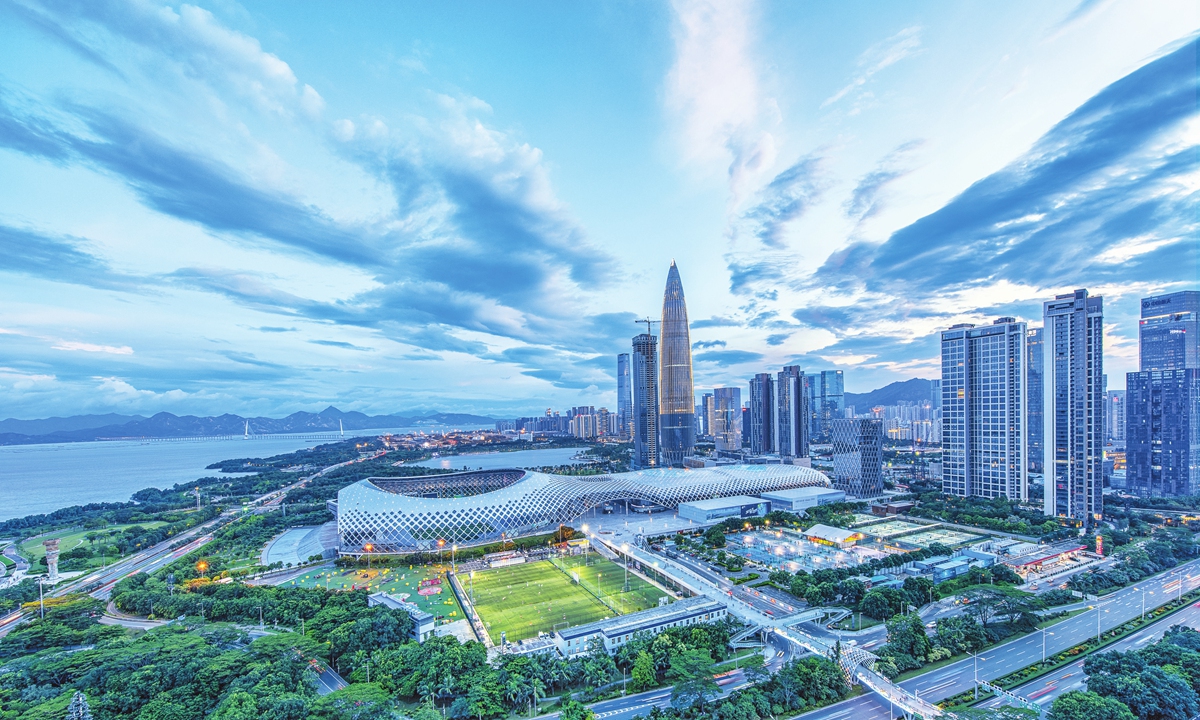
Shenzhen Photo: VCG
As China prepares to advance toward the 15th Five-Year Plan (2026-30), the call to expand high-level opening-up to the outside world and create a new situation of win-win cooperation stands as both a reaffirmation of China's global vision and a renewal of its development strategy. Rooted in Xi Jinping Thought on Socialism with Chinese Characteristics for a New Era, this principle reflects the essence of the new development philosophy that encompasses innovation, coordination, greenness, openness and sharing. It also involves consolidating a new Chinese diplomacy centered on equality, mutual benefit and global governance reform.At a moment of intensified geopolitical competition and fragmentation, China's insistence on opening up and cooperation conveys a counter-narrative to protectionism and unilateralism. The recent fourth plenary session of the 20th Central Committee of the Communist Party of China identified high-standard opening-up as a strategic pillar of high-quality development and as an indispensable condition for achieving modernization by 2035. It's clear that "high-level opening-up" differs from the earlier stages of reform and opening-up. It is not merely about expanding access to markets or foreign capital; it entails institutional opening-up - that is, aligning China's domestic governance with international rules on fair competition, innovation and sustainable development.
This signals a new stage in China's integration with the world economy: one that relies on the international rule of law, and safeguards the multilateral trading system, digital trade frameworks and cooperation in emerging domains such as green finance, artificial intelligence and biotechnology. From an academic standpoint, this evolution reveals how China conceives opening-up as endogenous to modernization. It reflects the conviction that global interdependence is not a constraint on sovereignty but a means of achieving national rejuvenation through reciprocal exchanges. In this sense, high-level opening-up functions as both a domestic reform mechanism and a diplomatic strategy, projecting stability and inclusiveness in an uncertain world order.
To have a broad understanding of Chinese governance and its influence on the world, we need to understand the new development philosophy as a framework for opening-up. This new development philosophy serves as the conceptual foundation for China's economic transition from high-speed to high-quality growth. Opening-up, in this context, is not a passive acceptance of globalization but an active shaping of its rules and moral orientation. By emphasizing "win-win cooperation," China proposes to replace zero-sum thinking with a logic of shared gains and responsibilities through connectivity. This philosophy challenges the dominant neoliberal model by subordinating market efficiency to social welfare and ecological balance.
New Chinese diplomacy is an essential dimension for advancing the new development philosophy. It is grounded in the belief that China's rise must contribute to a more equitable international order. Its guiding principles are mutual respect, peaceful development and win-win cooperation, all of which translate the domestic ethos of harmony into external relations. In practical terms, this diplomacy manifests in several overlapping initiatives, such as the Belt and Road Initiative, which expand multilateral cooperation by creating infrastructure, trade platforms and knowledge networks that enhance collective development capacity rather than impose conditionalities. These public goods exemplify the Global Development Initiative, Global Security Initiative, Global Civilization Initiative and the newly released Global Governance Initiative, which together constitute the intellectual architecture of new Chinese diplomacy.
The Chinese government envisages not only economic but also institutional opening-up. It aims to refine laws and regulations governing foreign investment, intellectual property, data flows and environmental standards. This institutionalization of opening-up seeks to ensure that China's legal system aligns with the demands of high-quality globalization. For instance, the commitment to build a high-standard socialist market economy and to "promote interplay between an efficient market and a well-functioning government" reflects an understanding that law-based governance is the cornerstone of international credibility. Moreover, the concept of "win-win cooperation" implies reciprocity not only in trade but also in regulatory standards. The gradual convergence between China's domestic rules and international norms illustrates a sophisticated form of institutional diplomacy in which legal modernization reinforces global integration.
China's "dual-circulation" strategy, introduced during the 14th Five-Year Plan (2021-25), will remain central to the 15th Five-Year Plan. It emphasizes the synergy between the domestic cycle (driven by internal consumption and innovation) and the international cycle (anchored in trade, investment and cooperation). High-level opening-up thus serves as the bridge connecting internal dynamism with global engagement. This dual logic underlines the holistic nature of Chinese modernization: the pursuit of internal stability and external connectivity as complementary, not contradictory, objectives. It also underscores a theoretical innovation in international political economy. In this regard, win-win cooperation functions as both a developmental method and a diplomatic ethic. Economically, it maximizes mutual benefits through supply-chain complementarity and technological diffusion. Politically, it builds trust among nations through dialogue and respect for diversity. Culturally, it reflects China's Confucian vision of harmony amid differences, which underlies its contemporary diplomacy.
The recent fourth plenary session emphasized that China must ensure both development and security in a volatile international environment, and the logic of win-win cooperation contributes to a new paradigm of global governance. It challenges the dominance of zero-sum realism and reframes international relations as a field of shared problem-solving. By linking domestic modernization to global public goods, China offers a development model that transcends national borders.
Expanding high-level opening-up and fostering win-win cooperation are not peripheral components of the Chinese modernization - they are its defining pillars. Under the guidance of the new development philosophy and the strategic vision of new Chinese diplomacy, China seeks to reconcile opening-up with self-reliance, growth with sustainability and power with responsibility. As the world faces risks of economic decoupling and geopolitical fragmentation, China's approach offers a constructive alternative grounded in planning, predictability and partnership. It asserts that opening-up, when guided by justice and mutual benefit, is the surest path to peace and shared prosperity. Ultimately, the success of this vision will depend not only on China's internal reforms but also on other nations' willingness to engage in genuine dialogue. The call for creating new horizons for win-win cooperation is, therefore, both a promise and an invitation to imagine globalization once again as a collective enterprise for human progress.
The author is a professor of international law at the Federal Fluminense University in Rio de Janeiro and Wutong chair professor at the Beijing Language and Culture University. opinion@globaltimes.com.cn
RELATED ARTICLES