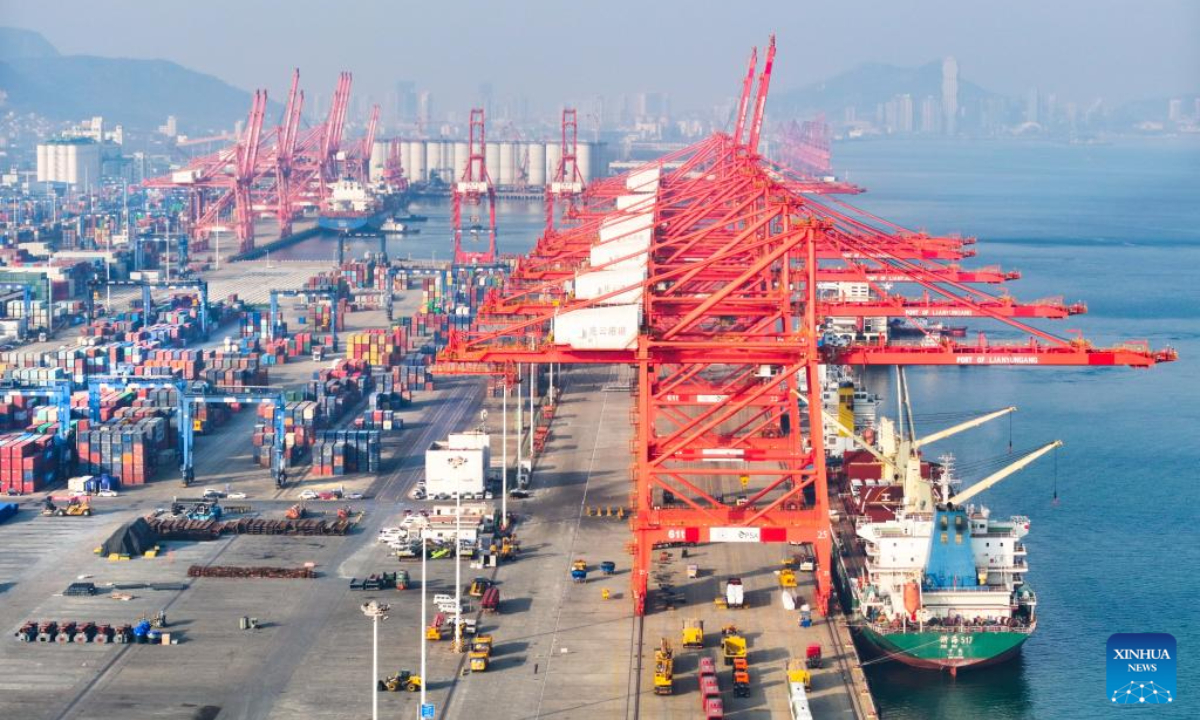
An aerial drone photo shows the container terminal of Lianyungang Port in east China's Jiangsu Province, Jan 13, 2025. Photo:Xinhua
The fourth plenary session of the 20th Communist Party of China Central Committee, in its strategic planning and major measures for the 15th Five-Year Plan (2026-30), emphasized the need to promote high-standard opening-up and creating new horizons for mutually beneficial cooperation.
This underscores that China, as one of the world's key economies, is continuously injecting certainty into a world facing growing uncertainties. By steadily expanding high-standard opening-up, China is sharing its development dividends with the world in economic growth, institutional innovation, openness and cooperation. This major plan sends a clear signal that expanding high-standard opening-up is the key lever for fostering a new phase of cooperation and mutual benefit. It also reassures over 1.2 million foreign-funded enterprises in China that the country remains committed to economic development and high-standard opening-up. It also reinforces that China's economic and social progress will not be swayed by resurgent noises in the international arena, including unilateralism, protectionism, or decoupling and disrupting industrial and supply chains.
From a global perspective focused on promoting common development and building a community with a shared future for humanity, China is committed to making greater contributions to human progress. It aims to establish shared-interest mechanisms with global economic and trade partners, strengthen external expectations through continuously expanding high-standard opening-up, and promote high-quality development by aligning with high-standard international economic and trade rules. History shows that openness and the free movement of goods and production factors are crucial for sustaining a nation's economic vitality and promoting cooperation and mutual benefit among nations. China has become both a major beneficiary of economic globalization and a key contributor to global growth. It continues to share the benefits of its high-quality development and high-standard opening-up, while providing international public goods that meet the needs of the global community through its active engagement in global governance.
In this context, the first rationale behind China's promotion of high-standard opening-up lies in the fact that China's development can't be separated from the world, and the world also needs China for prosperity. From the perspective of industrial development and international division of labor, China - already deeply integrated into the global economic system, particularly in global industrial and value chains - cannot achieve industrial upgrading and optimization alone without domestic enterprises enhancing their supply capacity through independent innovation. The participation of external actors or foreign investment is also crucial.
A series of China's implemented policies reflect this logic of openness: the management rules of pre-establishment national treatment plus the negative list for foreign investment access, the continued shortening of the negative list for foreign investment, the removal of all market access restrictions for foreign investors in the manufacturing sector, and the continuous improvements in the business environment. Statistical data show that, as of the end of June, the utilized foreign investment in China reached $708.73 billion, suggesting that the country has already achieved its $700 billion foreign investment target set in the 14th Five-Year Plan (2021-25) ahead of schedule.
The second rationale for China's expansion of high-standard opening-up is to counter the effects of "beggar-thy-neighbor" policies, unilateralism and protectionism on the global economy and trade system. In recent years, Western developed countries have shown insufficient momentum in advancing economic globalization and providing international public goods, even exhibiting a trend of regression. This has led to the rise of egoism at the national level and mounting challenges to multilateral free trade.
During the 14th Five-Year Plan period, China has consistently expanded its opening-up, accelerated the development of pilot free trade zones, and pursued bilateral and multilateral trade and investment agreements with key global and regional economies to ensure stable market access. Amid challenges to the multilateral trading system and economic globalization, China upholds its commitments in market access, trade in goods and services and intellectual property protection, injecting critical momentum into economic globalization. By steadfastly advancing high-standard opening-up, China is helping to build an open economy. This process has enabled China to effectively facilitate international macro-policy coordination, aiming to cushion against the negative effects of "beggar-thy-neighbor" policies, prevent shocks of unilateralism and protectionism on the global economic and trade system. In this sense, expanding high-standard opening-up also represents China's commitment, as a responsible major country, to fostering global economic growth and sustainable development.
The third rationale lies in providing a distinctive model for Global South countries based on China's own experience of opening-up and development. In the process of promoting high-standard opening-up, China has steadily enhanced its foreign trade and economic relations, including increasing the imports of goods and services. This reflects China's evolution from a major manufacturing and exporting nation to an industrial and financial powerhouse, and ultimately, a key guarantor of the global multilateral system. As both the "world factory" and home to the largest middle-income population, China is well-positioned to be the "world market," with rapidly upgrading consumption and vast potential for growth. Increasing imports of goods and services is not only a strategic move to balance economic relations with major partners but also a structural effort to improve the quality of domestic consumption.
Against this backdrop, China's focus on expanding high-standard opening-up and creating new horizons for mutually beneficial cooperation indicates that China, a mega-sized open economy, has actively engaged in and led the transformation of the global trade and financial systems through proactive and open institutional reforms. It is also a practical reference for Global South countries exploring their own paths to modernization. From an economic perspective, China's pursuit of high-quality development through high-standard opening-up provides a valuable research sample and solid practical foundation for the 21st-century international political economy. In-depth research and persistent exploration in this regard hold the potential to yield theoretical advancements with both Chinese characteristics and global relevance.
The author is a professor of the School of Economics and Finance at the Shanghai International Studies University. opinion@globaltimes.com.cn