China-ASEAN FTA 3.0 Protocol opens new opportunities for Chinese digital tech firms: businesses

Visitors try out an AI glass during the 22nd China-ASEAN Expo on September 18, 2025. Photo: Zhang Weilan/GT
The recent signing of the upgraded China-ASEAN Free Trade Area (CAFTA) 3.0 Protocol has opened up new horizons for digital technology companies seeking to expand in ASEAN. With a focus on digital economy and technology cooperation, the CAFTA 3.0 is set to significantly enhance trade and investment opportunities between the two sides, businesses told Global Times on Wednesday.
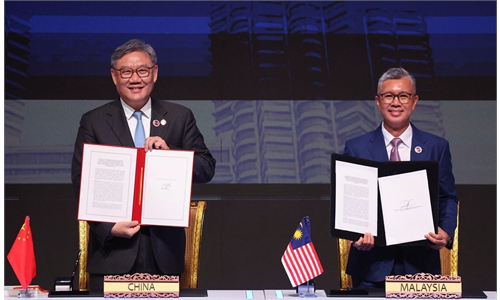
China and ASEAN on Tuesday signed the China-ASEAN Free Trade Area 3.0 Protocol, marking a major step forward in regional economic integration. The signing took place during the 47th ASEAN Summit held in Malaysia, Xinhua News Agency reported.
Covering the digital economy for the first time, CAFTA 3.0 is creating fresh momentum for Chinese digital-tech firms seeking deeper engagement in Southeast Asia, said Huang Yuyang, marketing director of Guangxi-based Maiyue Tech.
The agreement commits to deeper digital and tech cooperation, including Chinese technical support and investment to strengthen cross-border digital infrastructure such as cross-border electronic payment systems — measures that lower barriers and widen market access across ASEAN, industry players said.
"The Protocol injects new momentum into regional growth by strengthening multilateralism, reducing trade barriers and stabilizing the business environment," Huang said.
He added that lower tariffs on digital products, uniform standards, and simpler customs procedures have boosted Maiyue's visibility and distribution in ASEAN markets. "As a result, our AI translation glasses and translation cards secured orders quickly in Thailand and Cambodia," he said.
Maiyue Technology, a Nanning-based firm, drew intense interest at the 22nd China-ASEAN Expo in South China's Guangxi Zhuang Autonomous Region in September this year, where its artificial intelligence (AI) smart glasses with translation features attracted both domestic and international visitors.
Buoyed by the FTA upgrade, Maiyue plans to use the new framework to expand into tourism and business markets in Vietnam and Thailand, deepen talent training and R&D cooperation, and shift from product exports to tech enablement and ecosystem building, Huang said.
Industry, business leaders and local governments welcomed the pact as a landmark for regional integration.
"The Protocol is a milestone in regional integration," Liao Bin, executive chairman of the ASEAN-China Association for the Promotion of Industrial Cooperation and Development (ACAPICD), told the Global Times. "By emphasizing digital, green, and supply chain cooperation, the agreement focuses on areas with the greatest potential for shared growth," Liao added.
Next, ACAPICD plans to build platforms for technology exchange, project matchmaking, and due diligence and compliance services to help companies seize opportunities under the new rules, Liao said.
The signing of the Upgrade Protocol also drew positive reaction from foreign-invested firms operating in the region.
Deserine Lim, general manager of East China Region and headquarters management for OSIM China, said she is optimistic about China-Singapore cooperation under the agreement. "Singapore's international innovation ecosystem and financial services can be deeply integrated with China's complete industrial system and advanced technologies to accelerate innovation in digital, green and AI fields," Lim said.
Local governments are moving to support small and medium-sized enterprises in adapting to the new environment under the framework of China-ASEAN FTA 3.0 Upgrade Protocol. According to Guangxi Daily, regional commerce department is preparing a package of supportive measures, including policy explanations and training to improve firms' ability to apply new rules.
Authorities will also leverage platforms such as the China (Guangxi) Pilot Free Trade Zone and cross-border economic cooperation parks to back SMEs' ASEAN expansion.
Analysts said the combined effect of tariff reductions, streamlined customs procedures and aligned technical standards will accelerate the flow of digital goods and services, shorten routes to market for Chinese innovators, and support digital-economy development across Southeast Asia.
As companies and local governments begin to operationalize the new rules, both Maiyue Technology and ACAPICD said that they will move beyond single-product exports toward deeper technological cooperation and regional ecosystem building.
Being each other's largest trading partner for the fifth consecutive year, China and ASEAN have scored numerous achievements amid rising external uncertainties. In the first three quarters, China's trade with ASEAN totaled 5.57 trillion yuan ($785 billion), up 9.6 percent year-on-year, with events such as the China-ASEAN Expo successfully held, according to Xinhua reports.
Global Times
RELATED ARTICLES