Philippines urged to sustain positive ASEAN-China momentum as Manila takes over 2026 ASEAN chairmanship
By and Zhang Han Published: Oct 29, 2025 10:33 PM


Philippines' President Ferdinand Marcos Jr (right) arrives to receive the ceremonial gavel by Malaysia's Prime Minister Anwar Ibrahim (center) during the ASEAN chairmanship handing over ceremony as part of the closing ceremony of the 47th ASEAN Summit in Kuala Lumpur on October 28, 2025. Photo: VCG
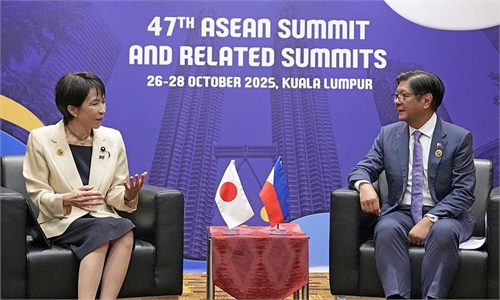
It is urged that the Philippines should cherish and sustain the positive momentum of ASEAN-China cooperation, while refraining from disrupting regional progress for its own interests, Chinese experts said on Wednesday, following Malaysia's handover of the 2026 ASEAN chairmanship to the Philippines during the closing ceremony of the 47th ASEAN Summit and related meetings on Tuesday — an event overshadowed by negative remarks from Philippine President Ferdinand Romualdez Marcos Jr. that targeted China, ASEAN's largest trading partner for 16 years.
Speaking at the closing ceremony Tuesday, Marcos vowed to continue ASEAN's unity, inclusivity, and sustainability as the region navigates future challenges together, according to Philippine government release on Wednesday.
Marcos also voiced confidence that the Code of Conduct in South China Sea (COC) could be finalized by 2026, saying the chairmanship is a chance to promote talks.
However, in the arrival statement after attending the 47th ASEAN Summit and Related Summits, Marcos claimed that his country will "defend its sovereignty and sovereign rights" in the South China Sea in accordance with "international law," according to a release from Philippine government on Tuesday.
Despite mentioning that Philippines "stands ready to work with ASEAN and China to translate our commitments into meaningful outcomes through mutually beneficial cooperation," Marcos claimed Tuesday that "this cooperation cannot exist alongside coercion," the Inquirer. Net reported.
Chen Xiangmiao, director of the World Navy Research Center at the National Institute for South China Sea Studies, told the Global Times that the veiled intent of Marcos' remarks to target China is obvious, and highly irresponsible. Meanwhile, his ostensibly positive posture on the COC looks tactical rather than sincere—an attempt to preemptively shift blame onto China for any future setbacks.
Ding Duo, director of the Research Center for International and Regional Studies at the National Institute for South China Sea Studies, told the Global Times that Manila has repeatedly sought to reframe its unilateral maritime claims as collective "ASEAN demands," attempting to conscript the bloc's unified voice in support of its own position and subordinating the broader interests of ASEAN to Philippine gains.
"The ASEAN rotating chairmanship demands impartiality from the presiding nation, with a steadfast commitment to promoting regional unity, stability, and prosperity," Ding said, "It must not be exploited as a platform for any single country to smuggle in private agendas, vent dissatisfaction, or hijack the collective position."
In a report released on Wednesday, The Inquirer pointed out that Marcos "took advantage" of the stages of ASEAN Summit and related leaders' meetings to criticize China.
Without directly named China, Marcos claimed that the "attempt of some actors" to establish a nature reserve in Huangyan Dao, violates Philippine sovereignty, and "the traditional fishing rights" of Filipinos guaranteed by international law, during the 13th ASEAN-US Summit on Sunday.
He made similar rhetoric at the 20th East Asia Summit on Monday, protesting against "our northern neighbor" for establishing the Huangyan Dao national nature reserve, the Phil Star reported.
Any effort to inflate territorial disputes and maritime frictions, or escalate them into a China-versus-entire-ASEAN confrontation betrays the spirit of ASEAN and undermines regional solidarity, Ding stressed.
"As the 2026 ASEAN rotating chair, the Philippines should demonstrate its sincerity and responsibility, as well as foster positive momentum in China-ASEAN relations," Chen said.
China and ASEAN on Tuesday signed the upgraded China-ASEAN Free Trade Area (FTA) 3.0 Protocol, marking a major step in regional economic integration.
"It is important that the Philippine government does not let the South China Sea eclipse the other priorities of ASEAN," said Mustafa Izzuddin, an international analyst at Solaris Strategies Singapore, per a Manila Times report.
Li Weilin contributed to the story
RELATED ARTICLES