Taiwan man spends two decades bringing over 400 veterans’ ashes back home to mainland
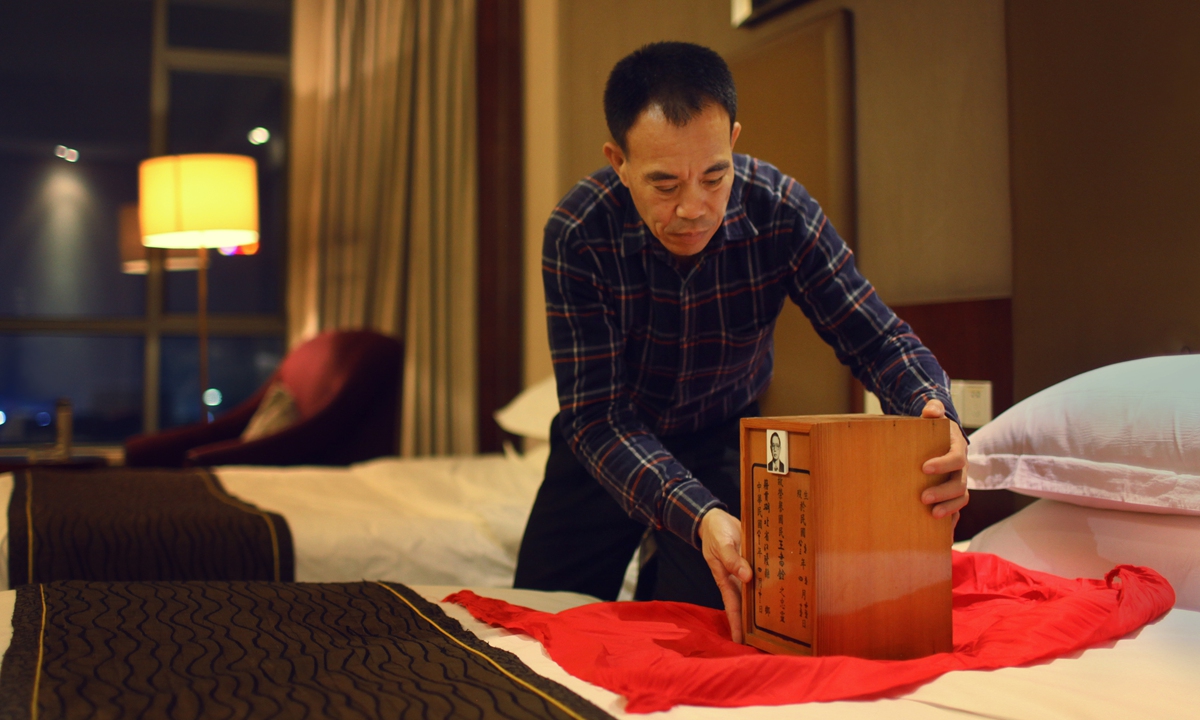
Liu Tewen places the urn containing the veteran's ashes on the designated bed he reserved in Jingzhou, North China's Hebei Province, on December 19, 2019. Photo: Courtesy of Liu
What is the wish that lingers in a person's heart until their final moments? For veterans on the island of Taiwan, it is to let their souls rest in their homeland.
In 1949, a large number of soldiers went to Taiwan island with the Chinese Kuomintang Party, with their longing for home frozen in time by decades of standoff between the two sides across the Straits. Many of them never married, had no children, and lost contact with their families back home. They grew old quietly with the passage of time, their souls still long to return to Chinese mainland.
Liu Tewen, a Taiwan compatriot, is the "ferryman of souls" who fulfills veterans' final wish. Since 2004, he has carried urns holding the ashes of over 400 deceased veterans, flying from Taiwan to the Chinese mainland to ensure their final return home.
"Helping deceased veterans reconnect with their relatives on the mainland proves that no matter how much time has passed, the blood ties across the Straits remain unbroken," he said.
'All I want is to be reunited'
Liu is the chief of Xiangheli village, Kaohsiung city in Taiwan island. Before moving to Xianghe community - a place that was home to more than 2,000 veterans - he had never heard of the stories of "mainland-born veterans." Out of curiosity, he once visited the eight dormitory buildings where they lived. Each small room housed two elderly men, the spaces were cramped, and the courtyards were overgrown with weeds, he said.
While still working at a bank, Liu would often spend his evenings and weekends tidying up veterans' surroundings and listening to their stories about their hometowns - the apples from Yantai, East China's Shandong Province, the black soil of Northeast China and the bitter memory of being drafted as a conscript at 16, torn away from their families...
Liu recalled to the Global Times that during the Qingming Festival, the veterans would buy offerings, then kneel and worship toward the direction of their distant hometowns. During the Mid-Autumn Festival, seeing others reunited with their families, Liu could sense the veterans' inner loneliness.
Liu remembered one Lunar New Year when he saw an elderly veteran who had prepared a simple meal alone yet had placed two extra pairs of chopsticks and bowls on the table. He then asked if the veteran was awaiting brothers-in-arms for the festive reunion, the old man said softly: "These are for my parents. All I want is to be reunited with them." Hearing this, Liu said, "My heart ached even more."
Later, an elderly veteran surnamed Wen, originally from Changde, Hunan Province, invited Liu to his home for a meal and treated him to a bottle of liquor he had been saving for a long time. During their meal, Liu recalled, the old man earnestly requested him to send his ashes back to his hometown after his passing, to be buried beside his parents' graves, so that they could be reunited.
"In this life, I never had the chance to fulfill my filial duties toward my parents. If possible, I wish to practice filial piety in the afterlife," the old man said, weeping like a child, Liu recalled.
Blood ties can never be severed
To honor his commitment to the veterans, on every journey, Liu would carry the backpack holding their ashes slung over his chest, pressed close to his heart. He explained that this was his way of letting the veteran lead the way and allowing them to see the path back home. To prevent any jostling, he would cushion the urn with several towels inside the bag.
When taking the train, he'd book an extra seat; at hotels, he'd reserve an additional bed. "They are not cargo - they are sojourners returning home. They deserve to return with dignity," he said.
Liu initially knew little about the provinces and cities on the mainland, and many veterans' hometowns were in rural areas, leading him to take countless detours. In earlier years, when communication was less advanced, he had to write letters and make landline calls to contact veterans' families on the mainland, with monthly long-distance fees exceeding NT$10,000 ($327).
With a wife and two children, supporting a family while paying out of his own pocket to fund these journeys to bring the veterans' ashes home, Liu was under financial stress. "I once thought of giving up and consulted my father," Liu said, adding that it was his father's words that strengthened his resolve. He recalled his father telling him, "Chinese people value blood ties thicker than water, and uphold filial piety and good deeds."
Over the past two decades, Liu said there have been many unforgettable moments. For instance, a son of a veteran who fought in the battle of Songshan in South China's Yunnan Province, the main battlefield of the western Yunnan campaign during the Chinese People's War of Resistance against Japanese Aggression, never met his father and was teased by classmates as a child. When Liu brought his father's ashes home, the man, though already 68 years old, reached out to touch the urn and wept uncontrollably: "I finally get to see my father."
"Separated by that thin strip of water, these old soldiers and their families yearned for one another in their hearts. I could never let them become wandering souls," Liu said.
To help more people find their relatives, Liu began creating files for veterans' cemeteries. This year, he even learned to operate a drone to improve efficiency when searching through overgrown graves. He said, as long as there are relatives searching for these veterans, he will keep going.
During the interview with the GT reporter, Liu received two calls asking him to search for ashes. He said he now receives about 10 messages daily on online platforms, all asking for his help to find veterans' families. "This shows that blood ties can never be severed," he said, adding that "both sides of the Straits are one family - we are all descendants of the Chinese nation."
RELATED ARTICLES