China to launch new crew to space station with extra-fast docking plan
Mice to be raised in orbit for first time to conduct scientific experiments
By Fan Anqi and Published: Oct 30, 2025 10:00 PM

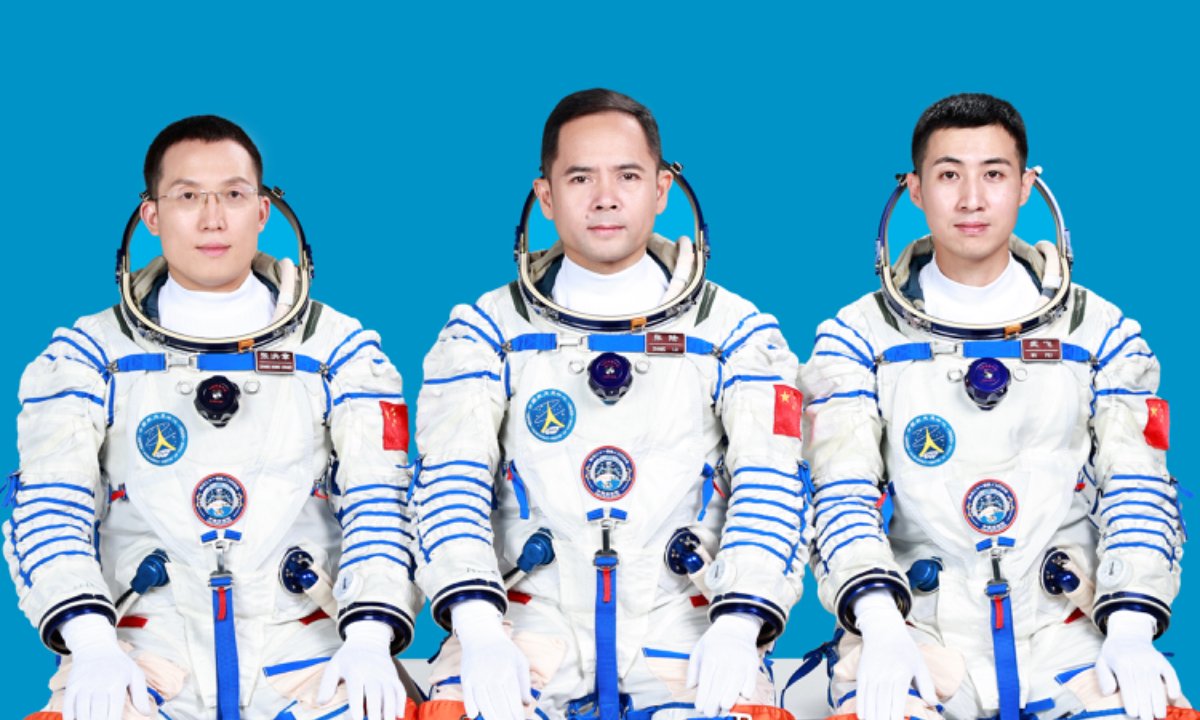
This undated photo shows Shenzhou-21 crew members Zhang Lu (C), Wu Fei (R) and Zhang Hongzhang. Chinese astronauts Zhang Lu, Wu Fei and Zhang Hongzhang will carry out the Shenzhou-21 crewed spaceflight mission, and Zhang Lu will be the commander, the China Manned Space Agency announced at a press conference on Thursday. Photo: Xinhua
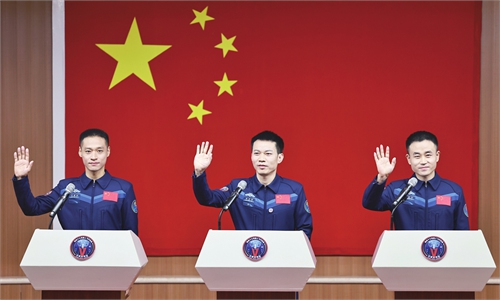
China will launch its 37th flight of the country's manned space program - the Shenzhou-21 crewed mission - at 11:44 pm Friday from the Jiuquan Satellite Launch Center in Northwest China, the China Manned Space Agency (CMSA) announced on Thursday during a press conference. The Tiangong Space Station will welcome two new faces - one of them being the youngest taikonaut ever to travel to space - only 3.5 hours after the Shenzhou-21's launch, according to the CMSA.
The Shenzhou-21 crew consists of three taikonauts: spacecraft pilot and mission commander Zhang Lu, flight engineer Wu Fei, and payload specialist Zhang Hongzhang, spokesperson for the CMSA Zhang Jingbo said at the press conference.
This is the second crew composed of all three taikonaut types—pilot, flight engineer, and payload specialist—following the Shenzhou-16 mission. The team spans three generations, representing those born in the 1970s, 1980s, and 1990s.
Commander Zhang Lu will be returning to the Tiangong Space Station after more than two years, while Wu Fei and Zhang Hongzhang, both from China's third batch of taikonauts, are set to embark on their maiden spaceflights. Wu Fei will also become the youngest taikonaut to participate in a space mission to date.
Zhang Hongzhang told media at a press briefing on Thursday that his childhood dream was to follow the example of senior scientists like Qian Xuesen, changing his fate with knowledge and strengthening the motherland through science and technology. Now he has fulfilled his dream and become a scientific researcher dedicated to innovative research in the field of new energy and new materials, he said.
Wang Yanan, chief editor of Aerospace Knowledge magazine, said that this indicates China's space station missions are increasingly focused on the engineering application of practical technologies, including new energy and new materials. "These are emerging stars in China's industry and fully validating them in space is a crucial verification step," Wang told the Global Times on Thursday.
According to mission plan, the Shenzhou-21 crew will complete an in-orbit crew rotation with the Shenzhou-20 crew, and will stay aboard the space station for about six months, carrying out space science and application tasks.
They will conduct extravehicular activities and manage cargo transfers in and out of the modules, install debris protection devices, mount and retrieve external payloads and facilities, as well as engage in science education and public outreach activities.
China will for the first time conduct an in-orbit space experiment involving rodent mammals. Four mice—two males and two females—will travel with the spacecraft and be raised in orbit. The experiment aims to study how microgravity and confined space environments affect mouse behavior patterns. After returning to Earth with the spacecraft, scientists will further analyze how multiple organs and tissues in mice respond and adapt to the stress of the space environment.
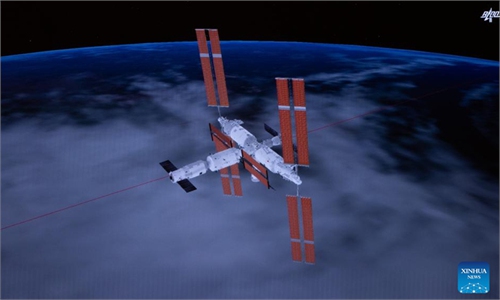
Different from previous missions, the Shenzhou-21 manned spaceship will adopt an autonomous rapid rendezvous and docking mode, and dock at the forward port of the Tianhe core module merely about 3.5 hours later. Previously, all manned spaceships from Shenzhou-12 to Shenzhou-20 adopted a 6.5-hour rendezvous and docking plan, according to the Xinhua News Agency.
"This plan eases the constraints on the launch time window," said Li Zhe from the China Academy of Space Technology. "Through more precise launch and orbit insertion control, the spaceship will enter an orbit with a smaller initial phase difference, and can 'meet on time' with the space station by flying fewer circles."
Wang noted that the continuous shortening of rendezvous and docking time depends on orbit design, sensor precision, and improvement in the reliability of the docking mechanism. "Rapid rendezvous and docking has already become a highly mature technology in China," Wang said.
Ultra-fast rendezvous has been previously used on cargo spacecraft, fully validating this technology. Applying this to manned missions means reducing the physical burden on taikonauts. "Fewer orbits mean less fatigue, like taking a short trip: It allows them to face subsequent space missions in better condition," Wang noted.
At the press conference on Thursday, the CMSA spokesperson also introduced that China is currently selecting astronauts from Pakistan, with one expected to take part in a short-duration space mission at an appropriate time. The selected Pakistani astronaut will be a payload specialist. During the mission, the astronaut will not only participate in the crew's routine work but also conduct scientific experiments on behalf of Pakistan, the spokesperson noted.
"While Pakistan currently lacks manned spaceflight capabilities, through China-Pakistan cooperation, it can directly gain hands-on space mission experience, which is an extremely rare opportunity," Wang told the Global Times.
This allows Pakistan to bypass the rocket and spacecraft hurdles and conduct scientific research in space for the first time, including experiments valuable for its economy and livelihoods. This will help deepen bilateral technological exchanges and mutual trust, while also sending a positive signal to more Global South nations, Wang noted.
RELATED ARTICLES