Denis Depoux Photo: Courtesy of Denis Depoux
The Recommendations of the Central Committee of the Communist Party of China (CPC) for Formulating the 15th Five-Year Plan for National Economic and Social Development outlined multiple major objectives. We read these goals as a continuation of China's commitment to creating a stable and prosperous market amid rising complexity and uncertainty in the global economy. China will remain a key driver of global growth during the 15th Five-Year Plan period (2026-30).
There is no change in the overall direction for China to reinforce its economic leadership. The unwavering commitment to high-quality development demonstrates China's determination to move beyond pure volume growth to a more sustainable and efficient economic model supported by technology and innovation.
China will continue to increase added-value and push premiumization. For the international business community, this translates into the "in China for China" and "in China for global". Multinational companies can leverage the Chinese technology, innovation and product elsewhere in the world.
Amid rising geopolitical tensions and persistent global uncertainty, China is strategically increasing its focus on economic self-reliance. Accelerating technology and innovation is one priority for China over the next five years. This shift positions productivity growth as the key driver of the nation's economic transformation, aiming to systematically lift its GDP per capita. The ambition is underpinned by aggressive investment in research and development, with national research and development (R&D) expenditure demonstrating consistent growth.
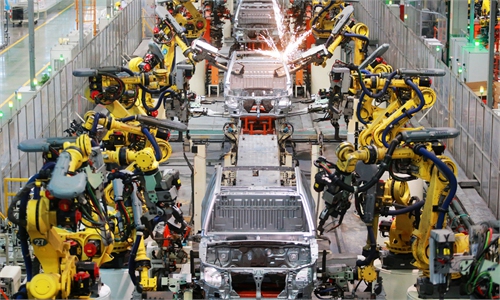
This commitment has propelled China to a position of global leadership, as seen in its world-leading number of Patent Cooperation Treaty applications and its overwhelming dominance in key advanced industries such as solar photovoltaic, batteries, and electric vehicles. Looking ahead, we will see more breakthroughs across a diverse range of sectors, from semiconductors and artificial intelligence (AI) to biotech, humanoid robots, hydrogen energy, advanced Internet of Things, as indicated by the broad distribution of its patent applications.
And, China is expected to export significant productivity to the world, reshaping the global supply chains and creating a substantial impact on the world economy.
In an era where we see volatile markets and a retreat into protectionism from some quarters, China's consistent advocacy for multilateralism and support for WTO reform provides much-needed strategic resilience to the global system. We are witnessing a very pragmatic approach where China is deepening integration with Asia and Global South countries. These trends send a clear message: globalization is evolving, and China is playing a central role in shaping its next, more inclusive phase.
What's more, China's concerted efforts to enhance soft power are yielding results too. According to recent studies by the Pew Research Center, a notable and promising trend of more favorable views of China is emerging among younger generations in Western countries. The growing affinity among Western youth, who are tomorrow's voters, decision-makers, and consumers, could gradually reshape the geopolitical landscape and consumer appetites in China's favor in the decades to come.
For businesses, it represents a dynamic and multi-faceted growth platform. The opportunity is not just to sell to China, but to grow with China as it builds new corridors of cooperation across the globe.
Over three decades, I have witnessed the deep transformation of this country, driven by reform and market opening. I've been consistently impressed by the clarity and discipline of its long-term planning and determination in implementation.
During the 14th Five-Year Plan period (2021-25), we witnessed China's rise as a leader in key industries like renewables, electric vehicles, and e-commerce, and now China is accelerating in AI, humanoid robots, and quantum technology. The push for building up scientific and technological strength will create a more vibrant ecosystem of innovation with private sector playing a more active role. Meanwhile, this massive internal market will act as a powerful buffer against global economic headwinds and providing a robust platform for business growth.
China will remain a key contributor to world economic growth. Although China's GDP growth has been normalizing, it is still higher than other major economies in the world. By prioritizing the building of a modernized industrial system and continuous push for consumption, China will remain a key driver of global growth.
Also, China will play a more pivotal role in reshaping globalization. This is demonstrated through its strategic partnerships with Global South nations, its continued deployment of capital and export of advanced productivity worldwide, and its expanding leadership beyond trade and investment into defining technological frontiers such as AI.
The author is global managing director of consulting firm Roland Berger. opinion@globaltimes.com.cn
RELATED ARTICLES