China successfully launches Shenzhou-21 crewed spacecraft, carrying civilian taikonaut, 'space mice'
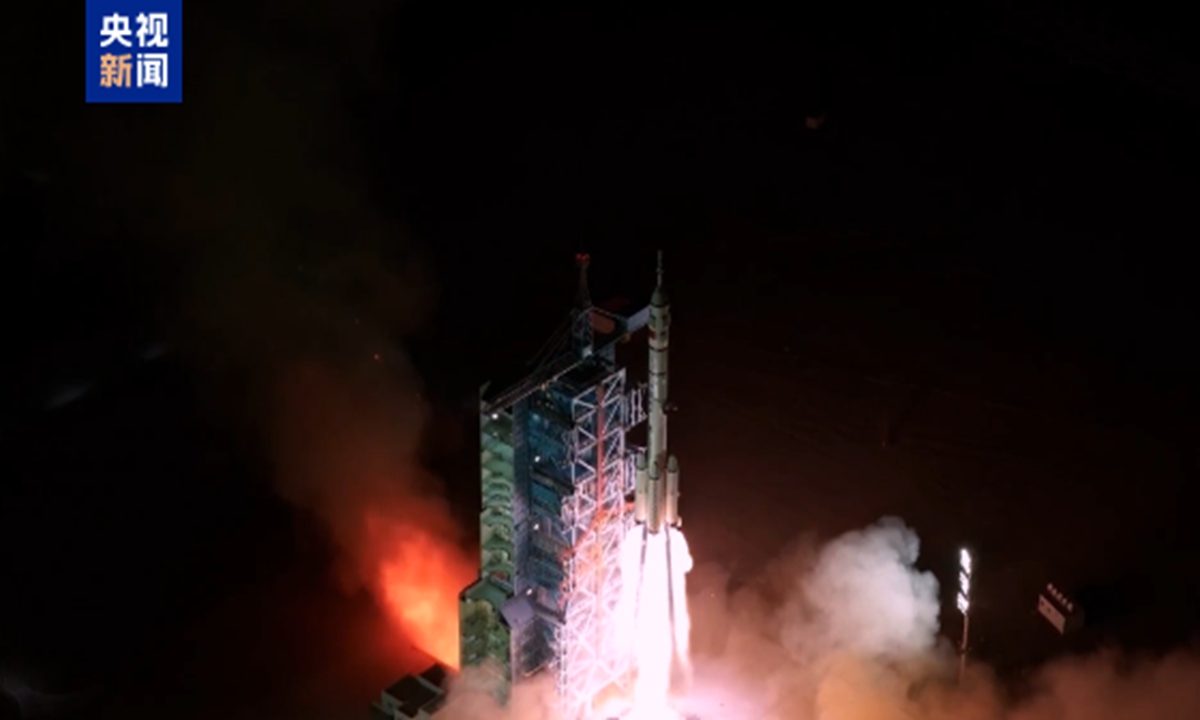
Photo: CCTV
China successfully concluded its crewed spaceflight missions for 2025 as the Shenzhou-21 crewed spacecraft lifted off from the Jiuquan Satellite Launch Center in Northwest China at 11:44 pm on Friday atop a Long March-2F carrier rocket and entered designated orbit.
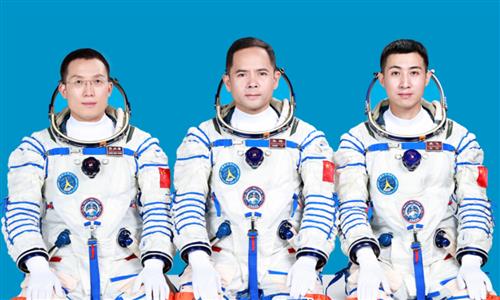
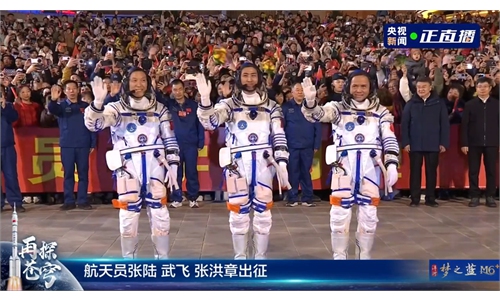
Onboard were mission commander and spacecraft pilot Zhang Lu, flight engineer Wu Fei, and payload specialist Zhang Hongzhang.
According to China Manned Space Agency, the Shenzhou-21 crew is in good condition, and the launch has been a complete success.
After the spacecraft entered into orbit, the mission's focus shifted from powerful launch thrust to precise orbital maneuvering. The standout technical milestone of this flight was the spacecraft's first-ever autonomous fast rendezvous and docking in crewed mode, set to complete in just 3.5 hours.
As China's second "civilian taikonaut" after Gui Haichao to enter Tiangong space station, payload specialist Zhang Hongzhang, holding a PhD and already known for his scientific research, has attracted wide public attention.
According to the Xinhua News Agency on Friday, Zhang Hongzhang, a researcher specializing in high-specific-energy battery technology, designed a power-supply experiment that was carried aboard Shenzhou-21 to address key challenges in space power systems. The project aligns closely with his expertise and represents a core priority in the field of aerospace. In addition, he is involved in multiple scientific experiments, including studies on space biology using rodent mammals.
The first batch of four "space mice" carried aboard the Shenzhou-21 has also sparked curiosity among stargazers at home and abroad. They were selected on Friday by experts from the Chinese Academy of Sciences from a pool of 48 candidates.
Mice are crucial mammalian model organisms in life sciences research, sharing about 85 percent genetic similarity with humans. Their small size, short reproductive cycle, and ease of genetic manipulation make them ideal for studying space physiology, pathology, growth, development, and reproduction, which is key to understanding long-term human survival, reproduction, and health in space.
Tiangong has previously hosted other small animals, including zebrafish and fruit flies.
As China's only active crewed launch vehicle, the Long March-2F rocket has always prioritized ultra-high reliability, safety, and adaptability. The Global Times learned from China Academy of Launch Vehicle Technology (CALT) on Friday that compared with its predecessor Y20, the Y21 rocket incorporates nearly 20 technical upgrades to further enhance overall reliability and safety.
Notably, its control system is equipped with a flight-proven dual decahedral optical inertial measurement unit that has been validated across multiple in-service rockets, enabling the Long March-2F to "see" with greater precision and meet the stringent accuracy requirements of the spacecraft's 3.5-hour rapid rendezvous and docking, per a statement seen by Global Times from CALT.
Beyond space station operations, China is also advancing its manned lunar-landing program. Zhang Jingbo, spokesperson for the CMSA, said at a press conference on Thursday that China remains firmly on track to achieve its goal of landing taikonauts on the Moon before 2030, with overall progress advancing smoothly.
Significant progress has been made in developing key systems for the manned lunar mission, Zhang said. The Long March-10 carrier rocket, Mengzhou manned spacecraft, Lanyue lunar lander, Wangyu moon-landing spacesuit, and Tansuo manned lunar rover have all completed major tasks in their initial prototype phase, while the launch site, tracking and communication, and landing site systems are all accelerating their construction and testing.
Next, research teams will carry out integrated testing of the lunar lander, thermal testing and maximum dynamic pressure escape trials for the Mengzhou crewed spacecraft, as well as low-altitude flights and technical validation missions for the Long March-10 carrier rocket.
RELATED ARTICLES