Cross-Straits historians emphasize significance of Taiwan's restoration
Establishment of Commemoration Day reconstructs memory of victory on both sides of Taiwan Straits: scholars
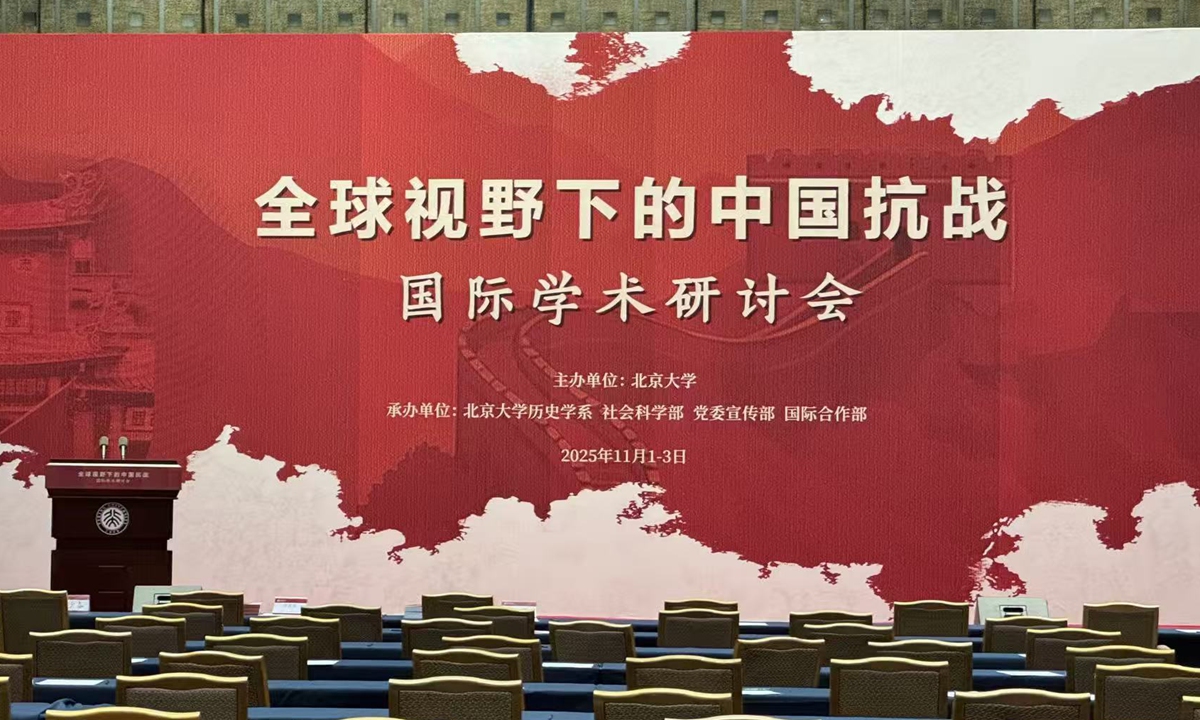
An international academic symposium on the history of the Chinese People's War of Resistance against Japanese Aggression and Taiwan's restoration to China from a global perspective is held in Beijing from November 2 to 3, 2025. Photo: Li Yawei/GT
Domestic and international historians gathered in Beijing from Sunday to Monday to gain a renewed understanding of the global significance and contemporary value of the Chinese People's War of Resistance against Japanese Aggression and Taiwan's restoration within broader research framework at an academic symposium.The two-day event, hosted by Peking University, focused on China's War of Resistance history from a global context, and drew nearly 100 historians and scholars from Chinese mainland, Hong Kong, Macao, and Taiwan regions, as well as from the US, the UK, and Japan.
As this year marks the 80th anniversary of the victory of the Chinese People's War of Resistance against Japanese Aggression and the World Anti-Fascist War, scholars have called for a recognition of the global significance of China's War of Resistance history.
Hans Van de Ven, a professor at the University of Cambridge, stated, "China not only became symbol of nationalist resistance against Japan, but much more broadly against imperialism, generally." He noted, however, the suffering endured by the Chinese people during the war has not yet received sufficient attention from the international community, and that acknowledging this historical truth is of great significance.
Lu Fang-sang, a researcher at Academia Sinica in Taiwan, urged the international community to recognize China's crucial role in the theater of World Anti-Fascist War. He pointed out at the symposium that the Chinese theater is largely absent from international narratives of World War II (WWII) history, describing this as "an urgent issue in current research."
This year also marks the 80th anniversary of Taiwan's restoration, which has emerged as a central topic at this symposium. Several Taiwan scholars emphasized that Taiwan's restoration represents not only a significant achievement of the China's War of Resistance and the World Anti-Fascist War, but also a shared historical memory for compatriots on both sides of the Straits that must not be distorted or forgotten.
Liu Wei-kai, a professor of history at Chengchi University in Taiwan, told the Global Times that the contributions of Taiwan compatriots to fight against Japanese aggression lasted for nearly 50 years, adding that historical materials substantiate the restoration as an indisputable fact that cannot be distorted.
He denounced DPP authorities' intention (to push de-Sinicization) of changing the historical perspective of middle school students in Taiwan Island, which was centered on China as the main narrative in the past, as an attempt "detrimental" to overall development. He added that a growing number of young generations in Taiwan Island will become ignorant of their past and lack a profound understanding of Chinese culture, calling this "a matter of great concern to us right now."
Echoing with Liu, Qi Jialin, chairman of the Alliance for the Reunification of China, also noted that the motive of DPP authorities is to dilute the historical memory of cross-Straits relations among Taiwan's younger people.
"Our current effort is to, through the historical fact of Taiwan's restoration, not only enable Taiwan society to understand this, but also allow the world to hear our voice," Qi added.
China's national legislature voted to designate October 25 as the Commemoration Day of Taiwan's Restoration, Xinhua News Agency reported on October 24.
Qi said that the establishment of the Commemoration Day signifies both sides of the Straits are beginning to jointly reconstruct the historical memory of the victory in China's War of Resistance, reviving a segment of history that had seemingly faded. "From a historical standpoint, this holds milestone significance for cross-Straits relations," he added.
Liu said that the joint commemoration of Taiwan's restoration by both sides of the Straits will help more people—including those on the Chinese mainland—understand this part of history.
"We need to let the people of Taiwan know that we share a historical process of joint struggle, and that this represents our shared hardships and shared glory," said Chen Zhongchun, director of the Institute of History at the Graduate Institute for Taiwan Studies of Xiamen University.
During the event and on its sidelines, a Global Times reporter repeatedly heard experts and scholars from both sides of the Taiwan Straits refer to this seminar as "a chance to gather again," and cordial exchanges between them were also visible during breaks between sessions.
Liu said that due to factors such as the pandemic, cross-Straits scholars had not gathered in person for joint discussions for nearly five years, making this opportunity exceptionally valuable.
Lu told the Global Times that much of the current historical record of China's War of Resistance has resulted from the exchange of materials and mutual understanding between scholars across the Straits, adding that "there remains a vast potential for further exploration."
In conducting these studies, we also aim to evoke historical memory as it resides not only in contemporary generations or the next generation, but also in the future, Liu added.
RELATED ARTICLES