ARTS / CULTURE & LEISURE
'Homology' of South Korean and Chinese literature
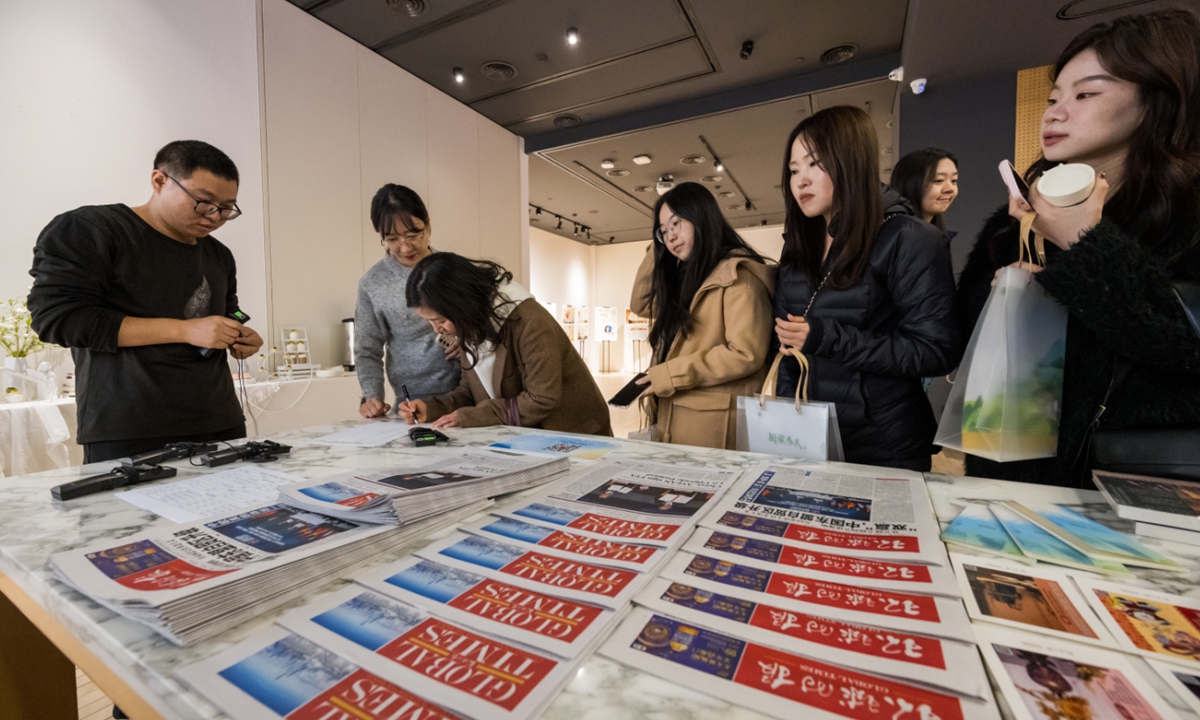
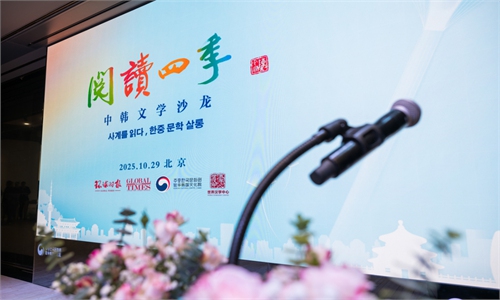
People attend the Global Times "Reading Through the Seasons" China-South Korea Literature Salon at the Korean Cultural Center, China on October 29, 2025. Photo: Chen Tao/GT
Editor's Note:Aiming to build a new platform for cultural exchange between China and South Korea through literary dialogue, the Global Times "Reading Through the Seasons" China-South Korea Literature Salon was held last week at the Korean Cultural Center, China. During the event, South Korean writer Lee Jee shared her recent reflections on the "homology" of South Korean and Chinese Literature as well as the relationship between "locality" and "universality."
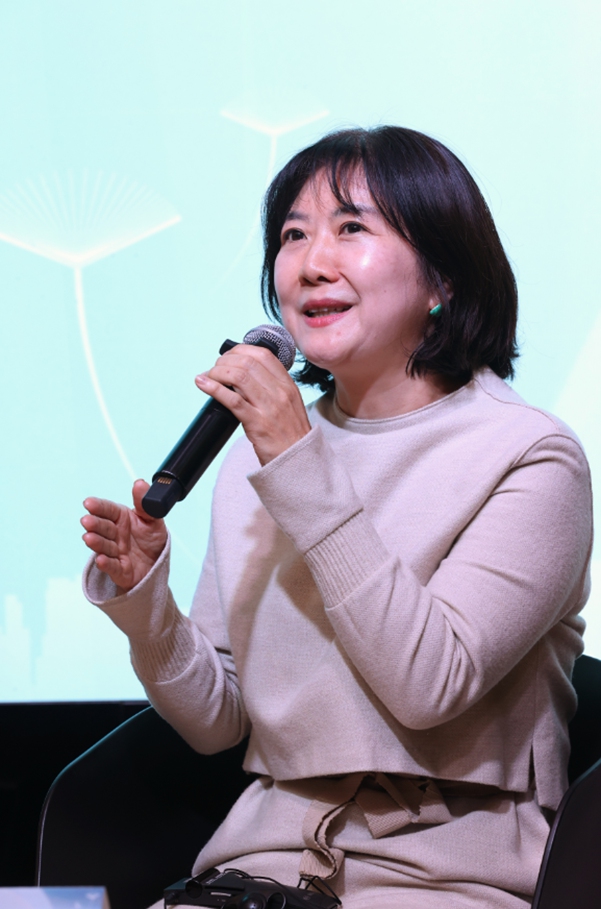
South Korean writer Lee Jee Photo: Chen Tao/GT
In fact, "homology" is not merely a legacy of the past. The grain of Chinese characters still lives within South Korean sentences, and the lyrical essence of The Book of Songs and the subtle nuances of classical Chinese poetry still breathe quietly within them.
Linguistically, over 60 percent of the South Korean lexicon consists of Sino-South Korean words; this is not simple borrowing but a cultural continuity that has created similarities in emotional structure. Thanks to this, South Korean literature has continuously maintained an invisible resonance.
I understand this "homology" not as "proof of similarity" but as continuity within difference. Just as flowers grown from the same roots bloom in different colors depending on their respective soil and climate, South Korean and Chinese literature have enriched each other through their differences. I believe this diversity is precisely the vitality we must preserve when discussing literary exchange today.
I live near Gyeongbokgung Palace in Seoul. Every day, I look out of my window at the curved lines of the palace roof, but lately, that distance feels unfamiliar. This is because, recently, with its appearance in animated films like K-Pop Demon Hunters and its popularity as a filming location for various dramas, tourists have been flocking there.
For me, it's the palace I walk through daily, but for them, it's a South Korean place to experience. Whenever I see such regional spaces being reconfigured within a global gaze, I find myself contemplating the relationship between "locality and universality." The same holds true for literature. The local is reread within the global, and the global re-recognizes itself through the local.
I hold the belief that the more local literature is, the more universal it becomes. Prime examples are Yu Hua and Mo Yan.
Yu Hua's novels are set in specific places like small villages in southern China, markets, hospitals, and town squares. Yet from within these, he elevates universal emotions like suffering, dignity, and human solidarity.
Mo Yan, likewise, faithfully preserves the soil, smells, dialects, and folktales while exploring fundamental human issues like violence and desire, memory and oblivion.
In this regard, (French philosopher) Jean-Paul Sartre's literary theory remains valid. In the book What Is Literature? he stated, "Literature is a means of creating a new reality, one that transcends the limitations of our everyday lives." This signifies not mere political engagement but an ethical act where the writer perceives the world and attempts to translate the suffering of others into their own language. Mo Yan's fantasy and Yu Hua's realism walk different paths, but both practice this Sartrean ethic. They write from local soil, but their writings ultimately testify to human dignity.
South Korean literature exists within the same context. The reason (South Korean writer and Nobel Prize winner) Han Kang writes by embracing South Korea's modern and contemporary history with her whole being, the reason (South Korean writer) Kim Ae-ran depicts the reality of labor and youth... all are to testify to the conscience of the world by writing about the local soil.
Their sentences grow from South Korean soil, but within them lies the universal truth of loss, guilt, and compassion felt by humanity. Therefore, I believe "locality" is by no means a parochial or closed concept, but rather the root of literature that enables universal resonance.
Just as the globalization of literature expanded through translation, generational change is now creating another inflection point. The change in the readership over the last decade has been faster and newer than the past 100 years.
Generation Z, those born between 1995 and 2009, no longer access literature only through "printed books." They scroll through text, expand interpretation through comments, and sometimes reprocess a single line of text into images or videos. Even within this change, the essence of literature remains alive. They discover poetic rhythm in social media feeds and create new narratives through chains of comments.
Within this, we see the modern form of "homology" again. It is the process where human thoughts, growing from local roots, evolve into universal problems. In today's world where AI intervenes in creation, literature is not becoming subservient to technology but is becoming a genre in which human imagination and ethics are tested through technology. AI can generate sentences, but transforming those sentences into something that resonates remains the task of humans.
Lately, I have been running a writing program at a local library. Once, a participant asked, "ChatGPT writes better. What's the point of us writing like this?" I smiled and answered, "What is the purpose of dating? Does the purpose of love have a clear outcome? If the act of writing, like dating and loving, is important in itself, then write yourself. If you entrust writing to AI, as if outsourcing dating, the owner of the emotion disappears."
Ultimately, what we share is not letters or vocabulary, but the capacity for resonating with the world and others. Even at the heart of globalization, literature has not lost its human voice.
RELATED ARTICLES