Australian defense minister hypes China’s ‘military build-up’ to create pretext for its own military expansion: expert
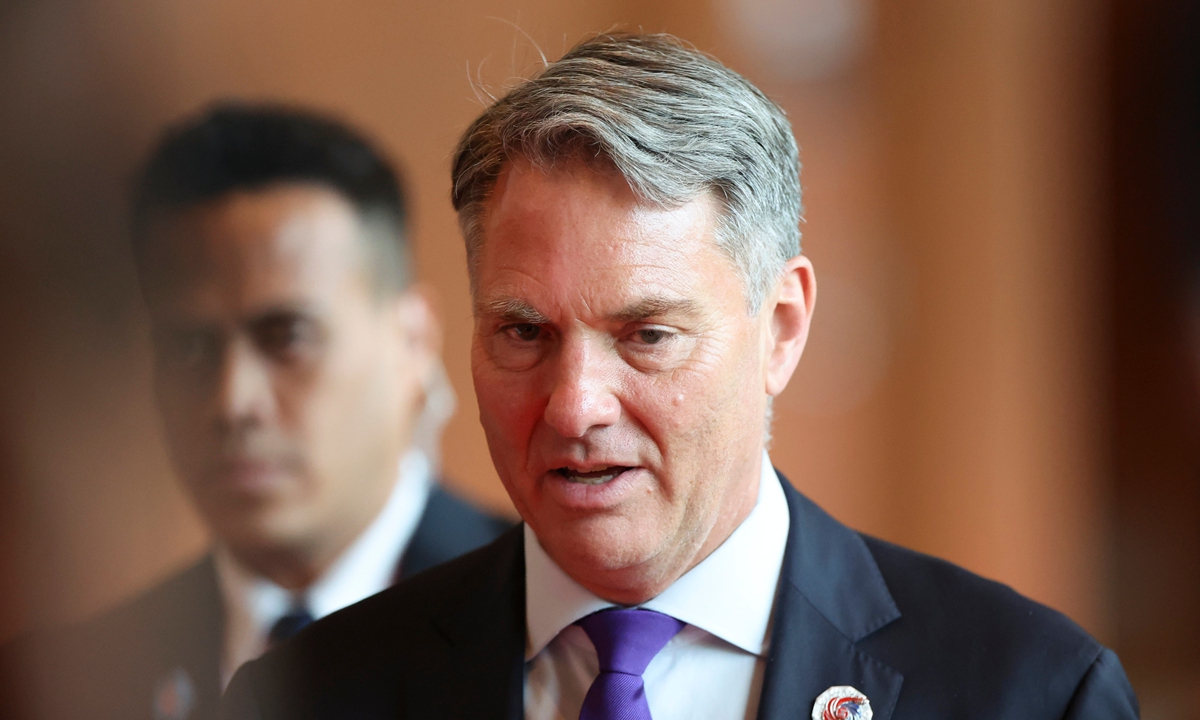
Australia Deputy Prime Minister and Minister for Defence Richard Marles attends the Association of Southeast Asian Nations (ASEAN)-United States Defence Ministers' High Tea, as part of the ASEAN Defense Ministers' meeting, in Kuala Lumpur, Malaysia, on November 1, 2025. Photo: VCG
Australia's defense minister Richard Marles claimed the work of Australia's defense force to protect its sea trade routes, including through the South China Sea, is becoming more risky as Beijing undertakes the "biggest military build-up in the world today," Reuters reported on Tuesday. A Chinese expert said Marles is taking a stance that appears to be orchestrated by someone in the US, which is to view China as an imaginary enemy and use the hyping as a pretext for the country's own military expansion.Marles made such claim during an opening speech at a navy conference in Sydney. He said that open sea lanes, including trade routes that go through the South China Sea and East China Sea, were at the core of Australia's national interest, Reuters reported.
"That work is challenging and in truth it is becoming increasingly risky. The biggest military build-up in the world today is China," he claimed, according to the report.
Marles's claim appears to show that Australia is viewing China as an imaginary enemy and taking it as a pretext to push for the expansion of its own defense budget, Chen Hong, director of New Zealand Studies Centre from East China Normal University, told the Global Times on Tuesday.
The navy conference in Sydney was attended by dozens of navy and coast guard chiefs, including those from the US, Japan, the Philippines, Singapore, and Pacific Island nations, according to the report.
It also came closely after the recent meeting held by the US, Australia, the Philippines, and Japan during the ASEAN Defense Ministers' Meeting in Kuala Lumpur. During the meeting, Pentagon chief Pete Hegseth took aim at Beijing over an increase in "destabilizing actions" in the South China Sea and committed to support Southeast Asian countries with technology to help them respond jointly to Chinese threats, Reuters reported.
Yang Xiao, an international strategy scholar who has long followed South China Sea issues, told the Global Times on Tuesday that Marles is taking a stance that is ultimately orchestrated by someone in the US, much like the roles played by the Philippines and Japan.
According to Reuters, Australian government recently announced an A$12 billion ($8 billion) project to upgrade facilities at the Henderson shipyard near Perth, as part of a 20-year plan to transform it into the maintenance hub for its AUKUS submarine fleet.
Australia should seriously reflect on whether it is essentially enacting a case of "the pot calling the kettle black," Yang said.
Australia's hyping up of the so-called "China threat" has also faced opposition from its own politicians. In 2023, when asked by a Sky News Australian anchor that "What makes you so sure China isn't a military threat to Australia?", the Former Australian Prime Minister Paul Keating said "Because I've got a brain, principally, and I can think."
When asked "whether China was a security threat to Australia" in June this year, Prime Minister Anthony Albanese said "I think that our engagement with the region and the world needs to be diplomatic, needs to be mature and needs to avoid the, you know, attempts to simplify what are a complex set of relationships."
This is not the first time Australia has been hyping up the "China threat," with similar hype spanning from the military domain to areas such as cybersecurity.
Australia and key intelligence partners in July 2024 accused a China-backed group of conducting a wide-scale cyber espionage operation, Australia's ABC News reported.
Australia's cyber intelligence agency claimed that the hacking group known as APT 40 had "repeatedly targeted Australian networks as well as government and private sector networks in the region," adding that ""the threat they pose to our networks is ongoing".
In response, Chinese Foreign Ministry spokesperson Lin Jian said that "We are firmly opposed to such repeated hypes about so-called 'Chinese cyberattacks' aimed to smear and frame China on cybersecurity." Lin added that "We urge relevant parties to open their eyes and make the right judgment, rather than serving as the cat's paw at their own expense."
Australia seeks to securitize, militarize, and politicize issues of development and cooperation, in order to find legitimacy for expanding its influence in the Asia Pacific and South Pacific, Chen said.
Rather than repeatedly provoking China to divert conflicts, what some Australian politicians should prioritize is reflecting on their own national defense and security strategies, said Chen. Otherwise, the holes Australia digs for itself in the security domain will only grow deeper and wider, he added.
RELATED ARTICLES