Chinese experts slam ‘jaw-dropping’ report from The Economist blaming China’s clean air efforts for global warming
By Published: Nov 04, 2025 08:17 PM

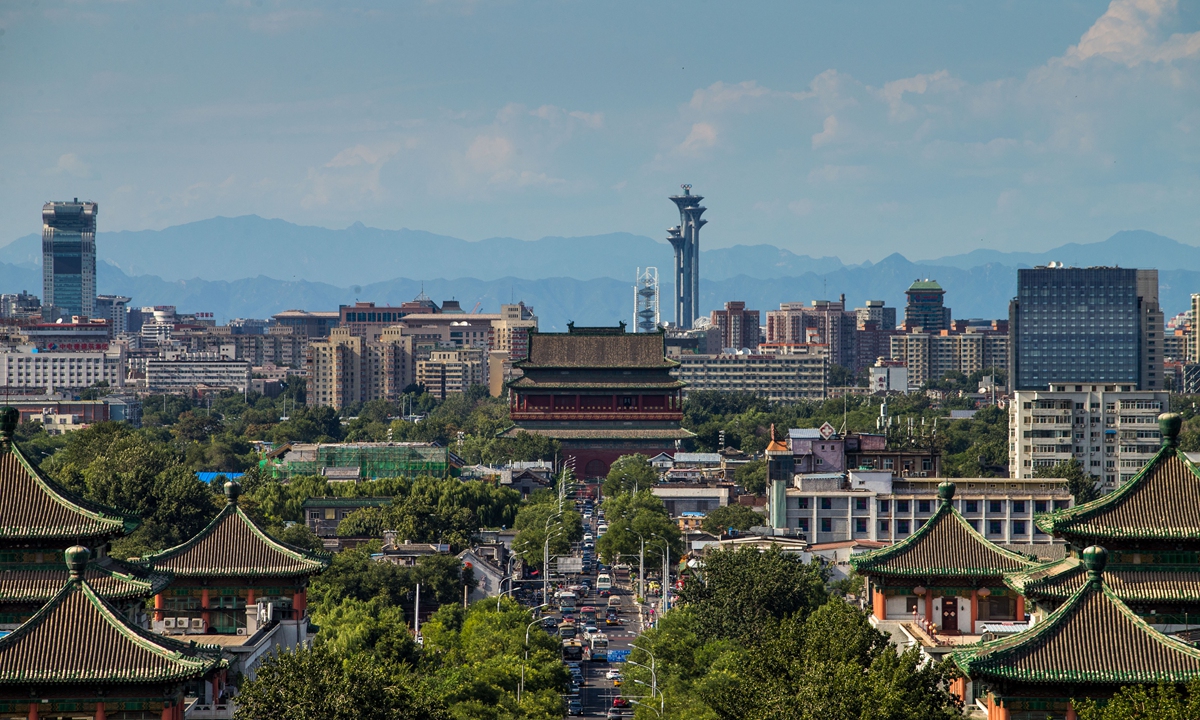
Blue sky of Beijing Photo: Li Hao/GT
The Economist, a British journal, has published a special report on Monday and claimed in the headline that China's improvements in air quality have hastened global warming. Chinese scientists described the logic as "jaw-dropping," saying some Western researchers are using a country's environmental achievements as an excuse for "finger-pointing."
In an article published on The Economist's special report section on Monday, it said that China has greatly reduced the burning of coal since 2013 and these efforts - cutting the use of sulphurous fuels and installing desulphurization equipment in power plants - have greatly improved air quality and public health.
However, the magazine went on to claim, without giving details, that as sulphate aerosols can reflect sunlight, they help cool the Earth's surface. As China and other Asian countries have sharply reduced sulphur emissions by fighting air pollution, the amount of sulphur in the atmosphere has fallen, which scientists say may have slightly accelerated global warming, The Economist article claims.
Commenting on The Economist report, an X user under the name of Tony Heller wrote that "TheEconomist is complaining about the clean air", coupled with a few clown emojis.
"Evidently building new coal plants weekly purifies the air. That's some hard-hitting reporting there, @TheEconomist. Cheers," another X user Harold Ambler said in a sarcastic tone.
In summary, the West seems to believe, "You can't be better than me. If you are better than me, it's a sin," wrote Wang Ye, a user on Xiaohongshu, China's equivalent of Instagram.
"No matter what China does, it's always wrong," added another Xiaohongshu user, Lurenjia.
Calling the logic of this report as "jaw-dropping," Chinese expert said that China's efforts to reduce coal consumption are clearly beneficial to building a cleaner planet, yet somehow they are being portrayed as a "sin" that accelerates global warming.
Perhaps, for Western "economists," a cleaner Earth is merely a hollow slogan — while a China that can do nothing right is their preferred reality, said experts.
From a scientific perspective, aerosols do have the ability to block solar radiation, however, such an approach - effectively "fighting poison with poison" - is clearly unacceptable, Ma Jun, director of the Institute of Public and Environmental Affairs, told the Global Times.
China's efforts to improve air quality and tackle global warming have been widely acknowledged.
The Chinese government has launched Air Pollution Prevention and Control Action Plan, and China became the first developing country in the world to impose large-scale efforts to reduce PM2.5 density, with Beijing taking the lead across Chinese cities, Xinhua News Agency reported.
The United Nations Environment Programme (UNEP) has hailed Beijing's achievements in improving air quality as the "Beijing Miracle," per Xinhua.
China's commitment to addressing climate change has brought "a lot of security" to the entire world, Ana Toni, CEO of COP30 Climate Change Conference, told the Global Times in September.
Even The Economist article admitted that getting sulphates under control in China "has saved hundreds of thousands of lives; more reductions will do more good."
Historically, both Europe and the US faced high levels of sulphur dioxide emissions. The US SO2 program was the first large-scale cap-and-trade system, designed to cut emissions by creating a market for sulphur dioxide allowances.
Before that, acid rain had been a serious environmental problem across North America and Europe, so such measures undoubtedly played a positive role in addressing it, said Ma.
Like all other countries, including those in the West, China's efforts and achievements in cleaning up its air deserve full recognition and encouragement. It would be unfair to one-sidedly claim China's pollution-control measures have accelerated global warming. In sharp contrast to China's vigorous efforts to cut carbon emissions, some countries are turning back to fossil fuels, said experts.
"Under any circumstances, China's achievements in improving air quality have made significant contributions to environmental protection and public health," Ma said, describing The Economist article as "clickbait" that distorts the country's environmental progress.
RELATED ARTICLES