IN-DEPTH / IN-DEPTH
Shifting attitudes, industry upgrades fuel pet economy boom in China and South Korea
Shared Paws

Pet owners and their furry companions attend the 5th Petjoy Fashion Week in Shanghai on November 1, 2025. Photo: VCG
At 6 pm on workdays, 28-year-old designer Zhang Yu habitually opens a home-monitoring app on her phone before leaving her office in Beijing. The screen lights up to show her four cats scattered around the living room of her rented apartment - some lounging lazily, and others playing on their own.
"Mom's off work," she coos into the microphone, before dispensing snacks remotely. Watching her furry companions rush toward their food bowls, the fatigue of the day seems to melt away.
What Zhang may not realize is that her cozy domestic ritual reflects a sweeping emotional and commercial transformation now unfolding across East Asia. Pets, once a symbol of leisure, are increasingly serving as emotional lifelines for urban dwellers - reshaping lifestyles, spending patterns and even social norms.
Across the sea, South Korea is experiencing a parallel phenomenon.
In 2024, China's urban pets (dogs and cats) market surpassed 300 billion yuan ($42 billion), and is projected to reach 404.2 billion yuan by 2027. Among pet owners, those born in the 1990s account for 41.2 percent, while those born after 2000 make up 25.6 percent, according to the 2025 China Pet Industry White Paper (Consumption Report) released under the guidance of the China Veterinary Medical Association.
As of the end of 2024, 15.46 million people had pets, which account 29.9 percent of the total population, according to the 2025 Korean Pet Report published by the KB Financial Group in May. This means that three out of 10 Koreans live with pets, reported Maeil Business Newspaper.
Total expenditure on animal-related services jumped by 30 percent in 2024 compared with 2021, according to a recent analysis of 24.85 million payment transactions by KB Kookmin Card. Over the same period, the number of customers increased by 39 percent. From 2021 to 2024, spending by customers in their 60s and older increased by 60 percent. Their spending on animal-related supplies surged by 77 percent, while expenditure on veterinary services rose by 57 percent, according to The Korea Times.
Both countries' booming pet industries are propelled by similar social undercurrents - urban isolation and a growing pursuit of emotional comfort and companionship. "Pets" have become "family members," driving an economy rooted in affection as much as consumption.
Just after the conclusion of the 32nd Asia-Pacific Economic Cooperation Economic Leaders' Meeting in Gyeongju, this article turns its focus to the cross-border pet economy, which not only reflects shifts in the social structures and emotional cultures of China and South Korea, but also serves as a new bridge for bilateral exchange and industrial integration.
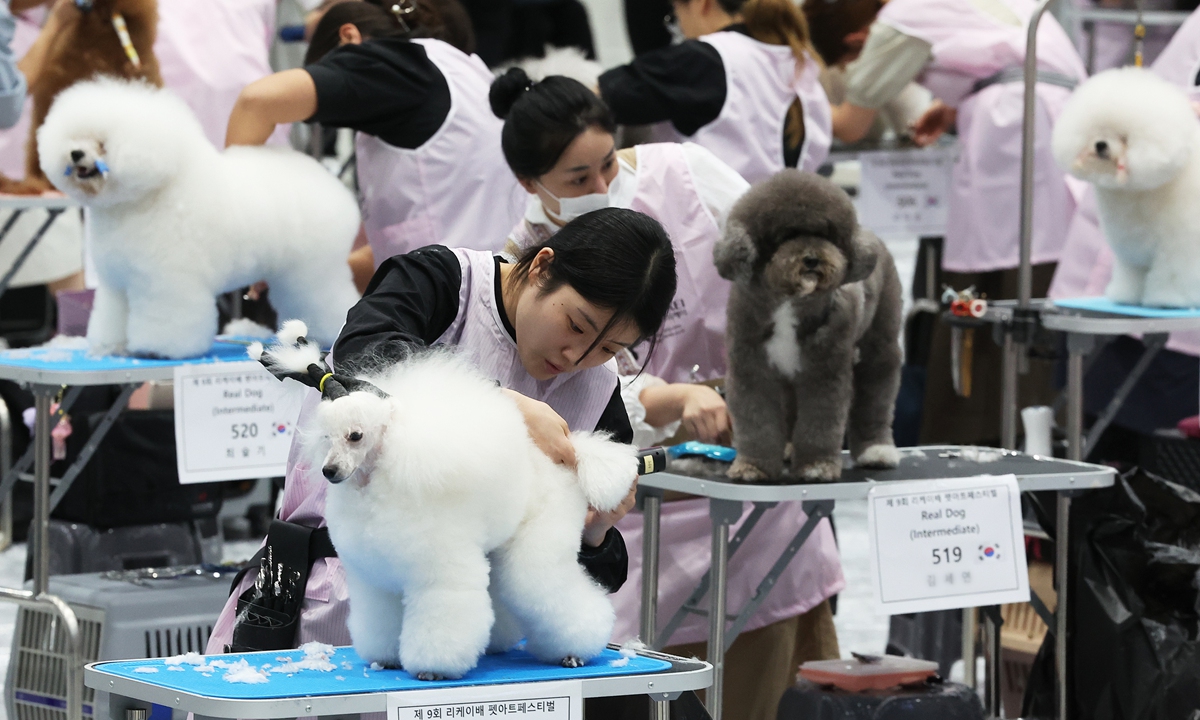
Participants showcase their pet grooming skills at a pet art festival in Suwon, South Korea on November 4, 2025. Photo: VCG
From pets to family
Zhang said all four of her cats were "rescued, not bought."
"'Mango' was a stray cat I found two years ago in the parking lot - skin and bones at the time. 'Yuan Yuan' came from a friend's neighborhood; I adopted the last kitten no one wanted. 'Fubao' was rescued by a friend, and the vet bills almost broke us. 'Pudding' came from an urgent adoption post on social media when the original owner had to leave Beijing," Zhang told the Global Times with a smile. "Each of them has a story. Together, we're a family."
Her mobile phone is filled with their photos and videos: Snuggling on her chest, wearing the Elizabethan collar after sterilization, or darting away guiltily after knocking over a flowerpot.
That sense of kinship shows up in her spending. Zhang feeds them imported food and hand-makes fresh cat meals twice a week, carefully balancing nutrients for each cat.
Her home features two smart litter boxes, two automatic water fountains, and a dual-bowl feeder that she controls remotely. "Once the fountain broke I immediately took a taxi home after work, worried they might go thirsty. I don't even treat myself that well," she jokes, her voice tinged with pride.
"People think having four cats means I'm rich," she laughed, "but I'm just a regular office worker. I might think twice before buying clothes, but for them, anything that improves their lives is worth it. It's not a burden - it's a sweet kind of responsibility."
Zhang followed a baking class on Xiaohongshu run by a joint China-Korea training studio under the Korean Pet Food Culture Association (KPCA). The account, which shares videos such as pet "longevity noodles" and handmade treats, has earned nearly 200,000 likes.
The Global Times learned from the studio staff that the curriculum integrates modules from KPCA and cutting-edge nutritional concepts from both China and South Korea, reflecting a cross-cultural blend in pet care aesthetics.
Just like those elaborate cakes, South Korea's pet owners are also pursuing a more refined and experiential pet lifestyle.
As fewer South Korean couples have children, many are channeling their nurturing instincts into raising pets, CNA reported.
And just like human children, some pets in South Korea are "going to school." At pet kindergarten Dog Us Planet in the capital of Seoul, dogs must first undergo a three-hour test before they can join classes in obedience, socialization, and group play, CNA reported.
According to the Korea Consumer Agency, the average monthly cost for a pet dog to attend kindergarten in Seoul last year was about 255,000 won ($180), higher than the average cost of early childhood education, the report said.
The emotional return appears equally strong. According to the 2025 Korean Pet Report published by KB Financial Group, the satisfaction of raising companion animals is continuously increasing. In 2024, it recorded 76 percent, an increase of 8.7 percentage points compared to 2023. The most positive effects of raising pets were "improving life satisfaction and happiness," followed by "reducing loneliness," "improving family relationships," "decreasing depression," "improving stress and coping ability," "improving health through increased physical activity," and "reducing anxiety."
"They're the only beings in this city who wait for me wholeheartedly," Zhang said. "That feeling of being needed, it's irreplaceable."
Rules catching up
In China, the growing ranks of pet owners like Zhang are driving not only economic expansion, but also a demand for clearer rules and protections. As millions of "family members" live within a legal gray zone, a new group of "pet lawyers" has emerged - defenders of rights and pioneers of regulation. Similar conversations are also taking place across the sea in South Korea.
"Our Pet Legal Alliance was founded on March 15, 2025, the World Consumer Rights Day," said lawyer Cui Can, one of the group's co-founders. The date, he added, carries symbolic meaning: It places pet protection squarely within the broader framework of consumer rights.
Through social platforms and chat groups, the alliance now connects more than 2,000 lawyers, most of whom are pet owners themselves. Many share legal advice and case studies online, quietly building a force for change.
Their clients are mostly young people - mirroring China's pet-owning demographics - but the issues are diversifying. "We now see cases beyond buying disputes or medical negligence," Cui noted. "They extend to pet funerals, food safety, and even travel-related disputes. Increasingly, senior clients are also seeking help, showing how universal the emotional bond has become."
The cases are rarely lucrative. "These disputes often involve small sums, sometimes just a few hundred yuan. We call it 'working for love,'" Cui said. "Still, many lawyers stay with the cases to the end."
Without dedicated pet protection law, most cases rely on the Civil Code's tort provisions or isolated clauses in the Criminal Law, such as those on "hazardous substances." "This patchwork approach creates uncertainty," Cui said, "but progress is growing from these small steps."
He cited advances in pet medical litigation: "A few years ago, there were almost no precedents for veterinary malpractice appraisals. Now, more courts are recognizing and initiating such procedures."
Policy support and new efforts are underway. During China's 2025 "two sessions," Zhao Wanping, a deputy to the National People's Congress, co-sponsored a proposal to draft a "companion animal protection and management law." The proposal calls for addressing fragmented regulations, defining owner responsibilities, regulating breeding and trade, establishing rescue systems for strays, and criminalizing abuse, according to South Reviews, a media outlet managed by the Guangzhou Daily.
South Korea, meanwhile, offers a more mature model.
"Since the 1990s, South Korea has had a dedicated Animal Protection Act and specialized pet lawyers," Cui said.
As a pet owner himself, Cui admires South Korea's industry standards. "South Korea has a very high density of pet medical services, with well-equipped facilities and detailed industry regulations. However, in terms of the diversity and abundance of pet entertainment facilities, such as large pet parks and pet gyms, as well as pet funeral services, I think some Chinese cities, like Chengdu in Southwest China's Sichuan Province where I live, are developing at a remarkably fast pace."
The country is also taking bold new steps. Seven out of 10 dog breeding facilities have closed their doors since the country enacted a law banning dog meat consumption a year earlier, said South Korea's Ministry of Agriculture, Food and Rural Affairs, according to the Yonhap News Agency in August, 2025.
MyBrown, South Korea's first insurer dedicated solely to pet insurance, was launched in August 2025, according to The Korea Times.
"In our legal education content, we often introduce international cases, including those from Korea," Cui added. "We see this as mutual learning. Earlier this year, I even referred a client to a Korean pet lawyer for consultation."
A shared future
Beyond the cross-border comparison, the market forces are already transcending national borders. China's pet industry, once a follower, is now taking the lead in innovation and global outreach.
Experts cited by xinhuanet.com noted that although China's pet industry started late, it has rapidly evolved from OEM manufacturing to independent innovation. New trends include brand-oriented pet food, smart devices, industrial clustering, and accelerated internationalization of Chinese brands.
At the 27th Asia Pet Fair held in Shanghai in August, innovation was on full display. Smart litter boxes that automatically detect usage and self-clean, AI monitoring systems, and functional nutrition feeds drew attention from visitors, the report said.
In this wave of globalization, Chinese pet companies are stepping onto the international stage.
One example is Catlink, a Shanghai-based smart pet product company founded in 2017. The Global Times learned from the company that by 2024, it had built a distribution network across 119 countries and regions, surpassed 100 million units in overseas sales, and reached seven hundred thousand registered users worldwide. Its products now rank among the top sellers on some platforms in South Korea.
Certain Chinese pet product brands are now gearing up on social media platforms such as Xiaohongshu for the upcoming 2025 MEGAZOO Pet Expo in South Korea in November, seeing it as a key opportunity to strengthen bilateral cooperation.
Although law remains largely territorial, Cui said he would welcome international exchanges.
"As neighbors facing similar market dynamics, I believe every pet owner shares the same hope - for a truly pet-friendly society," he added. "And with such a vast and passionate community, our shared future can only move in a positive direction."
RELATED ARTICLES