China, 5 Pacific Island nations ink deal to deepen partnership; ‘move boosts cooperation in marine economy and green development’
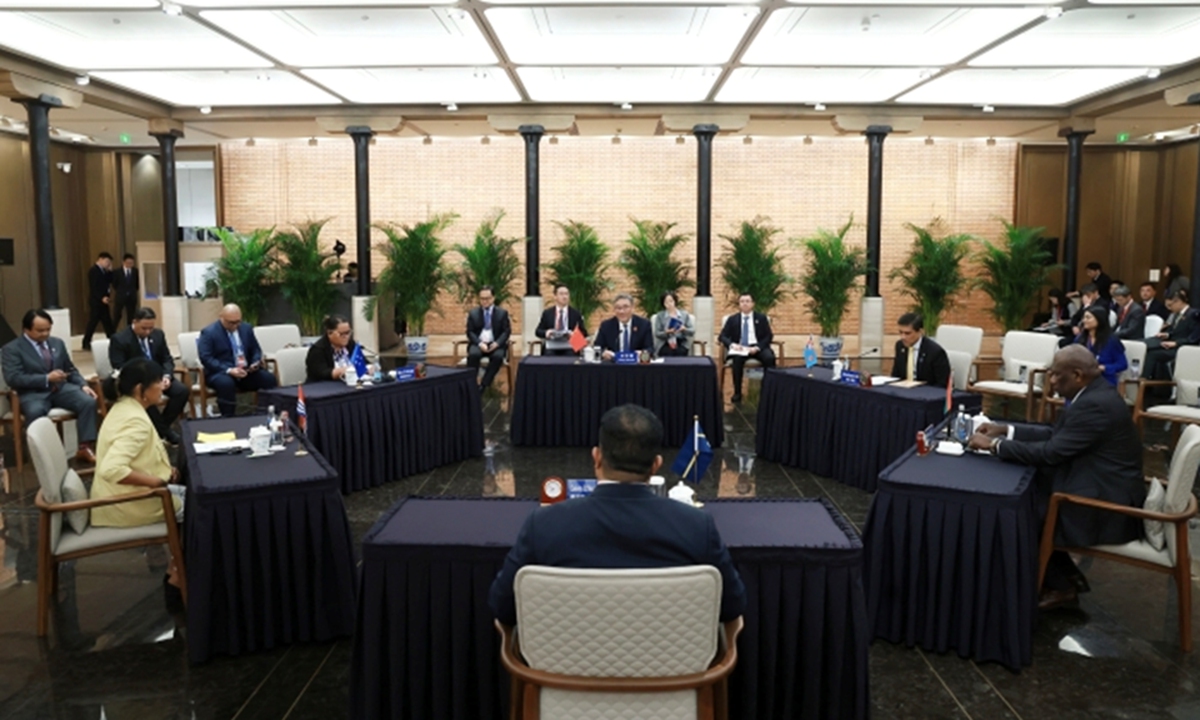
Chinese Commerce Minister Wang Wentao meets with senior officials from five Pacific Island countries on November 4, 2025. Photo: screenshot from the Ministry of Commerce (MOFCOM)'s website
China and five Pacific Island countries on Tuesday signed a framework agreement to upgrade their economic partnership, aiming to expand trade and boost investment, according to the Ministry of Commerce (MOFCOM). Experts said that the move is expected to help these countries diversify their economies and reduce dependence on traditional powers.
Chinese Commerce Minister Wang Wentao on Tuesday met with senior officials from five Pacific Island countries -- the Federated States of Micronesia, the Republic of Kiribati, the Republic of Nauru, the Republic of Vanuatu and the Republic of Fiji - and signed the framework agreement with representatives of these countries, according to a Wednesday statement published on the MOFCOM's website.
Insiders said that the framework agreement marks a shift in China-Pacific Islands cooperation from previously fragmented aid-, trade- and project-based arrangements toward a more long-term and institutionalized partnership.
The framework agreement includes a preamble, objectives, principles, scope of negotiations, contact points, institutional arrangements, future development, entry into force, amendments, and termination clauses, according to the MOFCOM.
China and the five countries agreed to carry out flexible and pragmatic negotiations on specific issues such as trade in goods and services, investment, rules, and practical cooperation, per the statement.
"Through establishing institutional arrangements, the parties aim to expand bilateral trade, support Pacific Island nations in attracting investment, accelerate industrialization and agricultural modernization, and deepen participation in global industrial and supply chain cooperation, in order to achieve common development and jointly build a closer China-Pacific Island community with a shared future," the statement said.
The progress aligns with the guiding principles of the 20th National Congress of the Communist Party of China (CPC) and subsequent plenary sessions, as well as being a key measure to further open up China's economy. It represents the latest progress in expanding China's network of high-standard free trade zones worldwide.
In line with the framework agreement, China will actively advance negotiations on specific topics with the relevant Pacific Island countries on the basis of mutual benefit and win-win cooperation. The goal is to further promote high-level opening-up, share China's vast market and development opportunities with the Pacific Island nations, and ensure that the benefits of the agreement reach businesses and people on both sides as soon as possible.
Sun Chang, a research fellow at the Institute of Southeast Asian and Oceanian Studies at the China Institutes of Contemporary International Relations, told the Global Times on Wednesday that cooperation between China and Pacific Island countries has maintained steady momentum this year, with both sides showing a strong willingness to deepen joint development.
"After the third China-Pacific Island Countries Foreign Ministers' Meeting earlier this year, both sides reached important consensus on working together toward common development. Against the backdrop of rising global economic headwinds and the sweeping US tariffs, China's move to strengthen cooperation demonstrates its role as a responsible major country supporting small island states in achieving sustainable growth," she said.
Sun noted that future cooperation will likely build on existing foundations in agriculture, forestry and fisheries, while expanding into new areas such as tourism and people-to-people exchanges. "China's institutional cooperation framework will help Pacific Island nations enhance connectivity and gain better access to the Chinese market, further integrating them into the regional industrial and supply chains," she said.
"The scope of cooperation has expanded beyond traditional areas to include the blue economy, education, and infrastructure," Chen Hong, director of the New Zealand Studies Centre at East China Normal University, told the Global Times on Wednesday. "In the coming years, China is expected to promote more 'small yet beautiful' projects in Pacific Island countries, marking a shift from 'project-based assistance' to 'capacity-building cooperation.'"
For Pacific Island countries, the agreement is expected to bring market opportunities and jobs, while helping them reduce excessive reliance on major powers such as Australia, New Zealand and the US, and strengthen their policy autonomy, Chen said.
Chen said that against a backdrop of intensifying geopolitical competition and rising uncertainty, China's approach stresses an equal partnership rather than assistance conditioned on political alignment.
Sun added that as regional integration among Pacific Island countries strengthens, China could also engage more deeply in discussions on trade rules, standards alignment and free trade zone development, fostering a more open and resilient regional economic architecture.
Chen noted that the focus of cooperation is shifting from trade and infrastructure projects toward marine resource development, climate and green transition, and improving the islands' capacity to export to and integrate with the Chinese market. He added that China is expanding market access and helping Pacific Island countries increase exports of seafood and agricultural products to China through e-commerce platforms, cold-chain logistics and digital payment systems.
RELATED ARTICLES