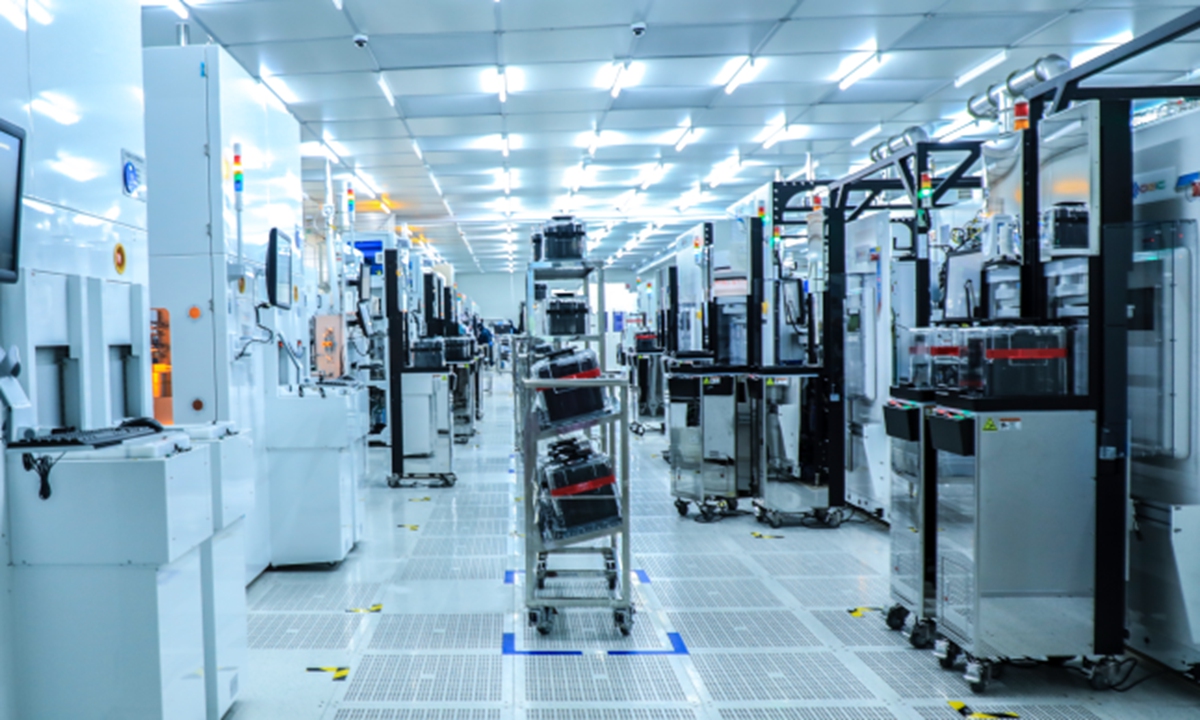
The white light area of an 8-inch silicon photonics platform at the Shaanxi Institute of Advanced Oeic Technologies Co (OEIC), Northwest China's Shaanxi Province. Photo: Official WeChat account of OEIC
A research institute in Northwest China's Shaanxi Province announced the official commissioning on Wednesday of the region's first silicon photonics pilot line, a milestone achievement that will serve as a core pillar in Shaanxi's efforts to build a 100-billion-yuan photonic industry cluster.
The Shaanxi Institute of Advanced Oeic Technologies Co announced in a statement on its official WeChat account that an 8-inch advanced silicon photonics integrated technology innovation platform under construction has been officially commissioned on Tuesday.
As the northwest region's first silicon photonics pilot line, the new progress will not only fill a critical gap in the area's relevant sector but also stands as a landmark outcome of the implementation of the province's innovation plan, positioning it as the core support for Shaanxi's development of a 100-billion-yuan photonic industry cluster, according to the statement.
"The commissioning of the platform completely addresses Shaanxi's shortcomings in the silicon photonics chip pilot production field," said Yang Junhong, general manager of the institute. This new breakthrough will integrate with advanced attosecond laser facilities at Xi'an science park and industrialization platforms in photonics sensing, providing full-chain support, from basic research and pilot verification to mass production and commercialization.
The institute has cumulatively invested about 1.5 billion yuan ($210 million) to build a dual pilot platform for 6-inch compound semiconductor chips and 8-inch silicon photonics chips, with the previous 6-inch compound platform having already served more than 50 enterprises, the institute's statement said.
With the enhancement of pilot production capabilities, the province will further attract the aggregation of upstream and downstream enterprises in the industry chain, accelerating the formation of a closed-loop ecosystem encompassing "materials—chips—applications."
Silicon photonics technology, as a core enabler for cutting-edge fields such as AI computing power, intelligent driving, and quantum communications, is currently at a pivotal stage of technological breakthroughs and application deployment, analysts said.
On the same day, the institute also officially released its first passive silicon-on-insulator (SOI) integrated ultra-low-loss silicon nitride product process design kit (PDK).
Yang noted that this is the institute's first PDK release, and the platform is expected to complete the commissioning of active products by 2026, including core devices such as high-performance modulators and detectors.
"This will accelerate product iteration processes applicable to fields like artificial intelligence, optical communications, optical computing, intelligent driving, low-altitude flight, and medical health," he added.
For a long time, global silicon photonics pilot resources have been highly concentrated among European and US enterprises, leaving domestic innovation and industrialization projects in China facing challenges such as production line construction, product validation, and market risks, according to Yang.
"The new breakthrough helps address these dilemmas faced by Chinese enterprises," Yang noted.
As a new round of technological revolution accelerates, photonics technology, as a key foundational technology for the future, is reshaping industry development patterns with unprecedented influence, Wang Peng, an associate researcher at the Beijing Academy of Social Sciences, told the Global Times on Wednesday.
The new platform, with a total investment of 750 million yuan, was launched at the end of 2023, and had completed all site and hardware facility construction by the end of September 2025. Based on a 130-nanometer silicon photonics process, the platform has upgraded to more advanced 90-nanometer technologies, forming an independent and controllable process system, per the statement.
"This latest breakthrough not only advances China's pursuit of self-reliance in technologies, but also sets the stage for faster innovation and commercialization in the photonics chip industry, while opening new opportunities to integrate photonics with cutting-edge fields such as AI and quantum applications," Wang added.
On September 25, last year, China's first photonic chip pilot line was officially completed in Wuxi, East China's Jiangsu Province, signifying that photonic chips have officially entered the fast track to industrialization, poised to unlock new horizons for large-scale intelligent computing, according to Wuxi municipal government.
RELATED ARTICLES