Nvidia CEO claims China ‘will win’ AI race with US; remark reflects anxiety to regain access to Chinese market and pressure Washington to ease chip export curbs, says Chinese expert
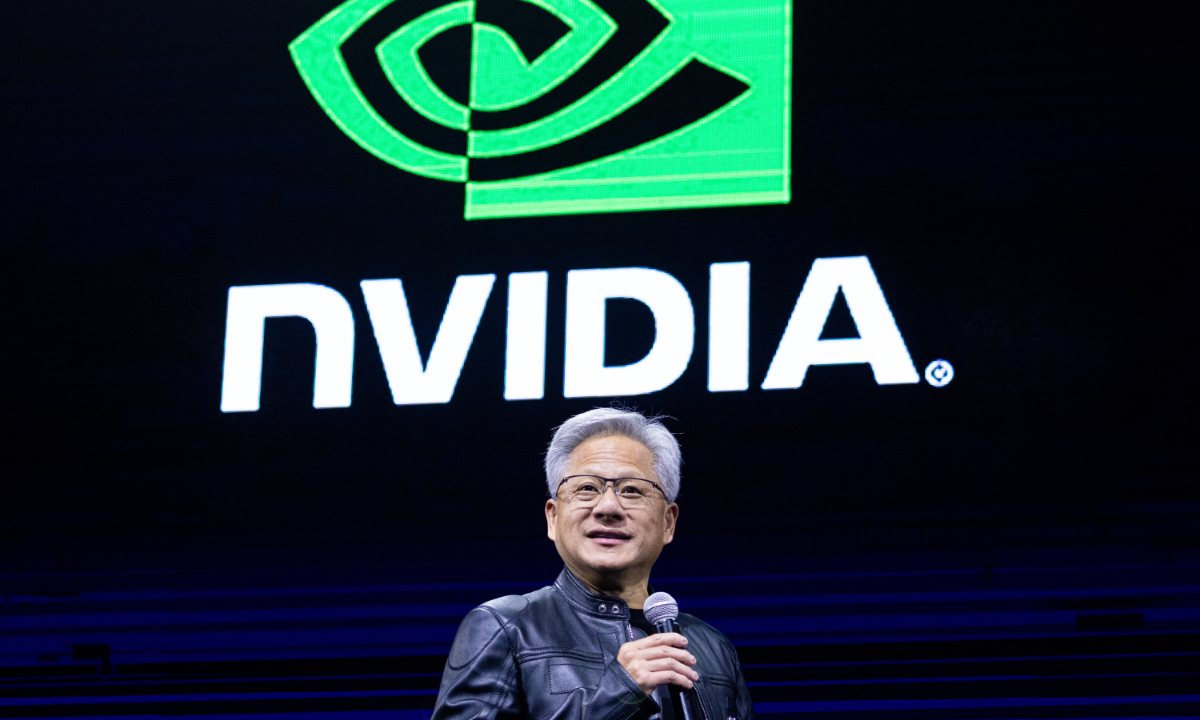
NVIDIA CEO Jensen Huang Photo: VCG
Nvidia CEO Jensen Huang said in an exclusive interview with the Financial Times on Wednesday that China "is going to win the AI race," which the report described as his "starkest comments yet." Chinese experts say the remarks reflect the American tech giant's anxious desire to regain access to the Chinese market.
By hyping up China-US competition in AI, Huang's comments are likely aimed at pressuring the US government to ease chip export restrictions that limit Nvidia's sales in China, they said.
Huang warned that China will beat the US in the AI race during an exclusive interview with the Financial Times on the sidelines of its Future of AI Summit on Wednesday, according to a Financial Times report.
His prediction comes at a time when intensified US tech restrictions against China have not only accelerated the latter's drive for technological self-reliance and spurred breakthroughs in areas such as semiconductors, but have also caused Nvidia to lose access to the vast Chinese market.
The Nvidia chief further contrasted the US' regulatory quagmire with China's enabling environment. The West, including the US and UK, was being held back by "cynicism." "We need more optimism," Huang said, according to the report.
Huang singled out new rules on AI by US states that could result in "50 new regulations." At the same time, he contrasted that approach with Chinese energy subsidies that made it more affordable for local tech companies to run Chinese alternatives to Nvidia's AI chips, per the report.
Xiang Ligang, a senior expert in the telecommunications industry, told the Global Times that Huang's remarks reflect Nvidia's pressing need and deep anxiety to sell its latest high-end chips to the Chinese market, which remains one of the company's most strategically important markets.
By emphasizing the so-called China-US competition in AI, Huang may be attempting to influence US policy and push for a relaxation of export restrictions that currently limit the company's sales in China. However, it is crucial to recognize that the development of AI in China and the US is not inherently a zero-sum game, the expert said.
Xiang also stressed that "China's rapid progress in the semiconductor field is driven by efficient resource allocation, strong management systems, and a vibrant market environment," noting that China's path, which underscores collaboration rather than confrontation, offers a more productive framework for global AI development.
Last week, Huang said he hoped to sell chips from the company's Blackwell lineup to customers in China, although the decision needed to be made by the US government, Reuters reported on October 31. "We're always hoping to return to China, and I think that Nvidia in China is very good. It's in the best interest of US. It's in the best interest of China. So, I'm hopeful that both governments will arrive at a conclusion someday where Nvidia's technology could be exported to China," Huang said.
In earlier October, the company chief warned during his talk with Sequoia Capital partner Konstantine Buhler in New York, that Nvidia's position in China has dropped from 95 percent of the advanced chip market to zero, as the semiconductor giant is not allowed to sell its advanced products to mainland companies under US export restrictions.
Ma Jihua, a veteran telecom industry observer, told the Global Times that, Nvidia has strong willingness to continue to stay and expand in the Chinese market, which is significant for the company's growth.
Not only the Chinese market represents a big chunk of the company's revenue and profit, the country's rapid and vast application for AI technology and the user feedbacks have also proved invaluable for Nvidia's R&D, Ma said, noting that losing the "irreplaceable" user feedbacks from the Chinese market will slow down Nvidia's development.
Huang has previously warned that the latest American AI models were not far ahead of their Chinese rivals, urging the US government to open up the market to its chips to keep the rest of the world dependent on its technology. Nvidia and AMD had previously agreed to remit 15 percent of their China-specific AI processor revenues to the US government, but thwarted by US ongoing attempt to restrict China's tech progress.
Amid US chip restrictions, China has repeatedly urged for stable supply chains. Foreign Ministry spokesperson Guo Jiakun said on October 29 that "China has made clear on multiple occasions its principled position on the US chip exports to China. We hope the US can take concrete actions to keep global industrial and supply chains stable," when asked to comment on Huang's remarks indicating his desire for US AI chips to be sold in China.
RELATED ARTICLES