North China’s Ordos introduces increased childbearing subsidies: 10,000 yuan per year for a third child
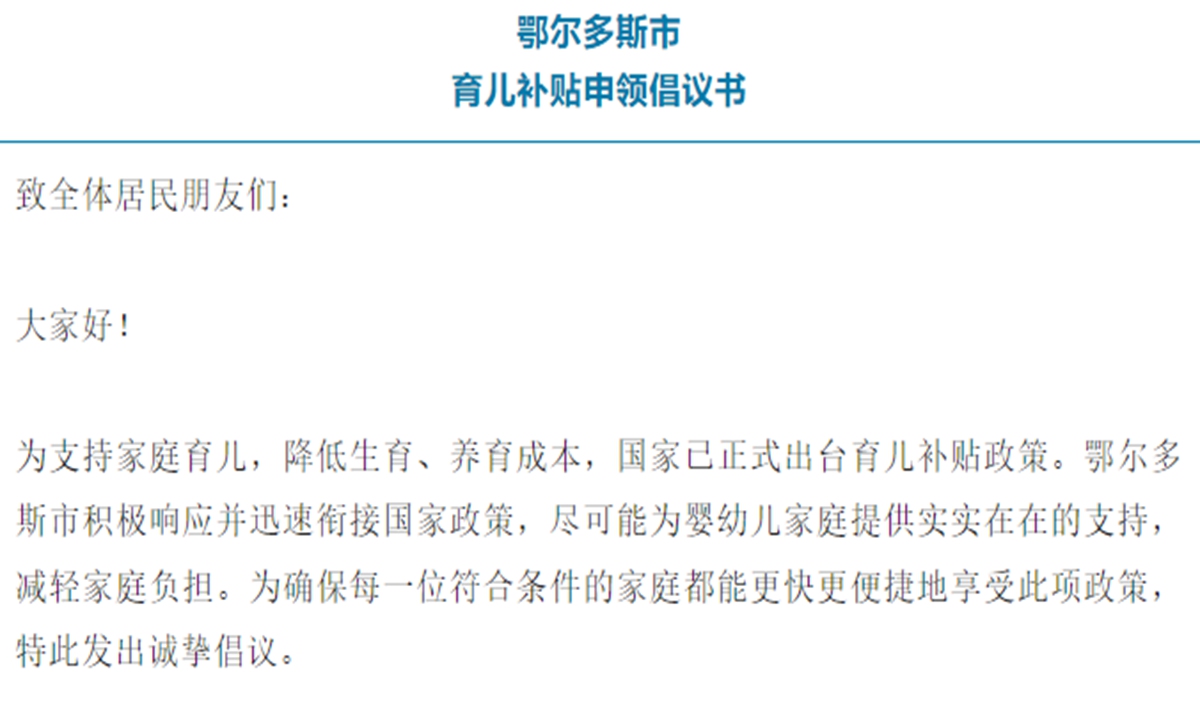
Screenshot of the "Letter of Initiative on Applying for Childbearing Subsidies in Ordos City," issued by the Ordos Municipal Health Commission on November 2, 2025 on the official account of Ordos Daily
Following the introduction of the national childbearing subsidy system, Ordos city of North China's Inner Mongolia Autonomous Region recently released the first local detailed rules for subsidy increases, offering 3,600 yuan ($505) per year for the first and second children and 10,000 yuan per year for the third child. This has sparked widespread attention on social media platforms on Thursday.
The "Letter of Initiative on Applying for Childbearing Subsidies in Ordos City," recently issued by the Ordos Municipal Health Commission, explains that subsidies are granted based on the principle of "taking the higher amount, not the lower," without stacking. Among them, the first and second children will still receive the national childbearing subsidy standard (3,600 yuan per year), while the third child will receive the municipal subsidy standard (10,000 yuan per year) for the portion exceeding the national standard. Subsidies will be disbursed until the child reaches 3 years of age.
The implementation plan for the national childbearing subsidy system—a major national policy concerning people's livelihoods—was announced on July 28: starting from January 1, 2025, regardless of whether it is the first, second, or third child, a subsidy of 3,600 yuan per year can be claimed until the child reaches 3 years of age. The plan specifies that childbearing subsidies will be disbursed annually, with the central government providing proportional subsidies to eastern, central, and western regions. Local governments can appropriately increase the subsidy standards based on their financial capacity, with the additional costs borne by local finances.
"Using real financial support to reduce the burden of child-rearing is both heartwarming and practical, setting a good example for the construction of a fertility-friendly society," commented one Weibo netizen.
"This policy in Ordos reflects care for families with three children, directly addressing the high cost of raising multiple children. From a social perspective, it helps increase the willingness to have children and promotes the optimization of the population structure. From an economic standpoint, it reduces the marginal cost of childbearing, removing obstacles for having a third child," said another netizen.
Global Times
RELATED ARTICLES