ARTS / CULTURE & LEISURE
Tiny zoo tended by retiree alone for decade sparks new reflections
A mountain zoo’s quiet rise

The gate of the Kaili Zoo Photo: Courtesy of Feng Yuanyong
At the foot of a mountain in Kaili, a city tucked deep into the forest of the Qiandongnan Miao and Dong Autonomous Prefecture in Southwest China's Guizhou Province, a red signboard catches the eye. Painted with bright yellow arrows, it points toward what looks like a faint dirt path winding upward. Following it long enough, a small white house slowly comes into view. A modest gate stands beside it, with five bold characters carved onto a plaque: Kaili Dongwuyuan, or Kaili Zoo.This tiny zoo in the mountains covers just more than 3,000 square meters. It is far from grand, not particularly modern, and certainly not the kind of facility one expects to find after such a climb. Yet within its compact grounds live more than 20 protected species, including Siberian tigers, Bengal tigers, vultures, and leopards.
In recent weeks, a video documenting a visit to the zoo and a conversation with its elderly director went viral across Chinese social media. What viewers found striking was not the flashy infrastructure or exotic exhibits, but something far simpler: the healthy-looking animals. They were well-fed and active, and displayed none of the repetitive pacing or agitation associated with confined wildlife.
The "most difficult zoo to reach," as netizens jokingly called it, has become an unlikely internet sensation, and so has the man, who has been caring for the animals, all alone, for a decade.
The sudden wave of attention has transformed the once-forgotten zoo almost overnight. On November 1, the Kaili Zoo saw its highest number of visitors in its 10-year existence.
Families from across the country crowded the narrow hillside paths. On Tuesday, the local culture and tourism bureau dispatched workers to clear the trails and begin repairs. By Wednesday, a shuttle bus route has been established to take visitors directly to the mountain entrance.
Behind the zoo's rise lies a story of endurance, humility, and a deeply personal way of stewardship.

Visitors flock to the Kaili Zoo in Southwest China's Guizhou Province on November 1, 2025. Photo: Courtesy of Feng Yuanyong
A decade of devotionWu Jianbin, a visitor from East China's Anhui Province, first heard of the zoo through the viral video and decided to take a family trip during the October off-season. He expected solitude. Instead, he arrived to find a swarm of tourists, young children, and even reporters making the steep climb.
"The zoo is simple, but it's very clean," Wu told the Global Times. "The variety of animals is certainly smaller than in big city zoos, but there were species we had never seen before."
One that captivated his son was a rare four-horned sheep.
"My child asked the zoo director why this sheep had four horns arranged like a windmill. The director was very patient, explaining that it was a genetic-mutated breed. He answered every question," Wu recalled.
The director he referred to is 70-year-old Feng Yuanyong. Despite his age, Feng is energetic, soft-spoken, and unfailingly attentive to every creature in his care. Before taking over the zoo, he was the principal of a local middle school. When he retired in 2015, he moved up the mountain to restore what had become an abandoned wildlife park. At the time, even the amusement park at the foot of the mountain had shut down, and no proper road led to the zoo.
For the next 10 years, before fame found its way into the valley, there were few visitors, sometimes only a handful a month. With limited funding, Feng prioritized what he considered the only thing that mattered: ensuring the animals were well-fed and healthy.
He managed their daily routines entirely on his own, subsidizing the zoo's expenses with his pension. Tickets remained at a symbolic 20 yuan (less than $3), and if someone slipped in without paying, he did not mind. Even the rugged mountain path leading to the zoo was something he had built himself.
When the recent video exposed Feng's personal ticket payment QR code, donations poured in from tens of thousands of viewers, accompanied by messages of gratitude and admiration. "I was shocked," Feng told the Global Times. "Caring for animals is just an ordinary task. I didn't know how to do any of this at first. I slowly learned about their diets, habits, and moods. After many years, I have come to know the animals' habits."
Even during the zoo's most difficult years, when its funds were nearly exhausted, Feng adhered to what he calls his "animal-first" rule: "No matter how poor we are, the animals are always fed first. Their health come before everything else."
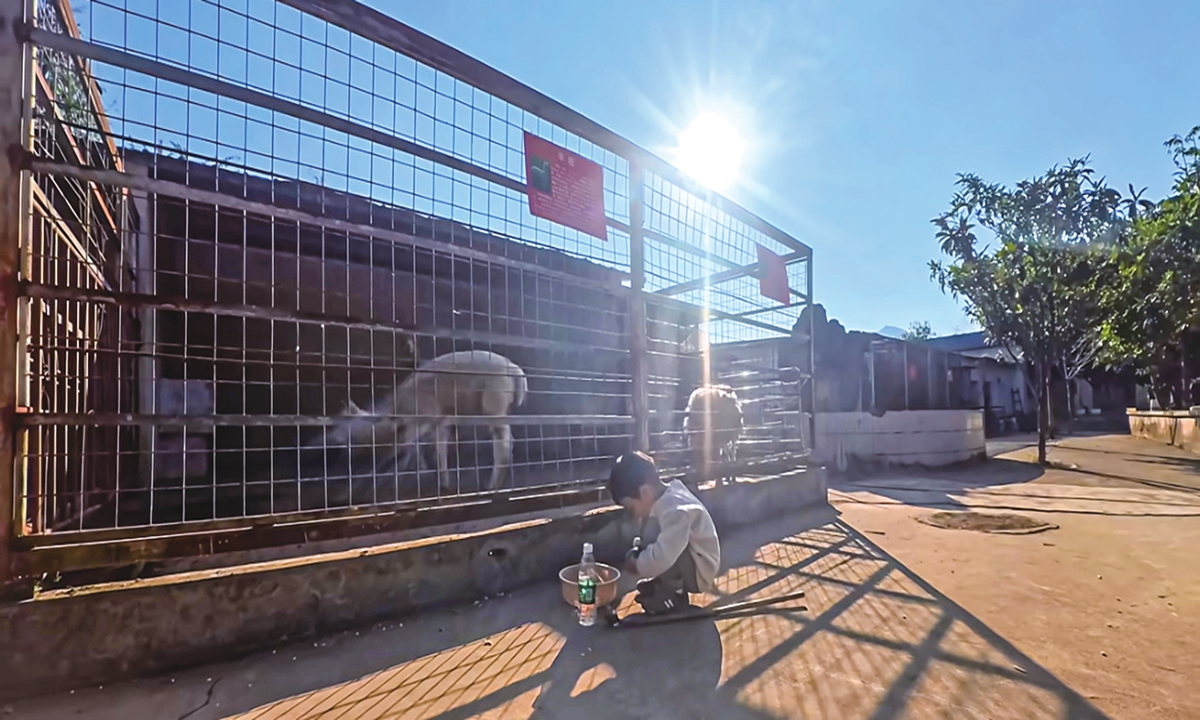
A boy checks peanuts and snacks offered to feed the animals in the Kaili Zoo in the Qiandongnan Miao and Dong Autonomous Prefecture, Southwest China's Guizhou Province, on October 28, 2025. Photo: Courtesy of Wu Jianbin
In harmony with natureSince his surge in popularity, Feng has brought back several former staff members so that the animals can grow and be cared for in a more organized way. He has also urged netizens to stop donating, saying the facility now has sufficient funds for operations.
For him, the zoo's greatest value lies in education. "If children can come here, learn about animals, and grow curious about nature, that is enough," he said. He often hands out peanuts and other small snacks for young visitors to offer the animals.
"I know exactly how much each animal should eat. I just hope the children can have a fun experience. But I ask them not to bring their own food as we need to control the amount."
Perhaps it is this unadorned sincerity that resonates with visitors like Wu. "So many parks and zoos operate primarily for profit, and that's normal," he said. "But that's also why this place, and someone like the director, is so special."
The local authorities have begun evaluating how best to support the zoo and ensure the sudden boom is managed responsibly.
Feng is not alone in his quiet devotion. In Central China's Hubei Province, another elderly caretaker known as "Grandpa Luo" has spent decades tending to animals on Phoenix Mountain. His zoo, perched on a slope much like Kaili's, charges just 10 yuan for entry.
Luo began by rescuing wild animals from vendors who sold them illegally, keeping them in his own courtyard. Over time, his home evolved into a sanctuary. Many of the animals he cares for have disabilities: injured legs, damaged wings, congenital conditions. He treats each like a treasure.
Though many of the larger animals have since grown old and passed away, Luo continues to care for dozens of others - monkeys, wild boars, sika deer - largely on his own. The Kaili Zoo's recent fame has also brought renewed attention to Luo's work, along with a wave of donations.
"There are so many kind people," he said. "I truly cannot thank them enough."
No matter how tiring the work becomes, he remains committed. "Every day, I grit my teeth to finish the tasks. Every animal must be treated equally," he said. "I will keep going, hopefully until I am 90."
Both caretakers share one simple wish: to welcome more children. If young visitors can meet animals, learn to appreciate them, and understand the natural world a little better, then the "uphill climb" has been worth it.
RELATED ARTICLES