Europe’s ‘non-market behavior’ to negatively impact its ties with China: expert
Europe’s ‘non-market behavior’ to negatively impact bilateral ties: expert
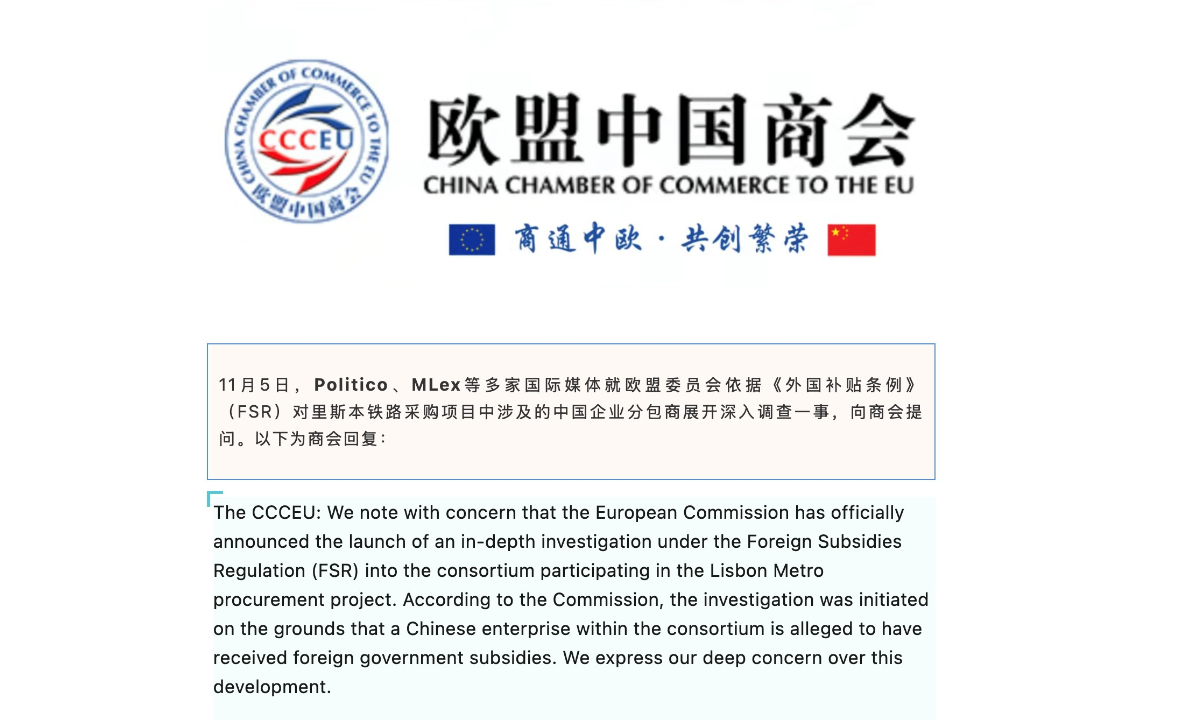
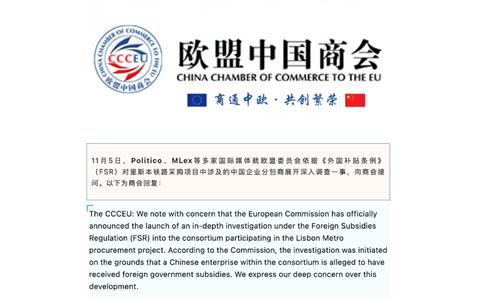
Photo: screenshot of the China Chamber of Commerce to the EU (CCCEU)'s official WeChat account
The European Commission (EC) on Wednesday launched a probe under the Foreign Subsidies Regulation (FSR) into a railway project in Lisbon, Portugal, to assess whether Chinese companies had gained "unfair advantage" in the public tender due to "subsidies". In response, the China Chamber of Commerce to the EU (CCCEU) on Thursday urged the EC to implement the FSR in a truly objective, fair, and non-discriminatory manner, warning against its use as a tool of protectionism or exclusion.
Based on a preliminary inquiry, the EC claimed it found that the Portuguese unit of a Chinese rolling stock manufacturer might have benefited from foreign subsidies in its participation in an April bid to build Lisbon's new "violet" line, a surface stretch linked to the city's underground, Reuters reported.
Chinese experts said that the EC move highlights Brussels' growing habit of turning regulatory tools into de facto protectionist measures, especially when Chinese firms bid for infrastructure projects there. They noted that such probes often start with an assumption of "non-market behavior," a long-standing bias that undermines trust and risks disrupting the broader China-EU economic relationship.
The CCCEU said in a statement on its social media account on Thursday that it is deeply concerned about the EC's decision to open an FSR investigation into the consortium bidding for the Lisbon Metro project.
The CCCEU said that the FSR is a "far-reaching regulatory instrument" that grants the EC "overly broad discretionary powers," and that its implementation has created "significant uncertainty" and "heavy compliance burdens" for Chinese companies. In public procurement, it added, the FSR has introduced "substantial market-access barriers" that risk "distorting fair competition."
"We have received consistent feedback from Chinese enterprises indicating that, in several FSR-related probes, they have faced disproportionate, discriminatory, and non-transparent treatment. Such practices risk sending a negative signal to international investors and could undermine the EU's long-standing principles of openness, fairness, and non-discrimination — values that have long been the foundation of its economic success and global reputation," read the statement.
The CCCEU urged the EC to apply the FSR in an objective, fair and non-discriminatory manner and to prevent it from becoming a de facto tool of protectionism or exclusion. It said that Chinese companies have shown strong competitiveness, compliance awareness and commitment to Europe's sustainable development. The chamber added that openness and cooperation — rather than suspicion and exclusion — are essential for building a mutually beneficial China-EU economic partnership.
Jian Junbo, director of the Center for China-Europe Relations at Fudan University's Institute of International Studies, told the Global Times on Thursday that the EU's repeated use of anti-subsidy tools against Chinese companies has increasingly become a protectionist practice. From electric vehicles to the Lisbon railway bid, Brussels often launches investigations pre-emptively — an "investigate first, justify later" approach that disproportionately targets Chinese participation in EU tenders.
Cui Hongjian, a professor at the Academy of Regional and Global Governance, Beijing Foreign Studies University, told the Global Times that the EU's use of the FSR reflects a structural issue in Brussels' long-standing approach to China. The EU's earlier refusal to grant China market-economy status, he noted, created a built-in presumption that Chinese firms engage in "non-market behavior," which has since become the legal basis for repeated anti-subsidy and investment-screening actions.
Such an approach undermines normal economic exchanges and damages the foundation for deeper China-EU cooperation, Jian warned. Overusing these instruments not only results in unfair treatment of Chinese firms but also weakens market principles and ultimately harms Europe's own interests.
Cui said that the EU should remove provisions that single out Chinese companies if it truly intends to uphold WTO principles. Brussels has increasingly relied on regulatory expansion as a form of rules-based influence, exporting its standards to compensate for its lack of hard-power advantages. But when these tools are applied selectively or used as de facto protectionist measures, Cui warned, they distort competition and weaken the EU's own claims to openness and fairness.
Cui said that China and the EU need to rebuild consensus on trade rules by reaffirming support for the WTO and exploring mechanisms that better reflect today's realities. As both sides accelerate their own free trade agreement (FTA) strategies with partners in Latin America and the Asia-Pacific, he warned that growing fragmentation makes closer coordination and "finding new common rules" essential to the future of China-EU economic ties.
RELATED ARTICLES