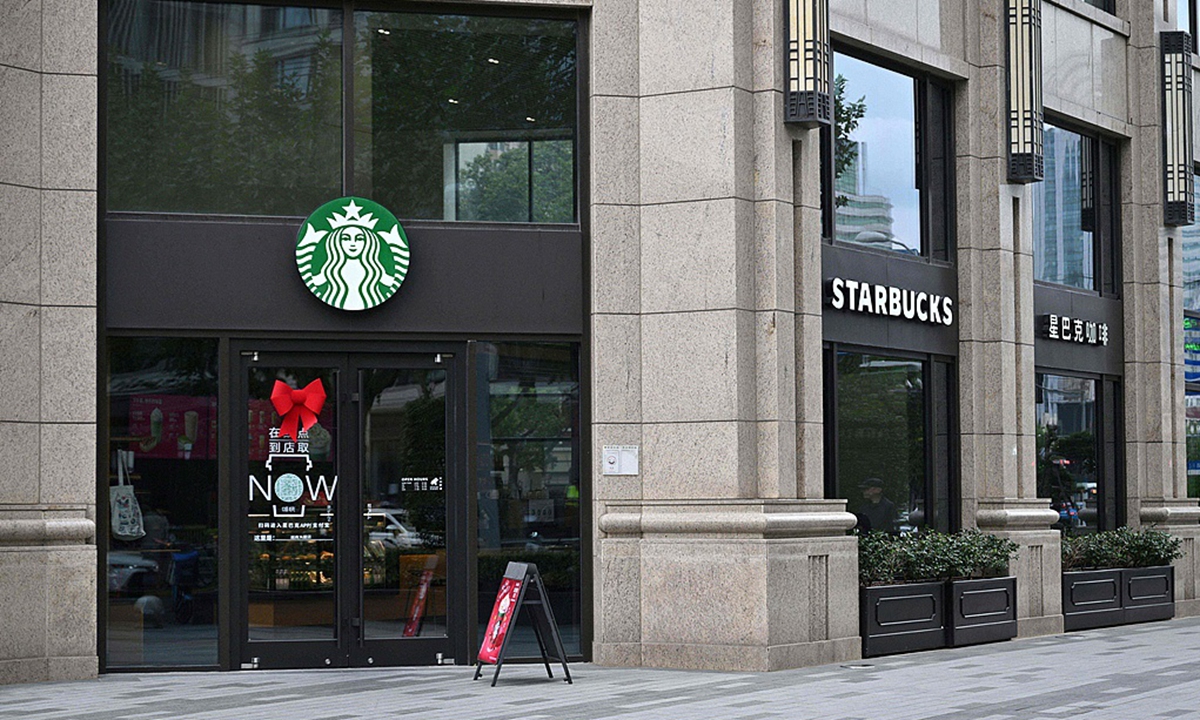
A Starbucks coffee shop at the Jing'an district in Shanghai on November 4, 2025. Photo: VCG
Starbucks Coffee Co announced on Tuesday that it has entered an agreement to form a joint venture (JV) with Boyu Capital, a leading alternative investment firm to operate Starbucks retail in China.
Under the agreement, Boyu and Starbucks will operate a JV, with Boyu holding an interest of up to 60 percent in Starbucks retail operations in China. Starbucks will retain a 40 percent interest in the JV and continue to own and license the Starbucks brand and intellectual property to the new entity. Boyu will acquire its interest based on a cash-free, debt-free enterprise value of approximately $4 billion.
Going through a 26-year journey in the Chinese market, why does Starbucks decide to sell its majority stake in China operations?
Adjustment amid fierce competition
The decision marks the most significant strategic pivot for Starbucks. Far from being just a financial transaction, it represents a profound adjustment by Starbucks to regain its growth momentum amid the aggressive rise of domestic brands like Luckin and Cotti. The company is heralding the opening act of a full-scale counteroffensive, some industry analysts said.
In January 1999, Starbucks opened its first store in Beijing, officially entering the Chinese market. According to its fourth-quarter financial report for fiscal year 2025 (ended September 28), as of the end of fiscal year 2025, the company has opened 8,011 stores across 1,091 county-level cities nationwide.
However, this number was far behind Chinese coffee chain operator Luckin Coffee, a company that was established in 2017 but now owned more than 20,000 stores across China.
"Luckin has become Starbucks' most direct competitor, as it employs flexible store models and franchise systems to accelerate market expansion, particularly with rapid deployment in lower-tier markets; in contrast, Starbucks is constrained by its self-operated model, resulting in slower expansion speed and less intensive channel penetration compared to Luckin," Wang Peng, an associate researcher at the Beijing Academy of Social Sciences, told the Global Times on Wednesday.
There is also the price factor. Although the coffee giant voluntarily lowered the prices of 10 non-coffee beverages for the first time in the Chinese market in 2025, domestic brands such as Luckin and Cotti have seized market share with their "9.9 yuan coffee" strategy, thereby undermining the appeal of Starbucks' premium pricing space, according to analysts.
Luckin Coffee Co-founder and CEO Guo Jinyi said during the second quarter 2025 Earnings Conference Call Transcript that "On the store front, we decisively seized the opportunity of rising demand to speed up new store openings, expanding our presence in high-quality locations across high-tier cities while deepening our reach into lower-tier markets."
Meanwhile, the cross-boundary incursions by tea beverage brands and fast food industry are further diverting Starbucks' target customer base, Zhang Yi, CEO of the iiMedia Research Institute, told the Global Times on Wednesday.
For instance, KFC and McDonald's have launched exclusive coffee brands to actively capture market share among young consumers with affordable prices. In addition, a number of local tea beverage brands, such as Guming and Chabaidao, have begun venturing into the coffee sector, leveraging their existing store networks for rapid market penetration with low-price strategies (less than 10 yuan per cup).
"The rise of domestic coffee and other drink brands has created strong competition in areas such as products, pricing, and operations, thereby impacting Starbucks' market share. The stake sale represents Starbucks' proactive strategic choice to counter this competition by introducing local capital and resources, enhancing its market responsiveness and operational efficiency," Wang noted.
"Boyu's deep local knowledge and expertise will help accelerate our growth in China, especially as we expand into smaller cities and new regions. We've found a partner who shares our commitment to a great partner experience and world class customer service," Brian Niccol, chairman and chief executive officer of Starbucks Coffee Company, said in a statement released by the company.
Shift in consumer attitudes
"Perhaps a few years ago, people thought buying a cup of Starbucks was something worth showing off, but in fact, coffee has transitioned from a 'social symbol' to an everyday essential for many young consumers. So now, I prefer coffee brands that offer better value for money," a white-collar worker surnamed Hao, based in Hangzhou, East China's Zhejiang Province, told the Global Times on Wednesday.
According to iiMedia Research, the market size of China's coffee industry reached 789.3 billion yuan in 2024 and is projected to exceed 1 trillion yuan in 2025. Data shows that among the single-cup coffee prices acceptable to Chinese coffee consumers in 2025, the 21-30 yuan price range accounts for the highest proportion at 46.44 percent, and the second-highest range is 11-20 yuan, with 30.34 percent, suggesting that consumers are price-sensitive and prefer coffee with high value for money.
Zhang noted that as per capita income continues to rise, the demand structure of Chinese consumers is undergoing a transformation. "People have demystified the 'Western lifestyle' and are instead pursuing more practical products with greater emotional value," Zhang added.
Therefore, an increasing number of merchants started to cater to consumer demands through diversified marketing strategies, such as IP co-branding by Luckin Coffee, Zhang said.
Since the second quarter, a series of creative and buzzworthy IP collaborations, including those with SpongeBob and Duolingo, have sparked strong emotional resonance and purchasing intent, further driving user engagement and unlocking consumption potential, Guo, CEO of Luckin Coffee, said.
"Compared with Starbucks, Luckin and other domestic coffee brands better understand the preferences of Chinese consumers," Zhang said, noting that the involvement of Boyu Capital, which deeply cultivates the Chinese consumer sector, can further enhance the operational capacity of Starbucks in China.
According to the company's website, founded in 2011, Boyu Capital is a leading alternative investment firm with Chinese roots and a global mandate with over 200 portfolio companies and offices in Hong Kong, Beijing, Shanghai and Singapore.
Its core competitiveness is reflected in its deep presence in the consumer retail sector from leading Alibaba's share repurchase, to taking a controlling stake in Beijing SKP and investing in Mixue Bingcheng, to serving as a cornerstone investor in the IPOs of CATL and Haitian, stcn.com reported.
"Building on our positive business momentum, our partnership with Boyu will enable Starbucks China to fully unlock the vast market opportunity. This collaboration is a powerful commitment to our next chapter of growth," Molly Liu, executive vice president and chief executive officer of Starbucks China, said in the company's statement.
New chapter
Yet, the Starbucks' move may prompt questions about its implications for the brand's long-term presence in the country.
According to the company's statement, "this partnership marks a significant milestone in Starbucks ongoing transformation and underscores its commitment to accelerating long-term growth in China, one of the company's most important and fastest-growing markets globally."
The business will continue to be headquartered in Shanghai and will own and operate the 8,000 Starbucks coffeehouses across the market today with a shared vision to grow to as many as 20,000 locations over time, Starbucks said.
"The decision by Starbucks is not an exit but a strategic adjustment. And the case serves as a microcosm of the development trajectory of international restaurant chains in China in recent years," Wang said.
In 2016, Yum! Brands, the US restaurant giant, completed the spin-off of its China operations. YumChina officially listed as an independent company on the New York Stock Exchange. According to Yum China's official website, following its independent listing, the company holds the exclusive operating and franchising rights for KFC, Pizza Hut, and Taco Bell brands in the Chinese market.
In 2017, McDonald's announced the completion of a strategic partnership with CITIC, CITIC Capital and Carlyle. Since then, McDonald's is shifting from direct operations to a light-asset model, accelerating its expansion in the Chinese market. In 2023, McDonald's acquired Carlyle's minority ownership stake in the strategic partnership that operates and manages McDonald's business in Chinese mainland, Hong Kong and Macao.
Once enterprises reach a certain stage of development in China, most may inevitably face the clash between the "global standardized model" and the Chinese market's emphasis on "rapid iteration, high efficiency, and strong localization." This does not mean the Chinese market is unwelcoming to foreign enterprises; rather, it depends on whether they can promptly adjust their development strategies to adapt to market trends, Zhang noted.
As a fresh example, Shanghai Disney Resort announced on Monday plans to build its fourth themed hotel, which will join the resort's current hotel portfolio, according to its official WeChat account. The announcement came after Shanghai Disney Resort recently welcomed its 100 millionth visitor since its opening in June 2016, setting a new record with 14.7 million visitors received in 2024, according to the company.
In addition, LEGOLAND Shanghai Resort opened its doors on July 5. It covers an area of 318,000 square meters in Jinshan district, heralding the arrival of China's first LEGOLAND resort, the world's 11th, and the largest one at the time of its opening, according to the Xinhua News Agency.
"The strong performance of international entertainment companies such as Disney and LEGO in China reflects the deep shift in the country's consumption structure with the shift from basic functional needs to emotional and experiential consumption," Zhang said.
The Chinese consumer market is still vast in scale with ample growth potential, with improving policy environment and deepening high-level opening up to foreign investment. And the key is: The more you understand Chinese consumers, the more you gain, Zhang noted.
RELATED ARTICLES