Chinese actress Wen Zhengrong claims AI face theft after multiple fake livestreams use her image: media report
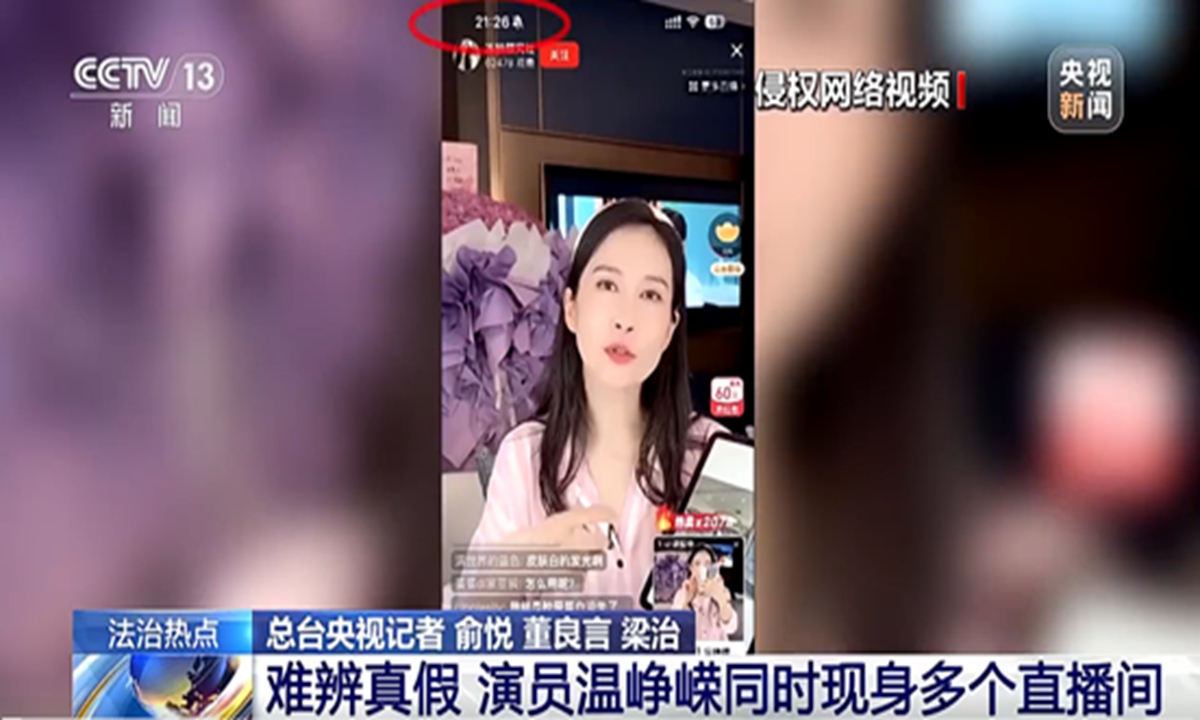
CCTV reports that Chinese actress Wen Zhengrong claims she has become a victim of AI face theft, as multiple fake livestreams used her image. Photo: Screenshot from CCTV News
Chinese actress Wen Zhengrong claimed that she became a victim of AI face theft, as China Central Television (CCTV) revealed multiple fake livestreams using her image—either AI-generated fakes or unauthorized re-broadcasts, according to CCTV on Friday.
Wen, born in 1977 in Southwestern China's Guizhou Province and a graduate of the Beijing Film Academy, stars in the recent TV drama Love's Ambition. In a CCTV report, she shared an unsettling experience: after wrapping up a late-night shoot and returning home, she was scrolling through her phone when she stumbled upon a livestream claiming to feature her. "We were filming until around 3 or 4 am," she recalled. "When I joined the livestream, I said, 'You're Wen Zhengrong, then who am I?' and was immediately blocked."
Wen also mentioned that before April, someone told her that she had appeared in multiple livestreams at the same time, with different makeup and hairstyles, promoting different products, but saying the same words, according to China News Service.
In response, Wen posted a video to debunk the fakes on April 1, stating clearly that she only has one account for livestreaming. She also encouraged her fans to report any unauthorized livestreams they come across, China News Service reported.
CCTV News, citing Wen's staff, reported that some merchants only need to capture a segment of footage and use simple AI generation technology to create false content, while the authorities or affected parties have to spend a great deal of effort to gather evidence.
Some netizens in the comments section of the CCTV report expressed that this is terrifying, noting that it is no longer just about protecting one's rights, but that AI-related crimes need to be taken seriously. Others raised the question of whether some videos featuring celebrities using certain products might also be AI-generated.
Previously, In June 2025, the Haidian District Market Regulation Bureau in Beijing investigated a case involving a company that used AI technology to impersonate the well-known CCTV host Li Zimeng in a deceptive advertisement. This marked the first time Beijing's market regulatory authorities applied the Advertising Law of the People's Republic of China to take action against the misuse of AI technology for fraudulent advertisements impersonating famous individuals.
Starting September 1, 2025, the Measures for Labeling AI-Generated Synthetic Content, jointly formulated by the Cyberspace Administration of China and other authorities, came into effect. The new regulations require all AI-generated content—whether text, images, or videos—to be clearly labeled, disclosing its origin and authenticity.
Li Liang, Vice President of Douyin (TikTok China), posted a statement on Weibo Thursday about the recent case of Wen being impersonated by AI in livestreams. He confirmed that the "simultaneous livestreams" incident did not occur on Douyin, but noted that some AI-generated videos impersonating celebrities for product promotions were found on the platform.
Recognizing that detecting AI content infringement is a challenging technical issue, Li noted that malicious impersonation accounts are continuously evolving to counter the platform's technology. Douyin will continue to invest in efforts to address this challenge and protect the legal rights of creators, businesses, and consumers. He also stressed that the special governance action is still ongoing.
Global Times
RELATED ARTICLES