Trump meets Central Asia leaders on critical minerals and trade; cooperation with US does not mean loosening Russia, China bonds: expert
By Published: Nov 07, 2025 10:48 PM

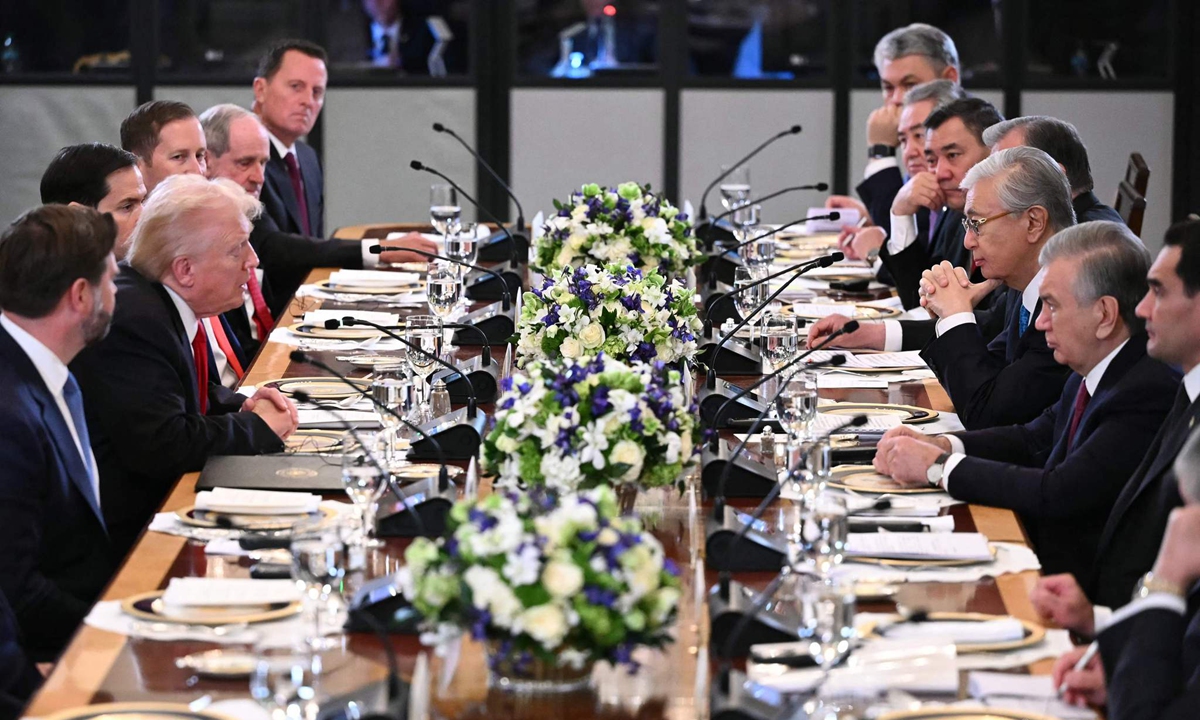
US President Donald Trump (2L) speaks during a dinner with Central Asian leaders in the East Room of the White House in Washington, DC, on November 6, 2025. Photo: VCG
US President Donald Trump met with leaders of the five Central Asian countries at the White House on Thursday local time, aiming to strengthen economic ties and overall relations with the energy- and mineral-rich region, according to media reports.
Some US media claimed that Washington is attempting to "assert influence in a region long dominated by Russia and China," while a Chinese expert believed that this by no means indicates that cooperation with the US will distance Central Asian countries from Russia and China, with whom they share far closer geographical proximity and deeper economic ties. Furthermore, the foundation of cooperation between China and Central Asia, built firmly on mutual respect and shared development, is robust, and no external force can easily shake it.
During the meeting with the leaders of the five Central Asian countries on Thursday local time, Trump claimed that he would look to diversify critical minerals purchases, Bloomberg reported. The Fox News reported that the talks centered on strengthening US access to strategic resources such as uranium, copper and rare earth elements as Washington "seeks to reduce reliance on China and Russia for essential supply chains."
Among the business deals that were announced was an agreement for Boeing to sell up to 37 airplanes to airlines in Kazakhstan, Tajikistan and Uzbekistan combined. A US company, Cove Capital, will mine tungsten in Kazakhstan with government-backed financing, Reuters reported.
The US president also announced a new trade deal across several sectors between Uzbekistan and the US on late Thursday local time.
In a post on Truth Social, Trump wrote, "Over the next three years, Uzbekistan will be purchasing and investing almost $35 Billion Dollars and, in the next 10 years, over $100 Billion Dollars, in key American Sectors, including Critical Minerals, Aviation, Automotive Parts, Infrastructure, Agriculture, Energy & Chemicals, Information Technology, and others."
According to Astana Times, Kazakhstan has signed $17 billion in commercial agreements with the US and formally joined the Abraham Accords.
The summit mechanism between leaders of the US and the five Central Asian countries marks its 10-year anniversary in 2025, according to US media reports. This summit marks the first time a US president has hosted the group leaders at the White House, with both US media and institutions viewing it as a sign that Washington is trying to "assert influence" in a region "long dominated by Russia and China."
Zhu Yongbiao, executive director of the Research Center for the Belt and Road at Lanzhou University, told the Global Times on Friday that the US Central Asia policy has long swung between high attention and relative neglect. After withdrawal from Afghanistan, US' focus and presence in Central Asia declined noticeably.
"Today, however, Central Asia's geopolitical location and its abundant energy and mineral resources have become increasingly critical amid global supply-chain restructuring and great-power technological competition," Zhu said, "as a result, the US is once again turning its gaze toward the region, attempting to drive a wedge for China and Russia in strategic competition and reshape American influence there."
On the other hand, Central Asian states have consistently pursued a multi-vector foreign policy, navigating the narrow straits of great-power games to maximize both strategic autonomy and economic gain, the expert said.
"They welcome American technology and security partnerships, yet they never lose sight of their deep historical, geographical, and economic ties with China and Russia," Zhu said, emphasizing that for Central Asian countries, developing ties with the US does not mean distancing themselves from China or Russia.
The second China-Central Asia Summit was held in Astana, Kazakhstan in June this year. In October, Russia also held its second Central Asia summit in Tajikistan.
During the second China-Central Asia Summit, leaders of China and the five Central Asian nations signed the treaty on eternal good-neighborliness, friendship and cooperation. In the keynote speech at the summit, the Chinese leader proposed a China-Central Asia Spirit of "mutual respect, mutual trust, mutual benefit and mutual assistance for the joint pursuit of modernization through high-quality development."
In its cooperation with Central Asian countries, China has always been a constructive participant and a reliable pillar of stability, Zhu said, adding that with a long-term vision, China is committed to enlarging the pie of cooperation together with its Central Asian partners and openly shares the fruits of its development - including a wide array of technologies, market, products, and solutions.
"More importantly, China treats Central Asian nations with genuine respect. It engages them on the basis of equality, a clear distinction from certain other major powers. Such a cooperation framework - built on mutual respect and shared prosperity - is rock-solid and cannot be easily undermined by any external force," said Zhu.
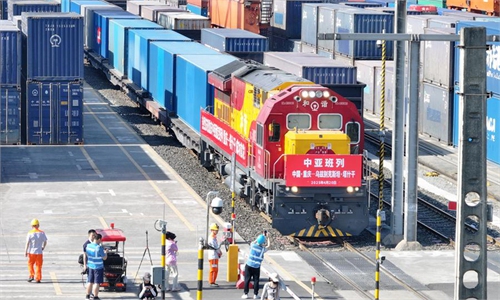
In recent years, economic and trade cooperation between China and Central Asian countries has surged in both volume and quality. China has become the largest trading partner and a major source of investment for Central Asian nations, according to Xinhua.
Data released in June by the General Administration of Customs showed China's trade with the five Central Asian countries had expanded from 312.04 billion yuan ($43.48 billion) in 2013 to 674.15 billion yuan in 2024, representing an increase of 116 percent.
In the first five months of 2025, China's trade with these countries reached 286.42 billion yuan, up 10.4 percent year on year, and setting a new record high for this period.
RELATED ARTICLES