10 years on, building a community with a shared future in cyberspace reshapes global internet governance landscape: academy
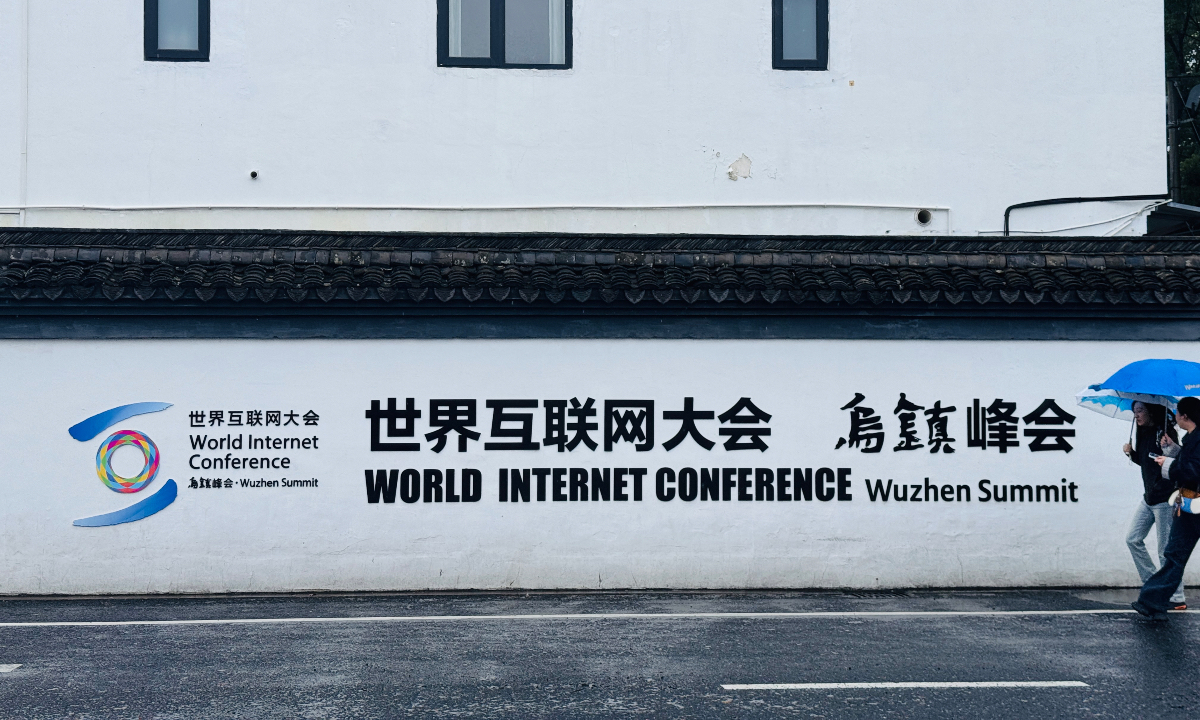
The 2025 World Internet Conference (WIC) Wuzhen Summit is held in the ancient water town of Wuzhen in East China’s Zhejiang Province. Photo: Chi Jingyi/GT
Over the past decade, the concept of building a community of a shared future in cyberspace and its successful practices have not only profoundly influenced the global internet governance landscape but also contributed Chinese solutions and wisdom to humanity’s joint efforts in addressing cyberspace challenges and sharing development opportunities, Wang Jiang, director of Chinese Academy of Cyberspace Studies, said on Saturday.
Wang made the remarks at a press conference during the ongoing 2025 World Internet Conference (WIC) Wuzhen Summit held in the ancient water town of Wuzhen in East China’s Zhejiang Province.
Wang said that China has successively released important documents such as the concept paper, action initiatives and white papers of Jointly Building a Community with a Shared Future in Cyberspace, systematically expounding the connotations and basic principles of building a community of development, security, responsibility and shared interests.
Facing new opportunities and challenges brought by scientific and technological revolutions and industrial transformations, this concept keeps pace with the times, promoting the building of a community with a shared future in cyberspace to a new stage, Wang noted.
In terms of information infrastructure connectivity, China has not only built the world’s largest 5G network domestically but also assisted developing countries in enhancing their digital infrastructure and capacity building, Wang said.
The country has implemented multiple demonstration projects with Belt and Road partner countries in fields such as e-commerce, remote education and smart cities, promoting the global application of the Beidou system, and advancing projects like the Greater Mekong Subregion Information Superhighway and the China-Pakistan cross-border optical cable, in a bid to actively bridge the digital divide, according to Wang.
In the digital economy sector, China has promoted the formulation of G20 Digital Economy Development and Cooperation Initiative, jointly initiated the Belt and Road Digital Economy International Cooperation Initiative, signed memoranda of understanding on digital economy cooperation with multiple countries, and developed partner countries for “Silk Road E-commerce.”
In the first half of 2025, China's total cross-border e-commerce import and export volume reached 1.37 trillion yuan, representing a year-on-year increase of 10.3 percent, Wang said.
In the realm of cybersecurity, China has actively engaged in international cooperation to combat cybercrime and cyber terrorism, promoting the adoption of the United Nations Convention against Cybercrime; released the Global Data Security Initiative, and signed data security cooperation initiatives with the League of Arab States, Central Asian countries, and others. The country has also strengthened cooperation with ASEAN countries to crack down on telecommunications network fraud and online gambling, Wang added.
China has signed memoranda of understanding on cybersecurity cooperation with multiple countries, bolstered international cooperation in cybersecurity emergency response and established international partnership relations with 292 computer emergency response organizations across 86 countries and regions, according to Wang.
“Through these concrete actions, China has provided robust safeguards for the security and stability of the global cyberspace, demonstrating the responsibility of a major power and firm support for multilateralism,” the director noted.
In the area of international governance, China released the International Strategy of Cooperation on Cyberspace in 2017, proposing the principles of “peace, sovereignty, shared governance, and shared benefits”.
It has also promoted the WIC Wuzhen Summit as an international platform for shared and co-governed internet development, and established the WIC as an international organization in 2022.
China supports the formulation of digital trust and security rules under the UN framework, actively participates in the development of the UN Global Digital Compact, the Internet Governance Forum, and other activities, as well as digital governance within mechanisms such as the G20, APEC, SCO and BRICS.
Especially in the field of artificial intelligence (AI) governance, China continues to deepen institutional innovation and practical exploration, Wang said.
In July this year, the Shanghai World Artificial Intelligence Conference released the Global AI Governance Action Plan, continuously launching Chinese solutions for AI governance. In addition, it has conducted intergovernmental dialogues on AI between China and the US, established cyber dialogue mechanisms with Europe, the Americas, and Russia, actively playing the role of a responsible major power, and contributing Chinese strength to international cyberspace governance, said Wang.
During the Wuzhen Summit, participants hailed China’s rapid development in the internet sector, while highlighting the country’s contribution to sharing its tech dividends to other countries.
Chinese “companies like Unitree with humanoid robots, DeepSeek with very large language models, Alibaba, Baidu, and telecom operators like China Mobile, China Unicom, and China Telecom... They were all there, contributing to our workshops and programming, showing demos and practical applications on how AI can help humanity in healthcare, agriculture and disaster management,” Frédéric Werner, chief of Strategic Engagement at ITU and co-creator of the UN AI for Good Global Summit, told the Global Times on the sidelines of the summit.
“China is one of only a few countries which is trying to bring countries together, to look at how best we can secure cyberspace and also how we can do new innovations in cyber. It’s helping developing countries like those in Africa,” Mudenda Mac Millan, senior conservation officer of the National Heritage Conservation Commission in Zambia, told the Global Times.
RELATED ARTICLES