Germany reportedly plans to re-examine so-called ‘security-related’ trade policies toward China; potential move harms own interests: expert
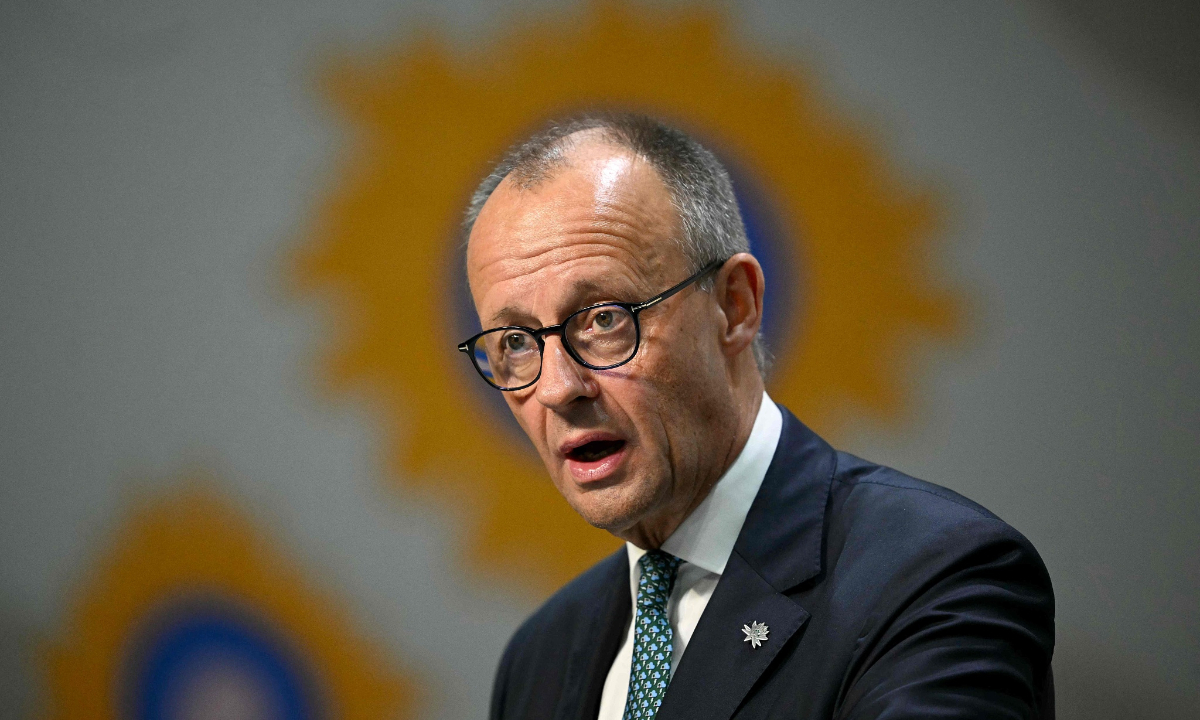
Germany's Chancellor Friedrich Merz speaks during a press conference at the Leaders Summit, ahead of the COP30 UN climate conference in Belem, Para State, Brazil, on November 7, 2025. Photo: VCG
In another protectionist move that runs counter to free trade spirit, Germany's coalition government plans to re-examine its trade policies towards China including on energy, raw material imports and Chinese investment in critical German infrastructure and will set up a committee of experts to report to parliament, according to Reuters. A Chinese expert said that Germany's current approach is based on a fundamental misconception as they misinterpret complementary relations as security threats and view normal trade exchanges as sources of risk.
The committee will examine so-called "security-relevant trade relations between Germany and China" and make recommendations to the government, according to a motion submitted by Chancellor Friedrich Merz's conservatives and their Social Democratic coalition partners, per Reuters on Saturday.
The motion is likely to be passed on next Friday and the committee - which will be staffed by a dozen academics, industry associations, labor representatives and think tank members - will be established shortly afterwards, the report said.
For decades, Germany saw China, another major exporter, as a natural ally in advocating for the open global trading system that helped Germany's manufacturing sector flourish. But Reuters claimed that a series of recent so-called "blows" - including Chinese restrictions on rare earth exports - have prompted a rethink,
Linking trade with security in Germany's China-related economic and trade policies is actually a long-standing issue, Jiang Feng, a research fellow at Shanghai International Studies University and president of the Shanghai Association of Regional and Country Studies, told the Global Times on Sunday. In recent years, Germany has continuously discussed and implemented the so-called "de-risking" policy toward China, which primarily focuses on bilateral economic relations and regional risk management. However, despite several years of implementation, Berlin believes the policy has not been thorough enough, considering that China's exports to Europe and Germany have even increased, while dependence on China in areas such as key raw materials appears to have intensified, Jiang explained.
"I believe this assessment is fundamentally flawed. The economy is inherently interconnected—how can trade exist without interdependence? Moreover, the economic and trade relationship between China and Germany is essentially highly complementary," Jiang said.
Germany's current approach is based on a fundamental misconception. They misinterpret complementary relations as security threats and view normal trade exchanges as sources of risk.
Earlier on Thursday, German Chancellor Friedrich Merz has backed protectionist measures to shield the country's ailing steel industry from cheap Chinese imports, in a striking departure from the country's traditional commitment to free trade, the Financial Times reported.
This stance was "different from what we always thought was right in earlier times", Merz claimed, adding that in those times markets were open, competition was fairer and the US had not embraced tariffs. "Unfortunately, these times are gone and that is why we must protect our markets, that's why we must protect our manufacturers," he claimed.
From January to August, Germany's exports to the US totaled 101 billion euros ($117 billion), down 6.5 percent from a year earlier. By contrast, trade between Germany and China proved more resilient, rising to 166.3 billion euros ($193 billion) during the same period.
As major countries and leading economies, cooperation between China and Germany is mutually beneficial. Especially under the current circumstances, the two sides should uphold mutual respect, treat each other as equals, pursue win-win cooperation, and push bilateral relations forward along the right track, the Chinese Foreign Ministry spokesperson Guo Jiakun said on October 27, adding that China has always viewed and developed its relations with Germany from a strategic height and long-term perspective.
Last month, German Foreign Minister Johann Wadephul postponed his planned visit to China while media report claimed that Beijing confirmed only one substantive meeting. Later, Germany has sought to play down the impact of Foreign Minister Johann Wadephul's decision to postpone visit to China, with officials and media outlets emphasizing that Berlin remains committed to dialogue with Beijing.
The German side believes the existing policies have loopholes and need strengthening, but this is actually leading them further down the wrong path, Jiang said. They fail to see that China's relevant measures are responses to specific international circumstances, not proactive provocations.
The principle is simple, as Jiang put it: only cooperation leads to win-win outcomes. Europe's current approach not only fails to resolve issues but also harms its own economic interests. Jiang also warned that such motion goes beyond mere protectionism; it fundamentally subverts the logic of global economic and trade relations. The economic prosperity of Germany and Europe as a whole is built upon a healthy international trade order, yet they are now undermining this very foundation—akin to cutting the ground from under their own feet, the expert said.
RELATED ARTICLES