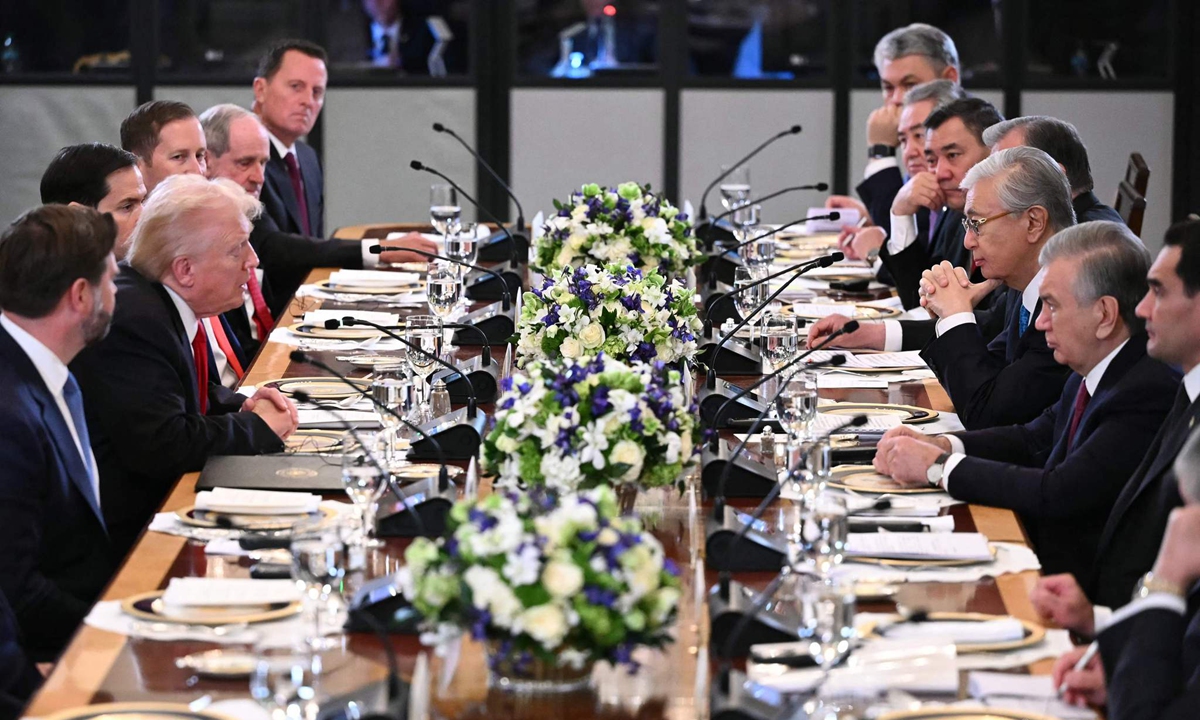
US President Donald Trump (2L) speaks during a dinner with Central Asian leaders in the East Room of the White House in Washington, DC, on November 6, 2025. Photo: VCG
US President Donald Trump hosted the leaders of five Central Asian countries at the White House on Thursday. Engagements between the US and the Central Asian region are seldom on the media's radar. Even the US president acknowledged that "previous American presidents neglected this region completely." While he claimed, "I understand the importance of this region," most media focused on the US intention to engage with Central Asia: to "boost critical mineral ties."Central Asia is of particular importance to the US in terms of resources, especially critical minerals. The region is home to 38.6 percent of the world's manganese ore reserves, 30 percent of its chromium reserves, 20 percent of its lead reserves, 12.6 percent of its zinc reserves and 8.7 percent of its titanium reserves.
Obviously, the US believes Central Asia could become an important "card" in its hands in its "Great Game" against China or even Russia, which it deems a threat.
The US still follows a modified version of the Monroe Doctrine, which states that the US has national interests in every corner of the world. The US has proclaimed its own interests in Central Asia as well. It could have a positive impact on the Central Asian nations if US interests complement the Chinese and Russian efforts to build prosperity in this part of the world. Yet the real-world situation has proved otherwise.
The US has failed to capitalize on the new developments in Central Asia and has not provided the deeply integrated and tangible public goods and development opportunities that China and Russia have offered. The interaction between the US and Central Asian countries, as well as the prospects for deepening relations, face a number of systemic problems.
First, the US and Central Asia are geographically distant from each other. The problem is exacerbated by the isolation of Central Asia from global trade routes, making the region less attractive to US businesses.
Second, Central Asia is not a priority for US foreign policy in the field of security. The US is redirecting its security focus from the "heart of Eurasia" to its periphery, as confirmed by the withdrawal of troops from Afghanistan. The main directions at the moment are Eastern Europe, the Asia-Pacific region and the Middle East. From this point of view, ensuring security in Central Asia is relegated to the background, which may hinder the development of relations in the area.
Third, Central Asia borders two major industrial powers - China and Russia - while US businesses are becoming uncompetitive. These two countries also meet the region's investment needs, particularly in areas such as transport and logistics, which are key economic drivers for Central Asia. Beijing and Moscow are involving the region in their projects such as the Belt and Road Initiative and the Eurasian Economic Union.
Fourth, US culture, particularly its entrepreneurial culture, is very different from that of Central Asia, which makes cooperation difficult. US businesses also do not trust Central Asia's investment climate due to what they perceive as underdeveloped market mechanisms and lack of necessary guarantees.
Fifth, the above-mentioned problems exacerbate the barriers to the interaction between the parties, in particular under a law called the Jackson-Vanik Amendment. This amendment establishes a ban on granting most-favored-nation treatment in trade with the US to countries with non-market economies. Although the repeal of this law concerning Central Asian countries has been discussed for several years, it still serves as a deterrent.
Sixth, in the long-term, the US will return to the issue of liberal values in its foreign policy and will repeatedly exert pressure on democracy and human rights issues.
In general, the C5+US Summit will not lead to any drastic changes in the relations between the parties or in the configuration of power in the region, but it may increase tensions between the US on one side and China and Russia on the other. As for the Central Asian countries, it is vital for them to maintain the current configuration of power in the region and not turn themselves into disruptive proxy actors.
The author is director of the Institute of World Policy of Kyrgyzstan. opinion@globaltimes.com.cn
RELATED ARTICLES