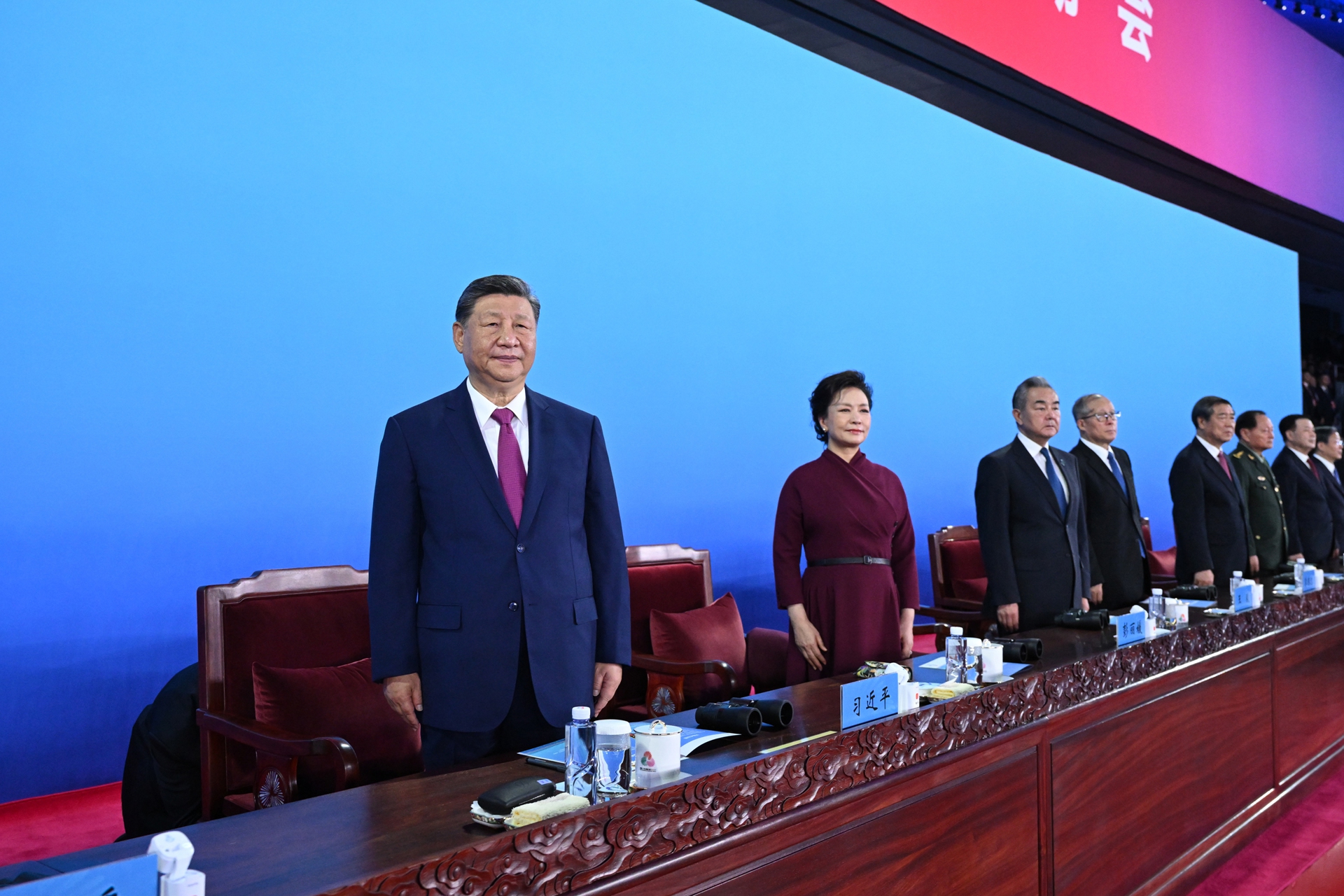
Chinese President Xi Jinping, also general secretary of the Communist Party of China Central Committee and chairman of the Central Military Commission, attends the opening ceremony of the 15th National Games and declares the Games open on November 9, 2025 in Guangzhou, South China's Guangdong Province. Photo: Xinhua
Chinese President Xi Jinping declared the 15th National Games open on Sunday. Xi, also general secretary of the Communist Party of China Central Committee and chairman of the Central Military Commission, attended the opening ceremony of the Games in Guangzhou, capital city of Guangdong Province.
Xi met with representatives of national model units and individuals in mass sports and competitive sports, ahead of the opening.
Xi extended his congratulations to the honorees, encouraging them to push their limits, strive for new heights, and make new contributions to building China into a sports powerhouse.
At the opening ceremony, robots playing ancient Chinese instruments, VR and AR technologies depicting local icons, performers doing local popular folk dance Yingge and martial arts Wing Chun performances invigorated the Guangdong Olympic Sports Center Stadium.
The much anticipated cauldron was jointly lit by Guangdong's veteran sprinter Su Bingtian, Hong Kong's Olympic fencing champion Cheung Ka-long and Li Yi, Macao's Asian Games Wushu champion.
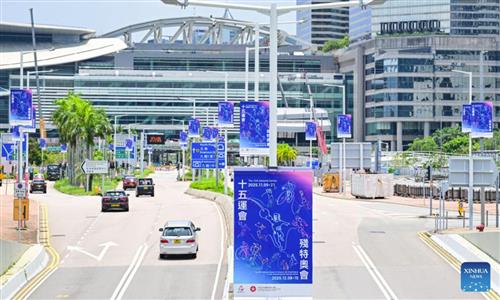
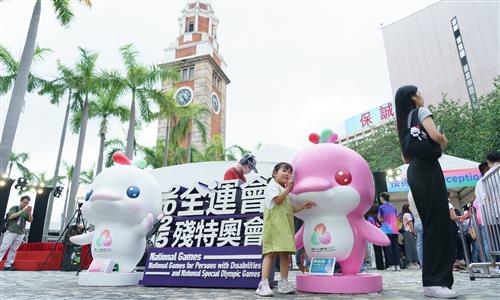
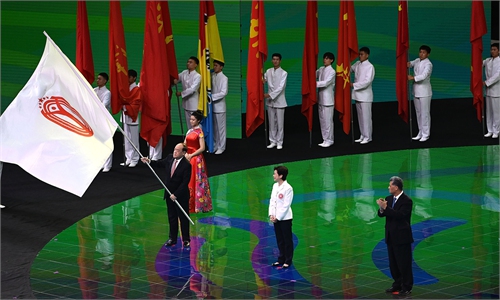
The Games, which run from Sunday to November 21 across Guangdong, Hong Kong and Macao, is the first time the event is being held across Guangdong-Hong Kong-Macao Greater Bay Area. A total of 14,252 athletes are competing in 419 disciplines and in 34 sports.
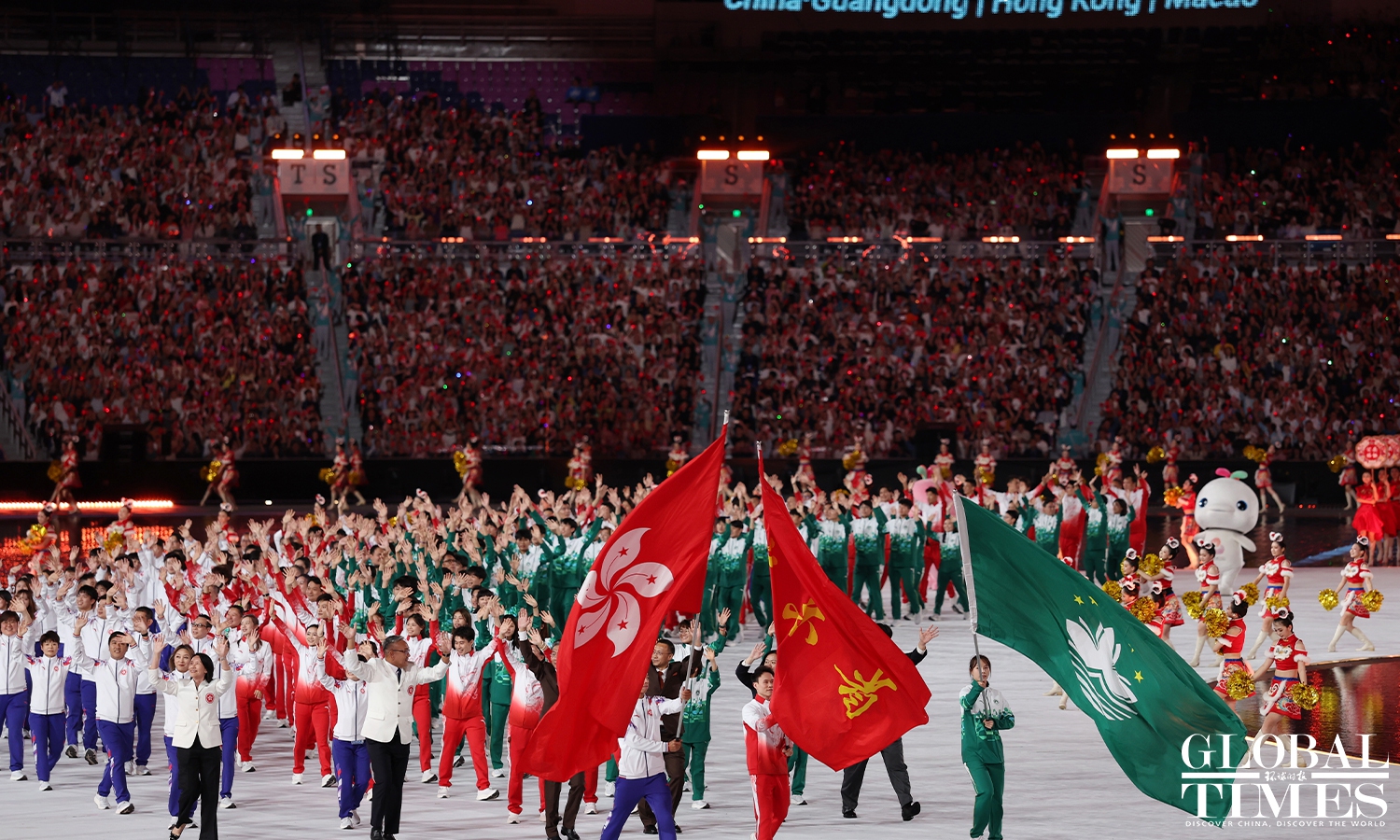
The host delegations of Guangdong, Hong Kong and Macao make a joint entry at the opening ceremony of the 15th National Games at the Guangdong Olympic Sports Center in Guangzhou on November 9, 2025. Photo: Cui Meng/GT
GBA fusion
Xi on Sunday also met with International Olympic Committee (IOC) President Kirsty Coventry and Honorary President for Life Thomas Bach. He noted that the Olympic spirit is an important part of human civilization, carries people's aspirations for a better world, and is highly consistent with China's vision of building a community with a shared future for humanity.
Noting that the Guangdong-Hong Kong-Macao Greater Bay Area is one of China's most open and economically dynamic regions, Xi said the goal of promoting the development of the area is to make it into a strategic underpinning for China's new development paradigm, a demonstration area for high-quality development, and a pacesetter of Chinese modernization.
He expressed confidence that this year's National Games will showcase not only China's new sporting achievements in the new era, but also the remarkable progress of Chinese modernization in the Greater Bay Area.
Coventry and Bach expressed their delight at being in Guangzhou to witness the tremendous dynamism and accomplishments of Chinese modernization in the Greater Bay Area.
Of particular note for this year's Games are two first-ever cross-boundary events: the men's road-cycling individual race that traversed the Hong Kong-Zhuhai-Macao Bridge linking the three cities on Saturday and a marathon route linking Shenzhen and Hong Kong on November 15.
Chan Kwok-ki, Chief Secretary for Administration of the Hong Kong Special Administrative Region (HKSAR) government, noted on Sunday at a delegation chief meeting that the completed cycling event featured seamless real-time customs clearance, with excellent coordination in port services and transportation.
The organizers have pioneered a new model of "pre-clearance, closed-loop operation and seamless border crossing," and have explored innovative mechanisms under the principle of "one matter for three regions."
These efforts have addressed the challenges of ensuring the efficient and convenient flows of people, goods and information across different systems, providing a valuable "National Games experience" to promote deeper and broader integration in the Greater Bay Area (GBA), said Li Jing, deputy director of the General Administration of Sport, Xinhua reported.
In addition, the emphasis on sustainability and cost-efficiency stands out. More than 90 percent of the venues are existing facilities that have been refurbished rather than new builds.
Equally central is the cultural component. The regional identity of Guangdong's Lingnan heritage has taken the stage, from traditional music and dance to the iconic floral symbols of the region and the GBA.
The Games' emblem design is an example of blending motifs of co-development and shared identity of the GBA region, as it consists of the kapok flower of Guangdong, the bauhinia of Hong Kong and the lotus of Macao.
Sports matters
Billed as China's domestic "mini Olympics," the quadrennial National Games, which was inaugurated in 1959, has featured Olympic disciplines plus multiple mass sports events.
Hong Kong sent its largest-ever delegation to the National Games, comprising more than 600 athletes. They will compete in 28 competitive sports events, according to Chan.
Including participants and staff involved in 23 mass sports events, the total delegation exceeds 1,800 people, the highest number since Hong Kong began taking part in the National Games in 1997, Chan said.
Games organizers have also vowed to continue the zero-tolerance stance toward doping, and more than 188 doping control officers are expected to conduct a record number of tests during the Games.
Along with international dignitaries such as new International Olympic Committee (IOC) President Kirsty Coventry, former IOC chief Thomas Bach, hundreds of national model representatives for mass sports and the sports system also attended the opening ceremony.
Quan Hanyan, Party secretary of Guangdong Experimental High School, told the Global Times that the joint hosting of the National Games by Guangdong, Hong Kong and Macao plays a significant role in encouraging public participation in sports.
Zhang Juanjuan, Beijing 2008 Olympic champion in archery and now head of the Shandong Archery Association, said that although at the National Games regional teams vie against each other, it also serves as a chance to learn from each other.
"Each province has its own strengths and characteristics, and through competition we can learn from each other and make progress together," Zhang told the Global Times.
The National Games also provides an invaluable learning opportunity for grassroots sports workers.
Zhou Fangxia, a sports official from Tongwei county in Northwest China's Gansu Province, told the Global Times that local sports facilities have been significantly improved during the 14th Five-Year Plan period (2021-2025), making it possible for county-level areas to host national-level mass sports events, greatly boosting public enthusiasm for sports participation.
"By observing the organization of these large-scale events, we can better understand sports development in our country," Zhou said. "When we return home, we can further promote fitness for all and youth sports and better align grassroots sports activities with national-level competitions."
RELATED ARTICLES