Investigative report reveals medical insurance cards used as 'shopping cards' in fraud scheme in several Chinese provinces
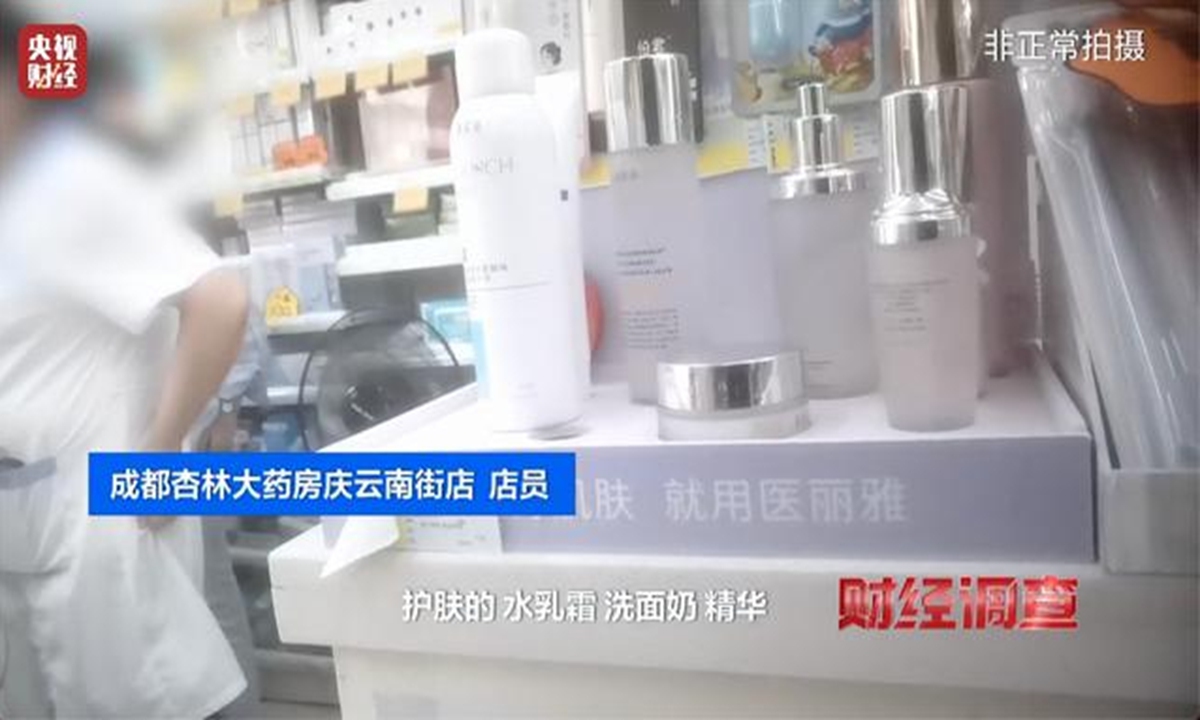
Screenshot of a CCTV investigative report revealing medical insurance cards used as 'shopping cards' in a fraud scheme Photo: CCTV
A CCTV investigation has uncovered a widespread scheme in which medical insurance personal accounts are being used to buy everyday consumer goods — from toothbrushes and face masks to sunscreen sleeves and cosmetic products — after being disguised as medical devices, drugstore items and "medical supplies."
Earlier this year, multiple municipal medical insurance bureaus issued warnings that some companies were reclassifying ordinary consumer products as medical devices so they could be paid for from individuals' medical insurance personal accounts. The practice violates China's social insurance law, which restricts basic medical insurance funds to medical-related expenses. But CCTV's undercover reporting shows that the abuse persists in pharmacies and manufacturers across several provinces.
"Shopping guides" for exploiting insurance cards have even appeared on social media, CCTV reported on late Sunday. Influencers and online posters openly share tips on how to use insurance cards in pharmacies to purchase daily-use items, encouraging consumers to treat their insurance balances as pocket money. Article 28 of the Social Insurance Law clearly stipulates that basic medical insurance funds may be used only to cover medical-related costs.
Examples from CCTV's field reporting are striking. At a pharmacy called Haiwang Xingchen, a reporter paid with an insurance card for an item listed in the store system as a "dental brush" classified as a Class I medical device — although staff admitted it is essentially no different from an ordinary toothbrush, according to CCTV.
At another pharmacy, the reporter bought a "dental cleaning device" recorded as a Class I device; staff said it was in fact dental floss, CCTV said.
In Chengdu's Quanyuantang pharmacy in Southwest China's Sichuan Province, colored contact lenses were purchasable with an insurance card; oddly, the item showed a catalog code of "000" in the payment system. When CCTV called the Sichuan provincial medical insurance hotline to verify, a staffer answered that such purchases are not allowed.
At Xinglin pharmacy and Haiwang Xingchen pharmacy chains, CCTV reporters were able to use medical insurance cards to purchase various "dressings" classified as Class II medical devices — which, according to store staff, were in fact skincare product sets repackaged under medical labels.
In Zhengzhou, Central China's Henan Province, at a Zhang Zhongjing chain pharmacy, reporters used their insurance cards to buy "medical dressings" registered as Class II medical devices. The store clerk admitted frankly that these so-called medical dressings were essentially facial masks, offering the same effects as ordinary cosmetic masks.
At a pharmacy branch called Dasenlin, the CCTV reporter found a product labeled as a "medical isolation pad" on the shelves. When asked, the store clerk revealed that the item was actually a pair of UV-protection cooling sleeves. When pressed on why a sun-protection sleeve was being sold as a "medical isolation pad," the clerk explained candidly: "The only special thing about it is that it can be paid for with a medical insurance card. To qualify for that, it must carry a medical label."
Following the information printed on the packaging, reporters visited the manufacturer, Henan Chaoya new materials, under the pretense of making a bulk purchase. The company's promotional materials, however, openly described these "medical isolation pads" — which had official medical device registrations — as sun-protection masks and sleeves.
According to the medical device classification catalogue issued by China's National Medical Products Administration (NMPA), the term "medical isolation pad" refers to protective products used for patient care, with specified application settings "mainly in general hospital wards." The products manufactured by Chaoya clearly did not conform to the official definition of medical devices.
Xu, a senior executive at Chaoya, told reporters that the company had found a lucrative formula — rebranding ordinary daily-use items as medical devices, then promoting them under the slogan of being "medical-grade, cleaner, and safer." This strategy, he admitted, allows the company to seize greater market share and significantly boost profits.
Proudly, Xu shared that earlier this year, Chaoya signed a major deal with a leading pharmacy chain to supply its so-called "medical isolation pads" — essentially sun-protection masks and sleeves — to nearly 20,000 pharmacies across China, with a contract value of 90 million yuan ($12.6 million).
When asked about how a product originally designed for sun protection could be covered by medical insurance, Xu explained that in some regions, "medical isolation pads" had been included in the list of reimbursable medical items, meaning customers could pay for them with their medical insurance cards. However, if the same product was sold simply as a sun-protection item, it would fall under the category of daily necessities — explicitly prohibited from insurance reimbursement.
Xu insisted that the company's production process was "fully compliant with regulations." Each "medical isolation pad," he said, carried a unique 27-digit medical insurance code, qualifying it for purchase through medical insurance systems.
He further elaborated that "medical isolation pads" are classified as Class I medical devices — a low-risk category that does not require rigorous clinical trials or extensive safety assessments. As long as the manufacturer completes the required registration, production can legally proceed in a certified medical device facility.
By exploiting this regulatory gap, Xu admitted, Chaoya was able to market its rebranded sun-protection products under a legitimate "medical" label — turning consumers' health insurance funds into company profits.
In Lanzhou, Northwest China's Gansu Province, the CCTV reporter visiting several outlets of the well-known Foci pharmacy chain found shelves prominently displaying products branded as Lanjimu and Yiyanjí — both marketed as so-called "medical skincare" items.
Without exception, these "medical skincare products" were registered as medical devices, allowing them to be purchased through China's medical insurance system. Yet, according to sales staff, the items were openly promoted as ordinary skincare products, with no genuine medical use.
Store clerks explained that the "intended use" and "product name" printed on the packaging had to match the official medical device registration information. Only then could the products pass the insurance system's verification process and be included in the local medical reimbursement catalog. Because such items yield higher profits than prescription drugs, pharmacies have strong incentives to push their sales, according to the CCTV report.
Posing as potential business partners, the CCTV reporter visited Hunan Muxue Times Biotechnology Co, the company behind the Yiyanjí and Lanjimu brands. The company's representative, surnamed Mao, proudly stated that their collaboration with Foci Pharmacy had been highly successful, generating nearly 10 million yuan in annual sales.
Another company executive, surnamed Liu, further revealed that pharmacy profits were closely tied to medical insurance settlements. "Selling medicine alone doesn't make money anymore," Liu said. "You need to open up new channels to earn more. 'Medical cosmetics' can be a profitable product line — you just need to know how to sell and recommend them."
All products produced by the company are registered as Class II medical devices, with their official filing stating they are intended for "post-cosmetic-surgery wound care." However, promotional materials provided by the company to pharmacies exclusively highlight the products' use as everyday skincare items.
When pressed by reporters, company employees admitted that the products are most commonly used for daily skincare rather than for any medical purpose. Despite this, such "skincare products" can still be purchased with medical insurance cards in some regions — a clear misuse of the public healthcare fund.
Liu, an executive at Muxue Times, told the CCTV that roughly 60 percent of the company's products sold in Lanzhou were purchased using medical insurance cards. Based on figures provided by the two company executives, reporters estimated that through just one channel — the Foci Pharmacy chain in Gansu — Muxue Times' so-called "medical skincare" products generated nearly 10 million yuan in annual sales.
If around 60 percent of those purchases were reimbursed through the medical insurance system, that would mean approximately 6 million yuan was drawn directly from consumers' personal medical insurance accounts.
Some comments pointed out that although China's medical insurance authorities have already established intelligent monitoring systems — employing big data analytics, rule engines, and artificial intelligence to detect and intercept irregular drug purchases, gender-mismatched treatments, and duplicate prescriptions in real time — regulatory loopholes remain.
The inconsistent approval standards for "pseudo-medical devices" and the inadequate supervision of non-pharmaceutical products being reimbursed through medical insurance at pharmacies have created oversight blind spots. These gaps have, in turn, placed additional financial pressure on the national medical insurance fund and undermined the collective interests of insured citizens.
Under such circumstances, it is crucial to further improve the regulatory framework for medical insurance management, according to some media comments.
Governance must evolve in response to new challenges, particularly by strengthening post-violation accountability mechanisms. At the same time, reforms to accelerate real-time settlement of medical insurance payments should be advanced, with clearer boundaries drawn around which medical products qualify for reimbursement. Such measures would help eliminate the gray areas that allow pharmacies to exploit the system.
After all, the medical insurance fund represents the "lifeline money" of ordinary citizens. Any act that seeks to profit from or misuse these funds — regardless of intent — must be met with strict punishment, some media comments said.
Global Times
RELATED ARTICLES