Chinese envoy slams Takaichi’s remarks that drag Japan onto chariot to divide China, leading Japan to wrong path of no return
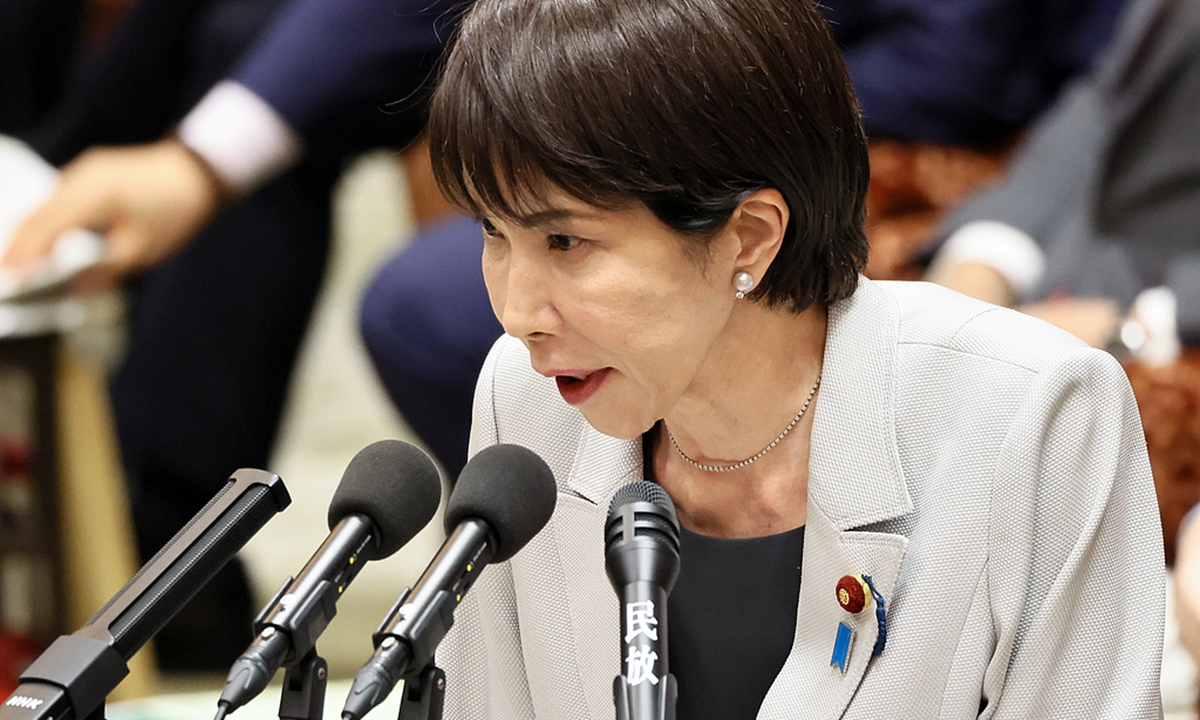
Japanese Prime Minister Sanae Takaichi attends the House of Representatives Budget Committee and responds to questions at the Diet building in Tokyo on November 10, 2025. Photo: VCG
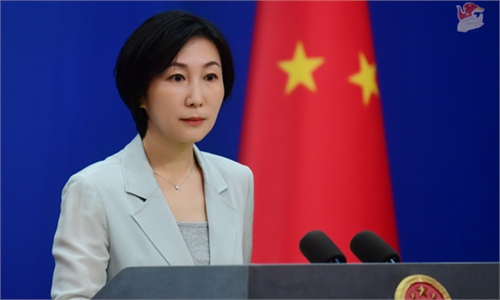
Chinese Foreign Ministry spokesperson Lin Jian stated at Monday's regular press conference that several days ago, the Japanese leader blatantly made wrongful remarks on Taiwan at the Diet that imply the possibility of armed intervention in the Taiwan Strait. It constitutes a gross interference in China's internal affairs and violates the one-China principle, the principles set forth in the four political documents between China and Japan, and basic norms in international relations.
"This is highly inconsistent with the political commitments made by the Japanese government so far and is egregious in terms of both the nature and impact. China deplores and opposes that and has made serious démarches and protests to Japan," Lin said, urging Japan to immediately stop interfering in China's internal affairs, stop making provocations and crossing the line, and stop going further down the wrong path.
These remarks were made in response to Prime Minister Sanae Takaichi's claim that a Taiwan emergency involving the use of military vessels and military force from the Chinese mainland could constitute a "survival-threatening situation" for Japan. According to its legislation, Japan's Self-Defense Forces could exercise the right of collective self-defense if such a situation is recognized as "survival-threatening."
According to Asahi Shimbun, when pressed by Katsuya Okada of the main opposition Constitutional Democratic Party of Japan on what she considered to be a survival-threatening situation on Friday, Takaichi claimed, "A judgment must be made after comprehensively assessing all information in line with the individual and specific circumstances of what has actually occurred."
Takaichi said if China conducted a naval blockade while military fighting was taking place, that would constitute a survival-threatening situation and the Self-Defense Forces (SDF) would be sent to provide support, she claimed.
Spokesperson Lin questioned what signal is the Japanese leader trying to send to "Taiwan independence" separatist forces? Is Japan up to challenge China's core interests and stop its reunification? Where exactly does Japan want to take its relations with China?
China's Ambassador to Japan, Wu Jianghao, also posted on X on Monday morning in both Chinese and Japanese that Taiwan island is an inseparable part of China and that how to resolve the Taiwan question is a matter for the Chinese people themselves. "The idea that 'Taiwan contingency is a contingency for Japan' attempts to drag Japan onto a chariot to divide China, which will ultimately lead Japan to a wrong path of no return," said the ambassador.
On Monday, Takaichi appeared to take a step back from her previous remarks as she returned to the Lower House Budget Committee morning and addressed her previous Diet response regarding Taiwan.
While maintaining that her position "aligns with the government's longstanding view and I have no intention of retracting or rescinding it," she characterized the statement as "a response based on a worst-case scenario" and pledged to "reflect on specific scenarios moving forward and exercise greater caution in future remarks," Mainichi Shimbun reported on Monday.
"Her revision of wording was clearly a strategic retreat under mounting domestic and international pressure to avoid further isolation—it does not indicate genuine acknowledgment or correction of error," said Xiang Haoyu, a research fellow at the China Institute of International Studies.
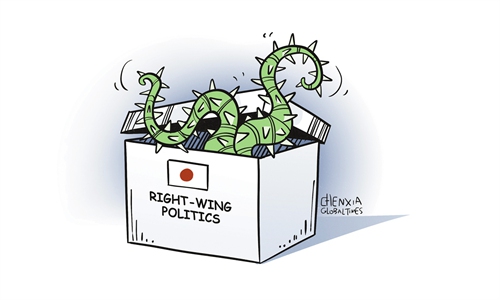
The expert stressed that Takaichi's repeated hyping of the Taiwan question stems primarily from her right-wing conservative ideology. By amplifying the so-called "China threat" narrative, she is catering to LDP hardliners and right-wing voters, solidifying her hawkish image while aligning with the US-Japan strategy to contain China by exploiting Taiwan question.
Da Zhigang, director of the Institute of Northeast Asian Studies at the Heilongjiang Provincial Academy of Social Sciences, told the Global Times on Monday that this incident also reflects Takaichi's immature approach in politics and mishandling of bilateral relations.
Domestic opposition
Takaichi faced swift backlash from across the political spectrum as soon as her remarks surfaced.
During the Diet hearing on Friday, Okada criticized Takaichi, saying, "One should not speak lightly about the use of force," Nikkei Asia reported.
Nikkei Asia describes her stance as "breaking with past governments," and said that "some believe that naming China in discussions about potential armed conflicts could be seen as Japan heightening tensions."
In its Monday editorial, Asahi Shimbun also commented that Takaichi's view opens up a wider interpretation of 'survival-threatening situation' by the government and her remarks "raised concerns."
Legislation passed in 2015 by then Prime Minister Shinzo Abe allows the government to declare a "survival-threatening situation" where the Self-Defense Forces can be mobilized to carry out limited collective self-defense operations, Japanese media reported. With the security legislation, the SDF gained the ability to work with US forces if the Japanese government determined the country's survival was threatened, according to Nikkei Asia.
Japanese Defense Minister Shinjiro Koizumi on Friday cautioned against presenting specific scenarios in the Diet. Speaking to reporters after the hearing, he said, "If we make clear that a particular case will lead to a particular response, we'll be revealing our hand to the other side, making it easier for them to attack Japan."
Former prime minister and Constitutional Democratic Party of Japan leader Yoshihiko Noda stated to reporters on Saturday that he "was very surprised" at Takaichi's remarks. Nikkei Asia cited Noda as saying "previous prime ministers had kept such discussions within certain limits. This will have repercussions both domestically and internationally."
According to Asahi Shimbun, Japanese prime ministers have been hesitant about clearly describing an attack on Taiwan as a survival-threatening situation because doing so would lead to heightened tensions between Japan and China.
Former Japanese prime minister Yukio Hatoyama also criticized Takaichi on social media on Friday, noting that Takaichi's remark was clearly stoking a crisis to justify military buildup. Japan should respect the fact that Taiwan island is part of China, he said, and the Taiwan question is entirely China's internal affair, and Japan must not intervene.
"Despite a rightward shift in Japanese society, her statements have drawn widespread criticism from media, political circles, and academia," Xiang added, noting that regarding the domestic backlash in Japan, her remarks broke with previous governments' deliberate ambiguity and lacked internal coordination and societal consensus. They also raised legal concerns by potentially violating Japan's pacifist constitution and China-Japanese joint declarations. Furthermore, her provocative rhetoric needlessly antagonizes China, deteriorates bilateral relations.
Da noted that many in Japan are not only "shocked," but also concerned about the impact of Takaichi's destructive remarks on the future trajectory of China-Japan relations.
According to Xiang, the stern statements from China's Ambassador to Japan and the Foreign Ministry spokesperson have shattered the illusion of impunity held by some in Japan.
If the Japanese side truly wishes to maintain the broader stability of bilateral relations, it must pull back before it is too late, curb provocative words and deeds, and the government must take concrete steps to undo the harmful effects of the erroneous remarks, the expert warned.
RELATED ARTICLES