Japanese leader’s reference to ‘survival-threatening situation’ on Taiwan question raises question of whether Japan attempts to repeat past mistakes: embassy
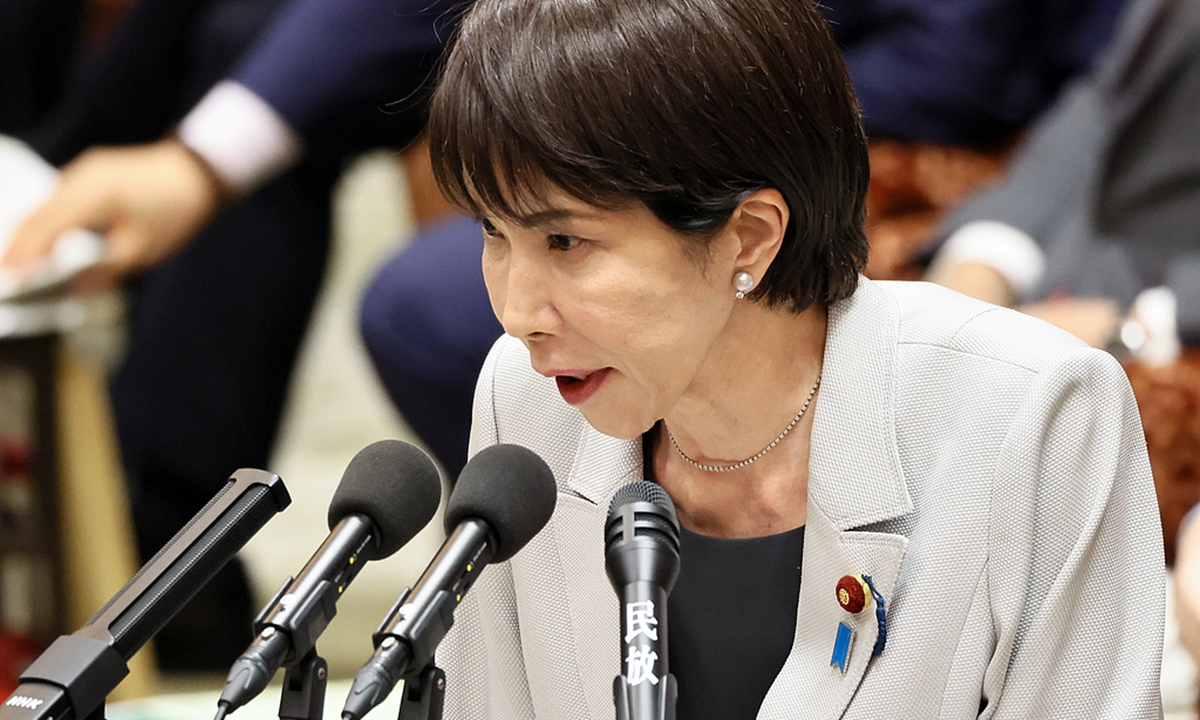
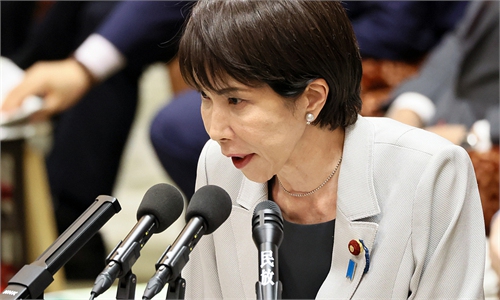
Japanese Prime Minister Sanae Takaichi attends the House of Representatives Budget Committee and responds to questions at the Diet building in Tokyo on November 10, 2025. Photo: VCG
Japan's reference to a “survival-threatening situation” and its attempt to associate itself with forces seeking to split China raises the question of whether Japan is attempting to repeat its past mistakes, a spokesperson from the Chinese Embassy in Japan said on late Monday night in response to remark made by Japanese Prime Minister Sanae Takaichi that a Taiwan emergency involving the use of military vessels and military force from the Chinese mainland could constitute a “survival-threatening situation” for Japan, and Japan’s Self-Defense Forces could exercise the right of collective self-defense.Recently, Japanese leader made provocative and blunt remarks on the Taiwan question, openly advocating for the possibility of military intervention in the Taiwan Straits. These statements severely violate the one-China principle, the principles set forth in the four political documents between China and Japan, and basic norms in international relations, the spokesperson said.
This is highly inconsistent with the political commitments made by the Japanese government so far and is egregious in terms of both the nature and impact. China deplores and opposes that and has made serious démarches and protests to Japan, the spokesperson added.
This year marks the 80th anniversary of the victory in the Chinese People’s War of Resistance Against Japanese Aggression and the World Anti-Fascist War, Japan should deeply reflect on its wartime responsibilities and draw lessons from history, the spokesperson said.
Japanese militarism has repeatedly used the so-called “survival-threatening situation” as a pretext for foreign aggression, including using the excuse of "exercising the right of collective self-defense” to orchestrate the September 18 Incident and provoke the war of aggression against China. Now, Japan's reference to a "crisis of survival" and its attempt to associate itself with forces seeking to split China raises the question of whether Japan is attempting to repeat its past mistakes, the spokesperson said.
This year also marks the 80th anniversary of Taiwan's recovery from Japanese occupation, during which Japan committed numerous crimes. Given this history, Japan should be especially cautious in its comments on the Taiwan question, the spokesperson said.
On a major occasion at the Diet, Japan's leaders have promoted the idea that "Taiwan contingency is a contingency for Japan," openly creating an excuse for possible intervention in the Taiwan Straits. This is a serious violation of international justice, a blatant challenge to the post-war international order, and a severe disruption of China-Japan relations and regional stability, the spokesperson emphasized.
Taiwan is an integral part of China, and how to resolve the Taiwan question and achieve complete national reunification is a matter for the Chinese people to decide, and no external forces have the right to interfere, the spokesperson said.
China will inevitably reunite, and it is an irreversible historical process. Any attempts to intervene in or obstruct China's reunification efforts are futile and will only bring disaster to those who attempt them, the spokesperson added.
China urges Japan to adhere to its political commitments on the Taiwan question, immediately cease sending erroneous signals to "Taiwan independence" forces, and stop any provocative or risky actions that cross red lines. Japan should not act as a disruptor in the Taiwan Straits or in regional affairs, and it must prevent further damage to bilateral relations, the spokesperson said.
RELATED ARTICLES