ARTS / CULTURE & LEISURE
Earliest prehistoric burial on Hainan Island unearthed at the Luobi Cave in South China
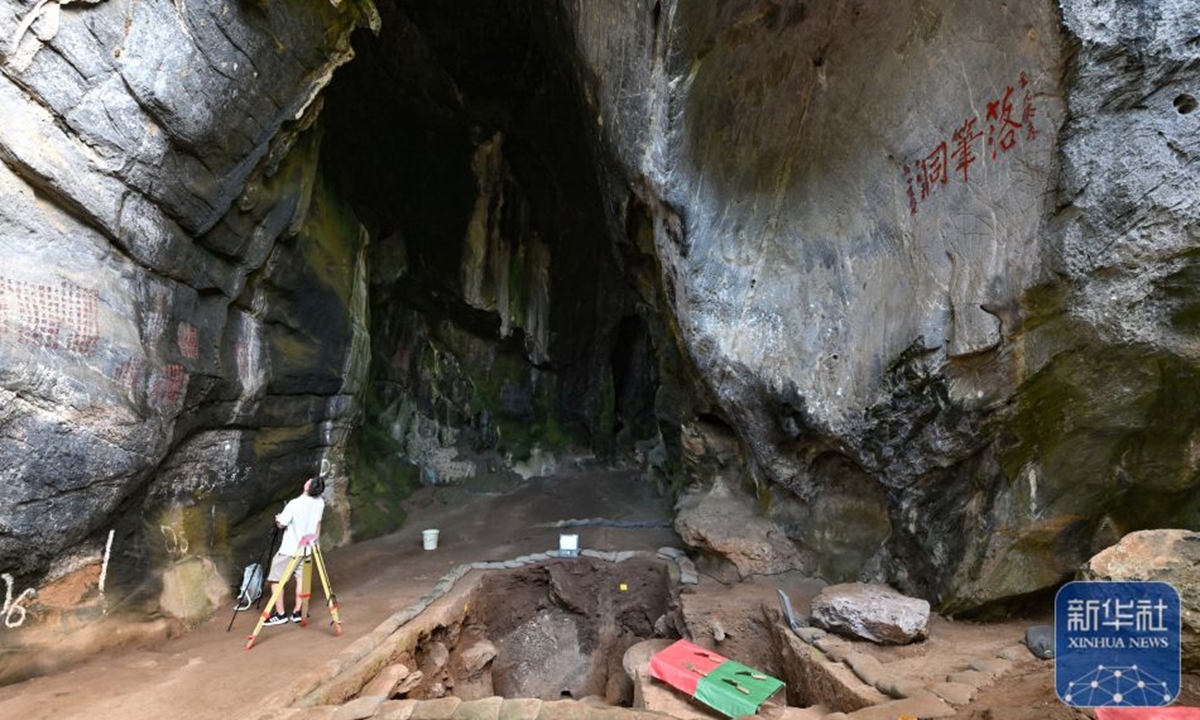
A prehistoric burial dating back 12,000 to 13,000 years was recently discovered at the Luobi Cave site in Sanya's Jiyang district, South China's Hainan Province. It is believed to be the earliest burial found on Hainan Island; preliminary analysis indicates that the burial belonged to a juvenile individual. Photo: Xinhua
A prehistoric burial dating back 12,000 to 13,000 years was recently discovered at the Luobi Cave site in Sanya's Jiyang district, South China's Hainan Province. It is believed to be the earliest burial found on Hainan Island; preliminary analysis indicates that the burial belonged to a juvenile individual, according to Xinhua News Agency."The skeletal remains were laid in a flexed position on their side, and the bones are relatively well preserved," Li Feng, the field director of excavations at the Luobi Cave site in Sanya, told the Global Times on Tuesday. "A large number of Nassarius shell beads were found near the head and waist, and the burial also contained a small number of stone artifacts and ochres."
"The Nassarius shell beads discovered in the burial are currently the earliest reported examples in China. They provide invaluable material for studying the prehistoric cultural practices of Hainan Island, as well as cultural exchanges in southern China and Southeast Asia," Li noted.
The new discoveries are highly significant for understanding the activity history of prehistoric humans on Hainan Island, reconstructing the island's prehistoric cultural sequence, and studying the exchange and spread of lithic technology and culture with humans in South China, Southeast Asia and beyond, Gao Xing, a research fellow at the Institute of Vertebrate Paleontology and Paleoanthropology of the Chinese Academy of Sciences, told the Xinhua News Agency.
According to Li, the site also yielded other human bones over 10,000 years old, offering crucial material for discussions on the physical characteristics, genetic makeup, and migration patterns of humans in Hainan from the late Pleistocene to the early Holocene. These findings not only shed light on the prehistoric inhabitants of the island but also provide important context for understanding the cultural development at the site.
The Luobi Cave site represents a transitional cultural period from the Late Paleolithic to the early Neolithic and has been listed as part of the fifth batch of national key cultural relics protection units. Located at the foot of Luobi Peak in Jiyang district, Sanya, the cave is a naturally formed limestone cavern, according to Sanyarb.com.
Discovered in 1983, the Luobi Cave site has yielded human fossils, stone tools, bone implements, and animal remains, providing the earliest evidence of human activity in southern China, it underwent two excavations in 1992 and 1993, according to the Xinhua News Agency.
In 2025, a new round of excavations at the site has been launched, with multiple institutions working together under the approval of the State Administration of Cultural Heritage. The primary academic goals are to reconstruct the chronological and cultural sequence of the site and to conduct multidisciplinary research, while also supporting the development of the Luobi Cave National Archaeological Site Park.
Excavations at the Luobi Cave site are still ongoing. The archaeological research is being carried out jointly by the Hainan Provincial Institute of Cultural Relics and Archaeology, the School of Archaeology and Museology at Peking University, and the Sanya Museum.
RELATED ARTICLES